Tag: Iain Duncan Smith

Stephen Crabb’s obscurantist approach to cuts in disabled people’s support

proper Blond

It’s less than two months ago that the new Work and Pensions secretary, Stephen Crabb, assured us that the Government had “no further plans” for specific welfare cuts. Now, he has admitted that welfare is to be the source of further austerity cuts to “bring down the deficit,” bearing in mind that the last budget saw alternative  and far more fair, humane measures taken off the table when the Conservatives controversially announced cuts to disability benefits to fund tax cuts for the most affluent – the top 7% of earners. The Chancellor raised the threshold at which people start paying the 40p tax. This leaves the poorest and some of our most vulnerable citizens carrying the entire burden of austerity and the whole responsibility for cutting the deficit.

Of course Crabb assumes we believe that austerity is an economic necessity and not an ideological choice. However, austerity is being used as a euphemism for the systematic dismantling of the gains of our post-war settlement: welfare, social housing, the NHS, legal aid and democracy. There is no such thing as conditional democracy. It can’t be rationed out or applied with prejudice and discrimination. That would make it something else, more akin to totalitarianism and not a necessarily inclusive democracy.

The Government has already made substantial cuts to the Employment and Support Allowance disability benefit, cutting the rate for new claimants in the Work Related Activity Group by £30 a week from 2017. Now the Work and Pensions Secretary has said he wants to go further than the £12 billion welfare cuts declared in the Conservative manifesto and to “re-frame discussion” around disability welfare support, signalling his intention to cut expenditure on disability benefits through further reform to the welfare system. The Conservatives are clearly using the word “reform” as a euphemism for dismantling the welfare state in its entirety.

Prior to 2010, cutting support for sick and disabled people was unthinkable, but the “re-framing” strategy and media stigmatising campaigns have been used by the Conservatives to systematically cut welfare, push the public’s normative boundaries and to formulate moralistic justification narratives for their draconian policies. Those narratives betray the Conservative’s intentions.

Crabb said that he will set out a “discursive” Green Paper on the additional proposed cuts to disability benefits later this year. Iain Duncan Smith had previously promised a more formal White Paper which was considered key to persuading Tory rebels to vote through the cuts despite opposition in February.

The shadow Work and Pensions secretary, Owen Smith, said that the Government should reverse the ESA cuts which had already been passed, adding that the Conservatives needed to offer clarity on how the “reforms” would support disabled people into work.

He said: “Yet again the Tories have let down disabled people, by breaking their promise to quickly publish firm plans on supporting disabled people in to work.

“When the Tories forced through cuts to Employment Support Allowance in the face of widespread opposition they bought off their own rebels with a promise to have a firm plan in place by the summer.

“Now the new Secretary of State has confirmed that he is going to downgrade the plan to a Green Paper, effectively kicking the issue in to the long grass for months, if not years.

The flimsy case for the cuts to Employment Support Allowance is now totally blown apart by this broken promise and the Tories must listen to Labour’s calls for them to be reversed.”

Remarkably, Crabb has claimed that disability benefit cuts are among policies “changing things for the better.” However, if cutting people’s income is such a positive move, we do need to ask why the Conservatives won’t consider taxing wealthy people proportionately, distributing the burden of austerity more fairly amongst UK citizens, instead of handing out money for tax cuts to those who need the very least support, at the expense of those who need the most.

The secretary for Work and Pensions has said: “The measures  that have either already been legislated for or announced get us to the £12 billion [welfare cuts planned in the Conservative manifesto].

Does that mean welfare reform comes to an end? I would say no. I’ve already pointed to what I see as one of the big challenges of welfare reform – and that’s around work and health.”

Crabb told MPs on Work and Pensions Select Committee that he would deploy “smart strategies” for cutting expenditure on disability and sickness benefits and would hopefully be able to secure the support of disability charities.

“In terms of how you make progress of welfare reform there when you are talking about people who are very vulnerable, people with multiple barriers, challenges, sicknesses, disabilities – I am pretty clear in my mind that you can’t just set targets for cutting welfare expenditure,” he said.

“When you’re talking about those cohorts of people you’ve actually got to come up with some pretty smart strategies for doing it which carry the support and permission of those people and organisations who represent those people who we are talking about.”

Both Crabb and his predecessor, Duncan Smith, have claimed that there are “millions of sick and disabled people parked on benefits,” yet rather than providing support for those who may be able to work, the Conservatives have abolished the Independent Living Fund and made substantial reductions to payments for the Access To Work scheme, creating more barriers instead of providing support for those who feel they are well enough to work.

A government advisor, who is a specialist in labour economics and econometrics, has proposed scrapping all ESA sickness and disability benefits. Matthew Oakley, a senior researcher at the Social Market Foundation, recently published a report entitled Closing the gap: creating a framework for tackling the disability employment gap in the UK, in which he proposes abolishing the ESA Support Group. To meet extra living costs because of disability, Oakley says that existing spending on PIP and the Support Group element of ESA should be brought together to finance a new extra costs benefit. Eligibility for this benefit should be determined on the basis of need, with an assessment replacing the WCA and PIP assessment. The Conservative definition of “the basis of need” seems to be an ever-shrinking category.

Oakely also suggests considering a “role that a form of privately run social insurance could play in both increasing benefit generosity and improving the support that individuals get to manage their conditions and move back to work.”

I’m sure the private company Unum would jump at the opportunity. Steeped in controversy, with a wake of scandals that entailed the company denying people their disabilty insurance, in 2004, Unum entered into a regulatory settlement agreement (RSA) with insurance regulators in over 40 US states. The settlement related to Unum’s handling of disability claims and required the company “to make significant changes in corporate governance, implement revisions to claim procedures and provide for a full re-examination of both reassessed claims and disability insurance claim decisions.

The company is the top disability insurer in both the United States and United Kingdom. By coincidence, the  company has been involved with the UK’s controversial Welfare Reform Bill, advising the government on how to cut spending, particularly on disability support. What could possibly go right?

It’s difficult to see how someone with a serious, chronic and progressive illness, (which most people in the ESA Support Group have) can actually “manage” their illness and “move back into work.” The use of the extremely misinformed, patronising and very misleading term manage implies that very ill people actually have some kind of choice in the matter. For people with Parkinson’s disease, rheumatoid arthritis, lupus and multiple sclerosis, cancer and kidney failure, for example, mind over matter doesn’t fix those problems, positive thinking and sheer will power cannot cure these illnesses, sadly. Nor does refusing to acknowledge or permit people to take up a sick role, or imposing benefit conditionality and coercive policies to push chronically ill people into work by callous and insensitive and medically ignorant assessors, advisors and ministers.  

The Reform think tank has also recently proposed scrapping what is left of the disability benefit support system, in their report Working welfare: a radically new approach to sickness and disability benefits and has called for the government to set a single rate for all out of work benefits and reform the way sick and disabled people are assessed. 

Reform says the government should cut the weekly support paid to 1.3 million sick and disabled people in the ESA Support Group from £131 to £73. This is the same amount that Jobseeker’s Allowance claimants receive. However, those people placed in the Support Group after assessement have been deemed by the state as unlikely to be able to work again. It would therefore be very difficult to justify this proposed cut.

Yet the authors of the report doggedly insist that having a higher rate of weekly benefit for extremely sick and disabled people encourages them “to stay on sickness benefits rather than move into work.”

The report recommended savings which result from removing the disability-related additions to the standard allowance should be reinvested in support services and extra costs benefits – PIP. However, as outlined, the government have ensured that eligibility for that support is rapidly contracting, with the ever-shrinking political and economic re-interpretation of medically defined sickness and disability categories and a significant reduction in what the government deem to be a legitimate exemption from being “incentivised” into hard work.

The current United Nations investigation into the systematic and gross violations of the rights of disabled people in the UK because of the Conservative welfare “reforms” is a clear indication that there is no longer any political commitment to supporting disabled people in this country, with the Independent Living Fund being scrapped by this government, ESA for the work related activiy group (WRAG) cut back, PIP is becoming increasingly very difficult to access, and now there are threats to the ESA Support Group. The Conservative’s actions have led to breaches in the CONVENTION on the RIGHTS of PERSONS with DISABILITIES – CRPD articles 4, 8, 9, 12, 13, 14, 15, 17, and especially 19, 20, 27 and 29 (at the very least.) There are also probable violations of articles 22, 23, 25, 30, 31.

The investigation began before the latest round of cuts to ESA were announced. That tells us that the government is unconcerned their draconian policies violate the human rights of sick and disabled people.

And that, surely, tells us all we need to know about this government.

 —

This post was written for Welfare Weekly, which is a socially responsible and ethical news provider, specialising in social welfare related news and opinion.


I don’t make any money from my work. But you can support Politics and Insights and contribute by making a donation which will help me continue to research and write informative, insightful and independent articles, and to provide support to others. The smallest amount is much appreciated, and helps to keep my articles free and accessible to all – thank you.
DonatenowButton
cards


Iain Duncan Smith abandoned his own sinking ship

Impact of tories on income.jpg

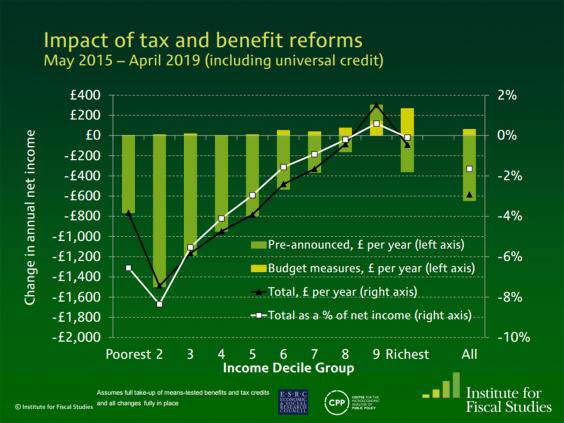
Analysis of George Osborne’s budget from the Institute for Fiscal Studies.

Stephen Crabb has been appointed as the new work and pensions secretary, after Iain Duncan Smith resigned in a flurry of controversy on Friday.

Mr Duncan Smith has said the latest planned cuts to disability benefits were “not defensible” in a Budget that benefited higher-earning taxpayers.

David Cameron said he was “puzzled and disappointed” that Mr Duncan Smith had decided to go when they had agreed to have a rethink about the policies

Iain Duncan’s Smith’s letter of resignation must be a BIG embarrassment to the  Government. It was certainly designed to inflict maximum damage particularly on Chancellor George Osborne. I’ve previously noted that the Chancellor has a tendency to regard the Department for Work and Pensions as little more than an annex to the Treasury, and the welfare budget as the Treasury’s disposable income, but I never anticipated that Duncan Smith would come to say that he sees it that way, too. This is, after all, a minister that has invented statistics and told some pretty far-fetched fibs to prop up justifications of his policies that entail some pretty draconian measures, such as sanctions and work fare, after all.

Yet surprisingly, Duncan Smith has also quite willingly and very publicly provided the government’s opponents with ammunition. He has effectively denounced not only Osborne’s budget, but also, his targeted austerity measures, yet curiously, Duncan Smith has until now been one of the most ideologically devout Thatcherite Conservatives, which is reflected in every policy he has formulated.

He has basically said what many of us have been saying for a long time: that the cuts are political and not because of economic necessity, nor will they help the economy. He also as good as said he doesn’t think we are “all in it together”. It turns out that Osborne blamed Duncan Smith for the Personal Independence Payment (PIP) and Employment Support Allowance (ESA) cuts. But Duncan Smith has been a very quiet man recently, often conspicuous by his absence during parliamentary debates, with Priti Patel left defending the ESA cuts in particular in the Commons.

However, the Department for Work and Pensions did a review of PIP last year, and that’s where the “justification” for the cuts came from – a sample of just 150 people, which was hardly a representative sample. It’s difficult to imagine that IDS didn’t order that review. But it was Osborne who announced the cuts to PIP, not Iain Duncan Smith. Just who carries the original responsibility for the proposed PIP cuts is probably never going to be fully untangled from the crossfire of accusations and counter accusations. But surely Cameron is ultimately responsible for Conservative policies?

In his resignation letter, Iain Duncan Smith says:

“I have for some time and rather reluctantly come to believe that the latest changes to benefits to the disabled, and the context in which they’ve been made are, a compromise too far. While they are defensible in narrow terms, given the continuing deficit, they are not defensible in the way they were placed within a budget that benefits higher earning taxpayers. They should have instead been part of a wider process to engage others in finding the best way to better focus resources on those most in need.

I am unable to watch passively while certain policies are enacted in order to meet the fiscal self imposed restraints that I believe are more and more perceived as distinctly political rather than in the national economic interest.

Too often my team and I have been pressured in the immediate run up to a budget or fiscal event to deliver yet more reductions to the working age benefit bill. There has been too much emphasis on money saving exercises and not enough awareness from the Treasury, in particular, that the government’s vision of a new welfare-to-work system could not be repeatedly salami-sliced.

It is therefore with enormous regret that I have decided to resign. You should be very proud of what this government has done on deficit reduction, corporate competitiveness, education reforms and devolution of power.

I hope as the government goes forward you can look again, however, at the balance of the cuts you have insisted upon and wonder if enough has been done to ensure ‘we are all in this together’ “

You can read the letter in full here

You can see Cameron’s response in full here

Many Conservatives have suggested that Duncan Smith – a supporter of Brexit – had been looking over several weeks for an opportunity to resign, and claimed that he wanted to find a moment when he could inflict maximum damage on the campaign led by Cameron and Osborne to keep Britain in the European Union. But writing in the Observer, Bernard Jenkin, a Tory MP and chair of the Commons public administration select committee, says that Duncan Smith was not prepared to tolerate another raid on the disability budget.

Referring to the prime minister’s letter to Duncan Smith, in which Cameron said he was “puzzled” by the resignation, Jenkin says: “What that letter does not make clear is that the £4bn savings in the budget from welfare still stands and, once again, Iain was being told to find similar cuts from other benefits for working-age people – including for the disabled – again undermining the positive incentives that make it worthwhile for them to take work. That is what he finds morally indefensible.”

However, Debbie Abrahams, the shadow minister for disabled people, who has faced Duncan Smith many times during Commons debates and Work and Pensions Committee inquiries, says she does not accept the reasons Iain Duncan Smith has given for resigning, and believes he chose to resign so he could “embarrass the government as much as he can”.

She adds that planned cuts to disability benefit payments in the Budget were “grossly unfair” and would hit “the most vulnerable in society at the same time the highest earners are getting tax cuts”. 

She says she is grateful that many Conservative MPs are critical of the proposals, but adds: 

“We must make sure that this last cut that has been announced around Personal Independence Payments is stopped and does not carry on.”

The resignation is particularly surprising given that, just hours earlier, the Treasury shelved the proposed cuts to PIP – following threats of a Tory backbench rebellion. Three Tory MPs – including mayoral candidate Zac Goldsmith – have  also been asked to resign as patrons of disability charities over their support for the recent welfare cuts. The complete failure of the austerity project is finally unravelling the Conservatives, and at a time when the Brexit faction of the party is already causing considerable disarray.

Even some of the most loyal Tories were finding it difficult to defend taking money away from sick and  disabled people – particularly since many of those who receive PIP are in work, and in fact some rely on it to stay in work. The cuts to ESA and PIP take place in the context of a Tory manifesto that included a pledge not to cut disability benefits. In fact in March last year, the Prime Minister signalled that the Conservatives will protect disabled claimants from welfare cuts in the next parliament (this one). Cameron said the Conservatives would not “undermine” PIP, which was introduced under the Coalition to save money by “targeting those most in need.” Now it seems those most in need are not the ones originally defined as such.

Controversially, the cuts to disability benefits were planned to fund tax cuts for the most affluent – the top 7% of earners. The Chancellor raised the threshold at which people start paying the 40p tax, in a move that will  see many wealthier people pulled out of the higher rate of income tax, in the coming budget. Mr Osborne said that he wants to “accelerate progress” towards the Conservative’s manifesto pledge of raising the threshold for the 40p rate to £50,000 in 2020. The average annual income in the UK is around £27,000.

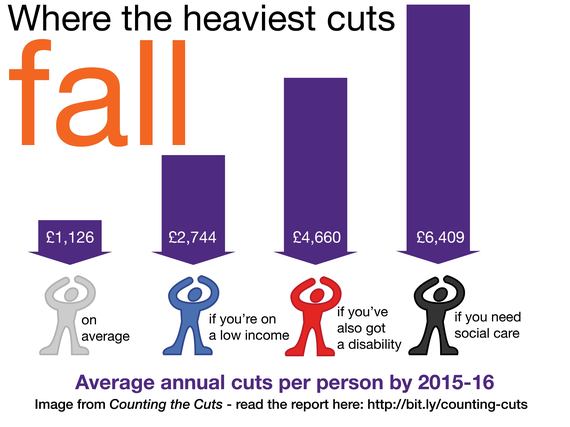
The Labour Party have urged Stephen Crabb to appear before MPs on Monday to announce formally that the cuts to disability benefits had been dropped. Owen Smith, the shadow work and pensions secretary, said: “His very first act as secretary of state must be to come to parliament on Monday to announce the full reversal of cruel Tory cuts that will see 370,000 disabled people lose £3,500 a year.”

He also urged Crabb to “stand up to a Treasury that is intent on cutting support for those most in need to pay for tax breaks for those who least need them”.

The main retaliation from the Conservative frontbench has been that Duncan Smith knew about the disability cuts (which he did) and that this is an act of mischief and sabotage designed and timed to destablise Cameron regarding Europe. It may well be. But the divisions had already caused wobbles, Duncan Smith just delivered a swift and hefty kick to the “in” crowd.

However, it’s also clear there has been a rising tension between the Treasury and the Department for Work and Pensions for some time. Duncan Smith felt that the benefits system could be scaled back only so far. Osborne and Cameron would prefer to see the welfare state completely dismantled.

Nonetheless, we have witnessed Duncan Smith’s long term disconnection from the impacts of his policies. He has persistently refused to engage with critics raising serious concerns about the consequences of the welfare “reforms”. He has refused to carry out a cumulative impact assessment of his policies and absolutely refused to monitor the impacts, most of which have been dire for sick and disabled people, and when the specifics of negative consequences were pointed out to him, he has typically reacted with denial, anger and accusations of “scaremongering.”

Duncan Smith used the mantra “there’s no proof of causality” to dismiss those who recognised a correlation between his welfare “reforms” and an increase in premature mortality rates and suicide. He has consistently and quite unforgivably shown that he is more concerned about hiding evidence and stifling criticism than he is about conscienciously investigating the harmful and sometimes devastating consequences that his policies have had on many people.

On the day he resigned, Duncan Smith’s department lost a four year legal battle to keep the many potentially humiliating problems with Universal Credit from the public.

Whatever the reasons may be for Duncan Smith’s resignation, he has certainly highlighted very well that Conservative budget decisions are partisan, taken for  party political interest rather than with consideration for the national interest. But in more than one way.

It’s also worth bearing in mind that it is Iain Duncan Smith’s “reforms” that have prompted a United Nations inquiry into grave and systematic violations of the human rights of disabled people. It’s highly unlikely that Duncan Smith’s reputation will be enhanced in the long-term regarding his legislative legacy, particularly regarding disabled people. He has collaborated with other ministers in designing and extending techniques of neutralisation to attempt justify what are extremely prejudiced, discriminatory and punitive policies aimed at the poorest citizens.

This is a man who has removed people from a structural socioeconomic context and then intentionally blamed them for their individual socioeconomic circumstances, most of which have been created by this government’s actions since 2010. Every single Conservative budget has taken money from the poorest and gifted it to the wealthiest. It’s inconceivable that Tory ministers don’t understand such policies will invariably extend and perpetuate inequality and poverty.

Duncan Smith has damned himself, but nonetheless, a Conservative minister resigning and stating that it is because of a Conservative budget, publicly citing reasons that correlate with the opposition’s objections regarding the government’s ideologically driven and targeted austerity, is a particularly damning turn of events for the Conservative Party as a whole, that’s for sure.

Now that Duncan Smith has publicly denounced the Conservative austerity project, I wonder if he will also recognise and embrace the rational expertise and economic competence of a real party of social justice, which rescued this country from the consequences of a global recession by the last quarter of 2009, whilst Osborne had us back in recession by 2011, and lost us our triple A Fitch and Moody credit ratings after promising not to. I wonder if Duncan Smith now supports the fair party with a track record of verifiable economic expertise – that would be the Labour Party.

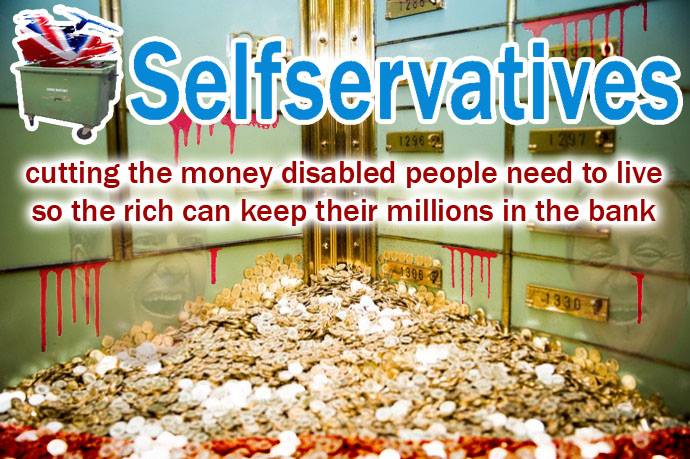
rich keep millons
Picture courtesy of Robert Livingstone

I don’t make any money from my work and I’m not funded. You can support Politics and Insights by making a donation to help me continue researching and writing independently, and to continue to help others.

DonatenowButton
cards

Labour Party To Refer Groundless Iain Duncan Smith Claim To Statistics Watchdog Again

Steve Bell cartoon


Iain Duncan Smith is telling fibs again. Work and pensions secretary claims that 75% of jobseekers think that benefit sanctions have helped them “focus and get on.”

The following is reported by Rowena Mason and Patrick Butler, for theguardian.com on Saturday 12th March 2016:

Labour is to challenge Iain Duncan Smith’s claim that 75% of jobseekers think benefit sanctions have helped them “focus and get on” by lodging a complaint with the official statistics watchdog.

Owen Smith, the shadow work and pensions secretary, said he would write to Duncan Smith challenging him to back up the “groundless” figure and refer the matter to the UK Statistics Authority for investigation.

The work and pensions secretary made the claim in an interview with the Camden New Journal, in which he suggested many claimants were grateful for the consequences of benefit sanctions.

“Seventy-five per cent of all those who have been sanctioned say it helped them focus and get on. Even the people in the jobcentres think it’s the right thing to do … sanctions are the reason why we now have the highest employment levels ever in the UK, and more women in work,” Duncan Smith said.

“What we say is: ‘We’ll give you all the support but at the end of the day we expect you to do something for it: go back to work, take the job, take the interviews.’ And it works, talk to any of the advisers in the jobcentres.”

While out campaigning for the Tory London mayoral candidate, Zac Goldsmith, Duncan Smith also dismissed protests about the controversial sanctions regime as “a classic buzz from the left” and claimed “these people are never going to vote for us – you have to understand, these people hate us”.

Owen Smith said: “Iain Duncan Smith’s claim that 75% of people who had been sanctioned say it ‘helped them focus and get on’ is groundless and shows he is out of touch with the real impacts of policies introduced by his department.

In reality, widespread concerns have been raised about this government’s use of sanctions, including from their own advisers, which is why the cross-party work and pensions select committee called for a full independent review into the system.

However, Iain Duncan Smith is reluctant to accept such scrutiny. Labour is calling for far greater transparency and honesty in this debate, so we can ensure greater numbers of people are actually helped into work, while being treated fairly.

That is why I will be writing to the secretary of state to inform him that we will refer his use of data to the Statistics Authority and calling for the long overdue independent review into sanctions to begin.”

Duncan Smith is believed to have been referring to DWP research that found 72% of jobseeker’s allowance (JSA) claimants said awareness of sanctions made them “more likely to follow the rules.”

However, that paper also said: “There was no evidence from the survey that knowledge of JSA conditions led to actual movement into work. Respondents who said they were more likely to look for work because of their knowledge of JSA conditions were no more likely than other respondents to have moved into work when they left JSA.”

After the interview, the Department for Work and Pensions released a statement saying: “Decisions on sanctions aren’t taken lightly but are an important part of our benefits system – they are only ever used as a last resort and the number of sanctions continues to fall.”

It is not the first time the UK statistics watchdog has been asked to adjudicate on the DWP’s approach to the sanctions regime.

Last year, it asked the DWP to ensure its statements on jobseeker sanctions are “objective and impartial” following a series of complaints by experts.

At the time, the authority’s chair, Sir Andrew Dilnot, wrote to the DWP’s top statistician asking the department to publish far more data and give the public a clearer understanding of how it is imposing sanctions on jobseekers.

Sanctions are used by civil servants to penalise jobseekers when they are alleged to have broken benefit rules, with punishments becoming increasingly severe over the last parliament.

The government has faced repeated calls from Labour to rethink the system, but is resisting pressure for an independent inquiry.

The Commons work and pensions committee last year urged the government to hold a wide-ranging independent review of the regime to address widespread concerns that it is unfair, excessively punitive, and does little to help people get into work.

© Guardian News & Media Limited 2010.

Related

A List of Official Rebukes For Tory Lies

Department of Work and Pensions officials admit to using fake claimant’s comments to justify benefit sanctions

The Department of Whopping Porkies is rebuked as claimants suddenly develop mysterious superpowers after being sanctioned

A letter of complaint to Andrew Dilnot regarding Coalition lies about employment statistics

Audit finds whereabouts and circumstances of 1.5 million people leaving welfare records each year “a mystery”

Universal Credit cuts will leave some people in work worse off

66864_464287263640807_1896397853_n

Despite Ian Duncan Smith’s persistent claims that “nobody loses a penny” under his flagship Universal Credit reform, the Department for Work and Pensions (DWP) has contradicted him and admitted that some claimants will be worse off. There seems to be a pattern emerging. Whenever the word “reform” is used by the Conservative government, it is always as a euphemism for “cuts to lifeline support.”

Guidance released this week by the DWP outlines how some working people will lose almost £900 a year. The memo supplies guidance on legislative amendments made in 2015 to the regulations which provide for the amount of earned income that is deducted from the Universal Credit maximum amount.

From 11.4.16 the range of work allowances available to Universal Credit claimants is reduced from seven to two (some rates are also reduced and some are removed completely). Consequently a work allowance will only be available where the claimant or either joint claimant is responsible for a child or qualifying young person and/or has limited capability to work (LCW).

On page three, the memo uses a case study – “Bella” – a 26-year-old shop worker who is single and lives with her parents. She works eight hours a week and earns £50, according to the DWP example. But at an hourly rate of £6.25, Bella apparently earns less than the legal minimum wage, which is £6.70 an hour for workers aged 21 and over. From April 1, the minimum wage is rising to £7.20 for employees aged over 25. The DWP guidance admits Bella, who is fictional, will see her monthly UC award plunge from £253.70 to £181.55 – a loss of £72.15 adding up to £865.80 a year.

There is no transitional protection for Universal Credit claimants whose work allowance is reduced or removed by this change.

The Shadow Work and Pensions Secretary Owen Smith said: “Iain Duncan Smith has spent months trying to pretend that ‘no one is going to lose a penny’ as a result of his Universal Credit cuts.”

“That’s now been blown out of the water by his own officials, who’ve produced a guidance note for DWP staff on how to implement the cut.

“Duncan Smith should read his own department’s guidance and call on the Chancellor to drop the Universal Credit cuts in the Budget.”

A DWP spokesman said: “Universal Credit (UC) is revolutionising welfare, with claimants moving into work faster and earning more than under the previous system.”

“As part of moving to a high-wage, low-tax society we are simplifying the work allowances under UC and giving those affected extra help to progress in work and earn more.”

“Even after the changes, UC claimants will know they are better off in work.”

The Poor Law Amendment Act of 1834 was based on the “principle of less eligibility,” which stipulated that the condition of the “able-bodied pauper” on relief be less “eligible” – that is, less desirable, less favourable – than the condition of the very poorest independent labourer. “Less-eligibility” meant not only that the pauper receive less by way of support than the labourer did from his wages but also that he receive it in such a way (in the workhouse, for example) that made pauperism less respectable than work – to stigmatise it. Thus the labourer would be discouraged from lapsing into a state of “dependency” and the pauper would be encouraged to work.

The less eligibility principle “made work pay”, in other words.

The current government is going even further, and applying the same punitive approach to people in low-paid employment, presumably to serve as a deterrent to poor wages. Personally, I think unions do that much better through collective bargaining, by addressing those actually at fault – exploitative employers, rather than poor, exploited employees.

This post was written for Welfare Weekly, which is a socially responsible and ethical news provider, specialising in social welfare related news and opinion.

Iain Duncan Smith is complaining about valid criticisms of his draconian policies by journalists and social media commentators

36626_217452248405831_532419169_n

The Work and Pensions Select Committee has just published some letters between Frank Field, the chair, and Iain Duncan Smith, who responded to questions about the correlation between benefit assessments and suicide.

Mr Field had asked what data the Department for Work and Pensions collects on the deaths of benefit claimants.

The issue had been raised in a research report by Oxford University and Liverpool University entitled First Do No Harm, which I also reported on last year.

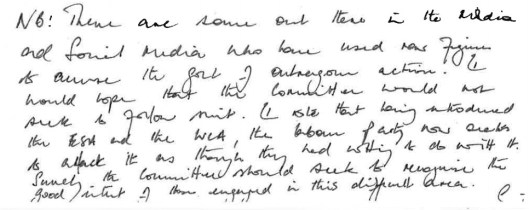
The letter addressed to Frank Field MP, features a barely legible hand-written footnote warning against listening to those “in the media and on social media” who “accuse the Government of outrageous actions.”

Duncan Smith writes in the footnote:

“There are some out there in the media and social media who have used [raw?] [ons ?- Office for National Statistics?] figures to accuse the govt of outrageous actions.

I would hope that the committee would not seek to follow suit. I [illegible] [note?] that having introduced ESA and the WLA, the Labour Party now seeks to attack it as though they had nothing to do with it.

Surely the committee should seek to recognise the good intent of those engaged in this difficult area.”

2014-02-17-BurdenoftheCuts-thumb
I would say that this blatant political discrimination constitutes an “outrageous action.” It’s difficult to recognise any “good intent” here, Mr Duncan Smith.

The correlation between the work capability assessment and suicide was established by academic researchers, not by journalists or social media commentators. We simply reported the findings.

Iain Duncan Smith will be accusing the United Nations (UN) of failing to see the government’s “good intent” when the inquiry into “grave and systematic violations” of the rights of disabled people in the UK concludes, next. Despite the fact that we are the first country to face such an inquiry, and given that the UN investigate only when there is evidence of grave and systematic violations of human rights, the prime minister has already dismissed the significance of the inquiry, ludicrously claiming “it may not be all it’s cracked up to be.”

It’s particularly noteworthy that when it comes to government claims, the same methodological rigour that they advocate for others isn’t applied. Indeed, many policies have clearly been directed by ideology and traditional Tory prejudices, rather than valid research and empirical evidence. The fact that no cumulative impact assessment has been carried out with regard to the welfare “reforms” indicates a government that is not interested in accountability, and examining the potential negative outcomes of policy-making. Policies are supposed to be about meeting public needs and not about inflicting Conservative dogma and old prejudices in the form of financial punishment on protected social groups.

As someone with a background in the social sciences, I have written extensive criticism of Iain Duncan Smith’s peculiar brand of epistemological and methodological fascism. He’s not exactly well known for his skill in statistical analysis, having been rebuked more than once for being notoriously conservative with the truth and numbers. Yet he feels compelled to dismiss the accounts of academics, campaigners, empirical evidence and the many qualitative accounts of those adversely impacted by his policies, in his vain attempt to exercise a stranglehold on his own peculiar brand of “truth.”

The goverment often claim that any research revealing negative social consequences arising from their draconian policies, which they don’t like to be made public “doesn’t establish a causal link.”  Recently there has been a persistent, aggressive and flat denial that there is any “causal link” between the increased use of food banks and increasing poverty, between benefit sanctions and extreme hardship and harm, between the work capability assessment and an increase in numbers of deaths and suicides, for example.

The government are referring to a scientific maxim: “Correlation doesn’t imply causality.” 

The tobacco industry made exactly the same claim about the established link between lung cancer and smoking.

It’s true that correlation is not the same as causation.

It’s certainly true that no conclusion may be drawn regarding the existence or the direction of a cause and effect relationship only from the fact that event A and event B are correlated.

Determining whether there is an actual cause and effect relationship requires further investigation.

This is something the government has persistently refused to do. (Here’s a full critique of Conservative methods of “social research”. I sent Mr Duncan Smith a copy, along with some information about proper definitions and measurement of poverty, but he clearly hasn’t read either. Unless he has included those in his arrogant and dismissive horror of “accusations”  criticisms on social media of course)

It is completely inaccurate to say that correlation doesn’t imply causation. It quite often does.

Here’s a final comment from a social media-based campaigner, analytical writer and a qualified social scientist who knows about statistical inference, causality and correlation and suchlike:

Iain Duncan Smith, you’re a blatant numpty.

160211IDSnote-outrageousaction

You can read the full letter here.

The importance of citizens’ qualitative accounts in democratic inclusion and political participation

disempowerment
Government policies are expressed political intentions regarding how our society is organised and governed. They have calculated social and economic aims and consequences. In democratic societies, citizens’ accounts of the impacts of policies ought to matter.

However, in the UK, the way that policies are justified is being increasingly detached from their aims and consequences, partly because democratic processes and basic human rights are being disassembled or side-stepped, and partly because the government employs the widespread use of linguistic strategies and techniques of persuasion to intentionally divert us from their aims and the consequences of their ideologically (rather than rationally) driven policies. Furthermore, policies have become increasingly detached from public interests and needs.

The merits of quantitative analysis

The government have denied there is a causal link between their welfare policies, austerity measures and an increase in mental distress, premature death and suicide. However, ministers cannot deny there is a clear and well-established correlation, which warrants further research. But the government are hiding behind a distinction often made by researchers, to avoid accountability and to deny any association at all between policy and policy impacts. That’s just plain wrong.

Correlation isn’t quite the same as causality. When researchers talk about correlation, what they are saying is that they have found a relationship between two (or more) variables. “Correlation does not mean causation” is a quip that researchers and quite often, the government, chucks at us to explain that events or statistics that happen to coincide with each other are not necessarily causally related.

However, the possibility of causation isn’t refuted by political denial or somehow invalidated by the establishment of a correlation. Quite the contrary. Indeed an established association implies there may also be a causal link. To prove causation, further research into the association between variables must be pursued. So, care should be taken not to make an assumption that correlation never implies causation, because it quite often does indicate a causal link.

Correlations between two things may be caused by a third factor that affects both of them. This sneaky, hidden third factor is called a confounding variable, or sometimes, simply a confounder.

However, a lot of social research tends to indicate and discuss a correlation between variables, not a direct cause and effect relationship. Researchers are inclined to talk cautiously about associations.

It’s worth bearing in mind that establishing correlation is crucial for research and shows that something needs to be examined and investigated further. That’s precisely how we found out that smoking causes cancer, for example – through repeated findings showing an association (those good solid, old fashioned science standards of replicability and verification). It is only by systematically eliminating other potential associations – variables – that we can establish causalities.

The objective of most research or scientific analysis is to identify the extent to which one variable relates to another variable and the direction of the association. If there is a correlation then this guides further research into investigating whether one action causes the other. Statistics measure occurrences in time and can be used to calculate probabilities. Probability is important in research because measurements, observations and findings are often influenced by variation. In addition, probability theory provides the theoretical groundwork for statistical inference.

Statistics are fundamental to good government; to the delivery of public services and to decision-making at all levels of society. Statistics provide parliament and the public with a window on the work, performance and intentions of a government. Such data allows for the design of policies and programmes that aim to bring about a desired and stated outcome, and permits better targeting of resources.

Once a policy has been implemented it is necessary to monitor and evaluate the effectiveness of the policy to determine whether it has been successful in achieving the intended outcomes. It is also important to evaluate whether services (outputs) are effectively reaching those people for whom they are intended. Statistics play a crucial role in this process. So statistics, therefore, represent a significant role in good policy-making, monitoring and political accountability. The impact of policy can be measured with statistics.

So firstly, we need to ask why the government are not doing this.

If policy impacts cannot be measured then it is not good policy.

Ensuring accuracy and integrity in the reporting of statistics is a serious responsibility. In cases where there may not be an in-depth understanding of statistics in general, or of a particular topic, the use of glossaries, explanatory notes and classifications ought to be used to assist in their interpretation.

Statistics can be presented and used in ways that may lead readers and politicians to draw misleading conclusions. It is possible to take numbers out of context, as Iain Duncan Smith, amongst others, is prone to do. However, official statistics are supposed to be produced impartially and free from political influence, according to a strict code of practice. This is a government that systematically breaches the code of conduct. See: List of official rebukes for Tory lies and statistical misrepresentations, for example.

We need to ask why the government refuses to conduct any research into their austerity policies, the impacts they are having and the associated mental distress, physical harm, deaths and suicides.

Without such research, it isn’t appropriate or legitimate to deny a causal link between what are, after all, extremely punitive, targeted, class-contingent policies and an increase in adverse consequences, such as premature mortality rates.

It isn’t unreasonable to be concerned about policies that are targeted to reduce the income of those social groups already struggling because of limited resources, nor is it much of an inferential leap to recognise that such policies will have some adverse consequences.

In social research, traditionally, quantitative methods emphasise maintaining objectivity, and aim to keep social inquiries “value-free.” However, the area of study is intentionally selected by researchers, funded by interested parties and there are problems related to the connection between observation and interpretation. Perhaps every observation is an interpretation, since “facts” are seen through a lens of perceptions, pre-conceptions and ideology.

The Joseph Rowntree Foundation choose to study poverty. Cynical Iain Duncan Smith simply changes the definition of it to reduce its visibility.

The importance of qualitative research: who are the witnesses?

Social phenomena cannot always be studied in the same way as natural phenomena, because human beings are subjective, intentional and have a degree of free will. One problem with quantitative research is that it tends to impose theoretical frameworks on those being studied, and it limits responses from those participating in the study.

Social reality is not “out there” waiting to be discovered: we are constructing and reconstructing it meaningfully. However, politically, there’s been a marked shift away from understanding the lived experiences of real people in context.

There are also distinctions to be made between facts, values and meanings. Qualitative researchers are concerned with generating explanations and extending understanding rather than simply describing and measuring social phenomena and establishing basic cause and effect relationships. Qualitative research tends to be exploratory, potentially illuminating underlying intentions, responses, beliefs, reasons, opinions, and motivations to human behaviours.

This type of analysis often provides insights into social problems, helps to develop ideas and establish explanations, and may also be used to formulate hypotheses for further quantitative research.

The dichotomy between quantitative and qualitative methodological approaches, theoretical structuralism (macro-level perspectives) and interpretivism (micro-level perspectives) in sociology, for example, is not nearly so clear as it once was, however, with many social researchers recognising the value of both means of data and evidence collection and employing methodological triangulation, reflecting a commitment to methodological and epistemological pluralism.

Qualitative methods tend to be much more inclusive than quantitative analysis, lending participants a dialogic, democratic and first hand voice regarding their own experiences.

The current government have tended to dismiss qualitative evidence from first hand witnesses of the negative impacts of their policies – presented cases studies, individual accounts and ethnographies – as “anecdotal.” However, that is a very authoritarian approach to social administration and it needs to be challenged. 

The most rigid form of quantitative research, associated with positivism, is a traditionally Conservative way of rigidly demarcating the world, imposing hierarchies of priority, worth and order, to assure ontological security and maintain the status quo, regardless of how absurd this shrinking island of certainty appears to the many of us that are being systematically exiled from it.

Neither positivism nor Conservatism extend an acknowledgement, recognition or account of human diversity – which is among our greatest assets, after all. It’s a curious ideological tension for neoliberal Conservatives: they value competitive individualism on the one hand, but have such rigid ideas about pluralism and social group deviations from imposed, value-laden norms, on the other. 

Competitive individualism arises from competitive systems, rather than co-operative, collective ones. The function of the system is to maintain inequality in the society and fields of human engagement, based on the largely unchallenged notions of ‘deserving’ and ‘undeserving’. These are tacit notions at the heart of meritocracy. Neoliberals believe that competition acts as an incentive to people’s behaviours, encouraging a “race to the top”. Those at the top then ‘trickle down’ wealth to benefit the poorest citizens, according to this behaviourist theory. But of course that hasn’t happened.

In any system of competition, there are inevitably relatively few ‘winners’ and rather more ‘losers’. Such is the logic of competition. And most people don’t share their trophies with others.

The competition is rigged in any case, since the Conservatives are not too keen on widening access to equality of opportunity. Such is the acrobatic, logic of elitism. 

The Conservatives don’t like social individualism, difference or diversity within society.  For them, the only individualism worth anything is that defined and categorised by how much money you have.  A ‘good citizen’ is wealthy. The logic follows that they must be ‘good’ to be so wealthy, after all.  Such is the politically convenient circular argument of meritocracy. 

In the current context, the Conservatives’ approach to ‘research’ is tantamount to a politically extended epistemological totalitarianism. (Epistemology is an important and underpinning branch of philosophy that extends various theories of the nature and grounds of knowledge in the social sciences, particularly with reference to its limits, reliability and validity.)

It’s merely politically convenient to use a discredited positivist approach to policy-making, because such pseudoscientific narratives can be used to legitimise and impose virtually any policy.  Pseudoscience was once used to justify eugenic policies, after all. This is an approach that purposefully excludes citizens’ accounts. It’s authoritarian.

However, a qualitative approach to research potentially provides insight, depth and richly detailed accounts. The evidence collected is much more coherent and comprehensive, because it explores beneath surface appearances, and reaches above causal relationships, delving much deeper than the simplistic analysis of ranks, categories and counts.

It provides a reliable and rather more authentic record of experiences, attitudes, feelings and behaviours, it prompts an openness and is expansive, whereas quantitative methods tend to limit and are somewhat reductive. Qualitative research methods encourage people to expand on their responses and may then open up new issues and topic areas not initially considered by researchers. 

As such, qualitative methods are prefigurative and bypass problems regarding potential power imbalances between the researcher and the subjects of research, by permitting participation and creating space for genuine dialogue and reasoned discussions to take place. Research regarding political issues and policy impacts must surely engage citizens on a democratic, equal basis and permit participation in decision-making, to ensure an appropriate balance of power between citizens and the state.

That assumes, of course, that governments want citizens to engage and participate. There is nothing to prevent a government deliberately exploiting a research framework as a way to test out highly unethical and ideologically-driven policies, and to avoid democratic accountability, transparency and public safeguards. How appropriate is it to apply a biomedical model of prescribed policy “treatments” to people experiencing politically and structurally generated social problems, such as unemployment, inequality and poverty, for example? This is happening and needs to be challenged.

Iain Duncan Smith and Priti Patel, amongst other ministers, claim that we cannot make a link between government policies and the increasing number of deaths of sick and disabled people. There are no grounds whatsoever for their claim. There has been no cumulative impact assessment or monitoring of welfare policies, no inquiry, no further research regarding an established correlation and a longstanding refusal from the Tories to undertake any of these. There is therefore no evidence for their claim.

Such political denial is oppressive – it serves to sustain and amplify a narrow, hegemonic political narrative, stifling pluralism and excluding marginalised social groups, excluding alternative accounts of citizen’s experiences, negating counternarratives; it sidesteps democratic accountability, stultifies essential public debate, obscures evidence and hides politically inconvenient, exigent truths. Denial of causality does not reduce the probability of it, especially in cases where a correlation has been well-established and evidenced.

So, how do we address these issues?

Democracy is not something we have: it’s something we have to DO 

Government ministers like to hear facts, figures and statistics all the time. What we need to bring to the equation is a real, live human perspective. We need to let ministers know how the policies they are implementing and considering directly impact ourselves, their constituents and social groups more widely. One of the most powerful things we can do to make sure the government listens to our concerns is to engage and support the organisation of family, friends, neighbours and wider communities. While many people regard state or national-level politics as an intractable mess that’s impossible to influence, collective voices really do make a difference. The best weapon of influence we have is meticulous documentation of our experiences.

Once upon a time, policy was a response from government aimed at meeting public needs. It was part of an intimate democratic dialogue between the state and citizens. Traditional methods of participating in government decision-making include:

  • political parties or individual politicians
  • lobbying decision-makers in government
  • community groups
  • voluntary organisations
  • public opinion
  • public consultations
  • the media
  • prefigurative politics

Nowadays, policies have been unanchored from any democratic dialogue regarding public needs and are more about monologues aimed at shaping those needs to suit the government and rigid policy outcomes. For many of us, policies are being formulated to act upon us as if we are objects, rather than autonomous human subjects. This political dehumanisation has contributed significantly to a wider process of social outgrouping and increasing stigmatisation.

But in democracies, Governments are elected to represent and serve the needs of the population. Democracy is not only about elections. It is also about distributive and social justice. The quality of the democratic process, including transparent and accountable Government and equality before the law, is crucial to social organisation, yet it seems the moment we become distracted, less attentive and permit inequality to fundamentally divide our society, the essential details and defining features of democracy seem to melt into air.

arnstein-ladder-citizenship-participation

 Sherry Arnstein’s Ladder of Citizen Participation and Power.

Whereabouts are you on the ladder? I think socioeconomic status has some bearing on how far up people place themselves and how much power they feel they have to influence decision-making. 

For Arnstein, participation reflects “the redistribution of power that enables the have-not citizens, presently excluded from the political and economic processes, to be deliberately included in the future. It is the strategy by which the excluded join in determining how information is shared, goals and policies are set, tax resources are allocated, programmess are operated, and benefits like contracts and patronage are parceled out. In short, it is the means by which they can induce significant social reform which enables them to share in the benefits of the affluent society.”

A starting point may be the collective gathering of evidence and continual documentation of our individual narratives concerning experiences of austerity and the welfare “reforms”, which we must continue to present to relevant ministers, parliament, government departments, the mainstream media and any organisations that may be interested in promoting citizen inclusion, empowerment and democratic participation.

We can give our own meaningful account of our own experiences and include our own voice, reflecting our own first hand witnessing, experiencing and knowledge of policy impacts, describing how we make sense of and understand our situations, including the causal links between our own circumstances, hardships, sense of isolation and distress, and Conservative policies and subsequent socioeconomic frameworks, as active, intentional, conscientious citizens. Furthermore, we can collectively demand a democratic account and response (rather than accepting denial and a refusal to engage) from the government.

ImageVaultHandler.aspx

Related

How can we find out whether people are really turning against democracy? – Democratic Audit UK

Psychologists Against Austerity campaign – call for evidence

The Psychological Impact of Austerity – Psychologists Against Austerity

A critique of Conservative notions of social research

The Conservative approach to social research – that way madness lies

Research finds strong correlation between Work Capability Assessment and suicide

Suicides reach a ten year high and are linked with welfare “reforms”

I don’t make any money from my work, and I’m not funded. You can help to support Politics and Insights by making a donation to help me continue to research and write independently and continue to support other people

DonatenowButton
cards

Thousands of disabled people have lost their specialist Motability vehicles because of Conservative benefit cuts and many more are likely to be affected

westminster-20121020-00081


In 2012, Esther McVey, then the Minister for people with disabilities, as good as admitted there are targets to reduce or remove eligibility for the new disability benefit Personal Independent Payment (PIP), which was to replace Disability Living Allowance. How else could she know in advance of people’s reassessment that 330,000 of claimants are expected to either lose their benefit altogether or see their payments reduced as she had informed the House of Commons?

This was a clear indication that the new assessment framework was designed to cut support for disabled people. A recent review led the government to conclude that PIP doesn’t currently fulfil the original policy intent, which was to cut costs and “target” the benefit to “those with the greatest need.”

That basically meant a narrowing of eligibility criteria for people formerly claiming Disability Living Allowance, increasing the number of reassessments required, and limiting the number of successful claims. The government have used the review to attempt to justify further restrictions to PIP eligibility, aimed at cutting support for people who require aids to meet fundamental needs such as preparing food, dressing, basic and essential personal care and managing incontinence. “Greatest need” has become an ever-shrinking category under Conservative austerity measures. 

McVey also said that around 200 disabled people in every parliamentary constituency were likely to lose their Motability vehicle when she changed the qualifying walking distance limit from 50 metres to 20-metres. 

And she pointed out that one of the Department for Transport’s own publications, Inclusive Mobility, recommends that “seating should be provided on pedestrian routes at intervals of no more than 50 metres, and that parking spaces for blue badge holders should preferably be provided within 50 metres of the facilities they serve”.

The Motability Scheme helped around 650,000 disabled people to lease specialist cars, wheelchairs and scooters. Anyone on the highest level of the Disability Living Allowance (DLA) was entitled to join the scheme which also helped to pay for expensive adaptations. Motability provides financial help (grants) to disabled people who would not otherwise be able to afford the vehicle or adaptations they need, and the charity undertakes a range of fundraising activities to contribute to the provision of financial help to those Scheme customers whose allowance does not cover the cost of the mobility solution that they need.

Last year, Motability revealed that around 100 disabled people claiming PIP are losing their crucial vehicle benefit every week.

According to Motability, who lease specialised cars and powered wheelchairs to disabled people, 3,000 out of 8,000 of their customers who have so far been reassessed for PIP, who were previously claiming the Disability Living Allowance, have lost their eligibility for the scheme and have therefore had to give up their vehicles.

Motability raised concerns that the government reforms to DLA would affect many more. It has.

Nearly 14,000 disabled people have had their mobility vehicle confiscated after the changes to benefit assessment, which are carried out by private companies. Many more, yet to be reassessed, are also likely to lose their specialised vehicles.

Under the new PIP rules thousands more people who rely on disability allowance to keep their independence are set to lose their vehicles. Many had been adapted to meet their owners’ needs and many campaigners warn that it will lead to a devastating loss of independence for disabled people.

A total of 45% or 13,900 people, were deemed as not needing the higher rate of PIP, and therefore lost their vehicles after reassessment. And out of the 31,200 people who were once on the highest rate of DLA who have been reassessed, just 55%, or 17,300 – have kept their car.

Given that many Motability vehicles are specially adapted to meet the highly individual needs of each person, I wonder what happens to all of those vehicles that are lost under the new restricted benefit eligibility criteria.

Around 51,200 disabled people have joined the Motability scheme using their PIP. Around 360,000 more people will undergo PIP reassessments and that will include “indefinite” or “lifetime” awards under the original DLA support.

Perhaps the government expect that severely and chronically ill people will miraculously recover, their progressive illness will stop progressing, maybe people will grow new limbs, find cures of their own where medical professionals and drug companies have failed and battle their “choice” of disability alone.

Being disabled is very expensive. The charity Scope has calculated that disabled people pay a huge financial penalty over and above the everyday living costs faced by the typical able-bodied person – on average £550 per month. One in ten pay more than £1000 a month over the odds.

Expenses range from door-to-door taxis to get around, extra heating costs, pricey specialist items like wheelchairs, hoists, or stair lifts. There may be extra laundry costs, continence aids, special dietary requirements, a need for home help and meals on wheels. Some disabilities place more wear and tear on shoes and clothing, some people need suitable kinds of footwear. Non-prescription medical items are also an additional cost. These are just a few examples of extra expenses. There are many more that most able-bodied people wouldn’t ever need to think of.

Liz Sayce, chief executive of Disability Rights UK, said: “Being disabled costs money.

The Personal Independence Payment is supposed to help with those costs, but many people are being denied the benefit because they are not assessed properly. Sometimes that means people lose their cars; a massive blow which impacts on their ability to remain independent, take part in their communities or get and keep a job.”

Recent research revealed that of all the appeals related to PIP, 60% of tribunals have ruled in the claimant’s favour.

Motability provides a support package, including a £2,000 grant, to anyone forced to leave the scheme following a PIP reassessment.

The charity added: “This helps individuals to remain mobile, in many cases by purchasing a used car. Motability has already provided some £16m in support through this transitional package.”

The Conservative claim that “Government is committed to supporting the most vulnerable” doesn’t stand up to scrutiny, given the Conservative policy record, including cruelly scrapping the Independent Living Fund, which has had a hugely negative impact on those trying their best to lead independent and dignified lives, and the Access To Work funding has been severely cut, this is also a fund that helps people and employers to cover the extra living costs arising due to disabilities that might present barriers to work. 

Mr Duncan Smith said at the Conservative conference last year that many sick and disabled people “wanted to work” and that the Government should give them “support” to find jobs and make sure the welfare system encouraged them to get jobs. I’m wondering what the word “support” actually means to Conservatives, because there’s every indication that over the past five years, there has only been a withdrawal of essential support and lifeline benefits from those who need them the most.

Article 19 of the United Nations Convention on the rights of persons with disabilities states that persons with disabilities have access to a range of in-home, residential and other community support services, including personal assistance necessary to support living and inclusion in the community, and to prevent isolation or segregation from the community. Article 20 states that Parties shall take effective measures to ensure personal mobility with the greatest possible independence for persons with disabilities, including by:

a) Facilitating the personal mobility of persons with disabilities in the manner and at the time of their choice, and at affordable cost;

b) Facilitating access by persons with disabilities to quality mobility aids, devices, assistive technologies and forms of live assistance and intermediaries, including by making them available at affordable cost;

c) Providing training in mobility skills to persons with disabilities and to specialist staff working with persons with disabilities;

d) Encouraging entities that produce mobility aids, devices and assistive technologies to take into account all aspects of mobility for persons with disabilities.

Article 28 requires that States Parties recognise the right of persons with disabilities to an adequate standard of living for themselves and their families, including adequate food, clothing and housing, and to the continuous improvement of living conditions, and should take appropriate steps to safeguard and promote the realisation of these rights without discrimination on the basis of disability.

It’s difficult to see how the government’s cuts to lifeline disability benefits can possibly be consistent with their obligations to uphold human rights law. 


images

Let’s keep the job centre out of GP surgeries and the DWP out of our confidential medical records


Image result for work coaches : you can still work if you are ill UK
Source: Work, health and disability green paper: improving lives. Consultation outcome


Last year I wrote a critical article about the government’s new
Work and Health Programme, I flagged up concerns regarding government plans to enlist GPs in prescribing work coaches for people who are sick and disabled, and in providing advice on job-seeking. The private and confidential patient-doctor relationship ought to be about addressing medical health problems, and supporting people who are ill, not about creating yet another space for an over extension of the coercive arm of the state to “help people into work”, regardless of whether or not they are actually well enough to cope with working.

I also posted my article on the Pulse site for medical professionals last October, raising some of my concerns. I proposed that the government may use the “intervention” as a further opportunity for sanctioning sick and disabled people for “non-compliance”, and I expressed concern that this would conflict with the ethics and role of a doctor. I also stated my concern about the potential this pilot has for damaging the trust between doctors and their patients. I do support the idea of social prescribing in theory, but this scheme is certainly not that. This is plain state harassment and coercion.

It’s interesting to see that among all those listed present at the various pilot-related meetings behind closed doors regarding the government’s new Work and Health programme, there isn’t a single sick and disabled person or relevant representative charity to be found. That’s telling, because it means that the provision is not founded on consultation, is not designed to be inclusive from the start, nor does it have a democratic or representative foundation. It’s another case of government policy that acts upon groups people, prescriptively, as if they were objects, rather than human subjects with identifiable needs and the capacity for democratic dialogue.

I discovered last October, almost by chance, that the Nudge Unit team have been working with the Department for Work and Pensions and the Department of Health to trial social experiments aimed at finding ways of: “preventing people from falling out of the jobs market and going onto Employment and Support Allowance (ESA).”

“These include GPs prescribing a work coach, and a health and work passport to collate employment and health information. These emerged from research with people on ESA, and are now being tested with local teams of Jobcentres, GPs and employers.”  Source: Matthew Hancock’s conference speech: The Future of Public Services.

Now GPs have raised their own concerns about sharing patient data with the Department for Work and Pensions – and quite properly so. Pulse reports that the Department for Work and Pensions (DWP) plans to extract information from GP records, including the number of Med3s or so-called “fit notes” issued by each practice and the number of patients recorded as “unfit” or “maybe fit” for work, in an intrusive move described by GP leaders as amounting to “state snooping.”

Part of the reason for this renewed government attack on sick and disabled people is that the Government’s flagship fit note scheme, which replaced sick notes five years ago in the hope it would see GPs sending thousands more employees back to work to reduce sickness-related absence, despite GPs having expressed doubts since before its launch, has predictably failed.

The key reason for the failure is that employers did not take responsibility for working with employees and GPs seriously, and more than half (59%) of employers said they felt unable to support employees by making all of the legally required workplace adjustments for those who had fit notes signed as “may be fit for work.” Rather than address this issue with employers, the government has decided instead to simply coerce patients back into work without essential support.

Another reason for the failure of this scheme is that most people who need time off from work are ill and genuinely cannot return to work until they have recovered. Regardless of the government’s concern for the business and state costs of sick leave, people cannot be simply ushered out of illness and into work by the state to “contribute to the economy.” When a GP says a person is “unfit for work”, they generally ARE unfit for work, regardless of whether the government likes that or not.

The government plans to merge health and employment services, and are now attempting to redefine work as a clinical outcome. Unemployment has been stigmatised and politically redefined as a psychological disorder, the government claims somewhat incoherently that the “cure” for unemployment due to illness and disability, and sickness absence from work, is work.

This is the kind of mentality that the new Work and Health programme is founded on: Dr Josephine Sauvage, the joint vice chair of NHS Islington CCG and a GP at City Road Medical Practice, where the programme is being trialed currently, said the programme can help patients.

She said: “When we become ill we often stop doing those things that get us out and about and bring fulfilment to our lives.”

Yes, that’s what being chronically ill means: we often become incapacitated and sometimes we can’t do all of the things we did before. But since when is working the only source of fulfilment? And how does forcing people who are ILL to look for ANY job, regardless of pay, security, terms and conditions and appropriateness lead to “fulfilment”? A patient is defined as:

  • A person who requires medical care.
  • A person receiving medical care or medical treatment.
  • A person under a physician’s care for a particular disease or condition.

There is no mention of a person’s employment status or the pressing need for a job prescription in that definition.

As part of the Work and Health programme, beginning next month, the DWP plans to access people’s medical information. Employment coaches will be able to directly “update” a patient’s medical record.

GPs will have to inform patients of the access to information and any extraction of confidential information from their medical files, but cannot withhold information unless their patient explicitly objects.

Sofia Lind, a senior journalist at Pulse, says: GPs, as data controllers, will be required to tell patients in person, via notices in the practice and on the practice website of the impending extraction.”

Patients have the right to object to the use and disclosure of confidential information that isn’t used for their medical care.

Patients can explicitly refuse their consent to data sharing. The Data Protection Act 1998 covers personal information including health records. Further provision under Article 8 of the Human Rights Act 1998 establishes a right to respect for private and family life. This underscores the duty to protect the privacy of individuals and preserve the confidentiality of their health records.

There is also additional guidance from the British Medical Association (BMA) here – GPs as Data controllers guidance. (PDF)

You can:

Write your own letter to the GP health centre. Here is a basic letter template in 3 formats that you can download and use:

Opt out letter (PDF)

Opt out letter (MS Word)

Opt out letter (Rich Text)

Make sure you state clearly that don’t wish for any of your data and medical information, including details of your fit notes, to be shared with the DWP and any other third party. You can also:

In addition to sharing information with the DWP, due to changes in legislation, your GP can now be required to upload personal and identifiable information from the medical record of every patient in England to central servers at the Health and Social Care Information Centre (HSCIC).

Once this information leaves your GP practice, your doctor will no longer be in control of what data is passed on or to whom. This information will include diagnoses, investigations, treatments and referrals as well as other things you may have shared with your doctor including your weight, alcohol consumption, smoking and family history. Each piece of information will be identifiable as it will be uploaded with your NHS number, date of birth, post code, gender and ethnicity. NHS England – the body now in charge of commissioning primary care services across England – will manage and use the information extracted by HSCIC for a range of purposes, none of which are to do with your direct medical care.

Whenever I am ill, I don’t ever consider consulting Iain Duncan Smith or the government more generally for advice. There are very good reasons for this. I don’t want to be confronted with pseudoscientific Conservative anti-welfare dogma, I prefer instead to seek the expert, trusted medical opinion of a qualified doctor. I expect professional medical care, not brute state coercion and a punishment regime that is particularly reminiscent of the 1834 Poor Law amendment Act.

And despite assurances from those professionals currently trialing the Work and Health programme that all participation is (currently) voluntary, against the current backdrop of ever-increasing welfare conditionality, the political stigmatisation of people not in work, the frequent punitive deployment of benefit sanctions, the mandatory  welfare-to-work schemes, it’s difficult to imagine a Conservative scheme that will not entail exercising Conservative prejudice and pseudoscientific justifications of Tory economic Darwinist ideology.

It’s hardly the case that the state has an even remotely credible track record of assessing people’s medical conditions, nor is it the case that this government bothers itself with empirical evidence, or deigns to listen to concerns raised by citizens, academics, professionals and charities regarding the harm that their policies are causing. This is a government that can’t even manage to observe basic human rights, let alone care about citizen’s best interests, health and wellbeing.

It’s not possible to make people who are ill better by punishing them, in just the same way as state coercion and using prejudiced language doesn’t “cure” poverty.  I don’t need more quack medicine on top of the current heavy doses of Conservative big state psychopolitics, traditional prejudices and subsequent quacking, slapstick psychobabble. It’s bad enough that Jeremy Hunt thinks he’s the all singing homeopathic Minister for magic and that Iain Duncan Smith thinks he can miraculously cure sick and disabled people by simply forcing them to work. The side-effects of five years of the Conservative’s ontologically insecure rhetoric, that’s been largely ranting, repetitive, incoherent monologue, are nauseating enough. Nobody should need to say any of this in 2016, but tragically, we seem to have a government that hasn’t yet escaped the feudal era. Or playing with their alchemy sets.

I’m in full agreement with Boycott Workfare, the Mental Health Resistance Network, and Disabled People Against the Cuts. I shared my original article with two of those groups and I’m pleased that they have since organised a protest for March 4, 3pm at the City Road Surgery, 190-196 City Road, London EC1V 2QH to raise public awareness of the issues and implications outlined. I just wish I was currently well enough to get to the protest.

They say: GP surgeries are for medical treatment, the job centre is for “employment coaching” and job-hunting.

And governments in first-world liberal democracies are for creating policies that actually meet public needs, rather than imposing totalitarian control, manipulating and micromanaging citizens to meet government needs and political outcomes.

650

My work isn’t funded. But you can support Politics and Insights, and help me to continue researching, analysing and writing independently.

Mother who faced bedroom tax eviction after son’s suicide found hanged with note to David Cameron

An inquest has heard that Frances McCormack, a 53-year-old school cook, had been hounded for bedroom tax payments since the tragic suicide of her 16-year-old son, Jack Allen, in 2013. A handwritten note, dated 10 days before her death, was found in her bedroom, part of which was addressed to David Cameron, outlining the hardships and distress that the Bedroom Tax was causing her.

Ms McCormack’s body was discovered by her close friend Natalie Richardson at her home in Maltby, near Rotherham.

An eviction notice was served on Ms McCormack the day before her body was discovered, the court heard.

Frances McCormack had been helping Rotherham Council with its suicide prevention work following the tragic suicides of an increasing number of local young people.

Her ex-husband Jimmy Allen said after the inquest: “She was a strong-willed woman and a good, loving mother. This was a totally unseen body blow to the family.”

Close friend Natalie Richardson told the Doncaster inquest: “Frances had spoken to me previously about the property.

“She wanted to buy into it, it was where the three boys were raised and where Jack took his last breaths, ate his last meal and spoke his last words.

“She was a very strong woman, very strong minded. I felt she was getting a lot better with herself. She had decided to go out a bit more, she had started going to the gym, she was very focused and always had something to do.

“She never gave me any kind of inkling and was strong for me when my partner passed away. She was my rock.”

A Department for Work and Pensions spokesman said: “Our sympathies are with the family of Ms McCormack. This is a tragic and complex issue and it would be misleading to link it to one cause.”

The cause of Frances McCormack’s suicide was the distressing impact of a cruel and punitive policy that is intentionally designed to target our poorest and most vulnerable citizens. Frances was already vulnerable because she was grieving her son. But she was also bravely supporting others, in her contributions to suicide prevention work. It must have been profoundly distressing to receive notice that she was to be forced out of her family home.

How many more suicides will it take before this souless, indifferent government recognise the all too often devastating consequences of their “reforms” and engage with citizens, honestly and openly investigating their accounts, and those of campaigners, academics and professionals? There is an established correlation between Conservative austerity cuts and an increase in suicides and deaths that demands urgent investigation.

Surely what is needed, instead of a wall of oppressive political denial, is a democratically accountable impact assessment of the Conservative’s draconian and ideologically-driven policies. Denying other people’s experiences of inflicted political cruelty is the hallmark of Despotism. It’s not the behaviour one would expect from an elected government in a first-world liberal democracy.

Recent research by Iain Duncan Smith’s own department showed 78% of bedroom tax victims were penniless by the month’s end and at least half had to turn down their heating.

The study report was released on December 17 – the very last day of parliament before the Christmas break.

The Labour Party have confirmed the report was received by the Department for Work and Pensions on December 8 and signed off completely for publication on December 11.

A Department for Work and Pensions spokesman insisted it was standard practice for there to be a week’s delay between reports being received and published online.

But the shadow work and pensions secretary Owen Smith said: 

“The Tories are right to be ashamed about a report showing the Bedroom Tax is driving people deeper and deeper in to poverty.

“Iain Duncan Smith should show some decency, by being honest about the damage his hated policy is causing. Then listen to Labour’s calls to scrap the Bedroom Tax at once.”

The government released 36 ministerial statements – compared to three or four on an average day – in a mountain of information on the last day of Parliament before Christmas. Anyone would think the Conservatives want to avoid any democratic scrutiny or accountability.

Alison Garnham of the Child Poverty Action Group said:

“The DWP’s own evaluation finds the ‘bedroom tax’ is not only pushing families into hardship but it’s also failing to free up more accommodation for families – the key argument ministers used to justify this controversial policy.

“This is a long and deep look at a hugely controversial policy – it really should not have been released just as MPs rise for Christmas.”

Department for Work and Pensions sources maintain that the bedroom tax is “fair”, claiming that it was “wrong” that “taxpayers had to “subsidise” benefit claimants to live in houses that are “larger than they require.”

However, most benefit claimants have actually worked or are working in low paid jobs, and have therefore contributed to their own provision.

It would be far more reasonable, credible and valid to object to the “taxpayer” having to subsidise big businesses who are avoiding paying their taxes. The public are paying for a grotesquely greedy level of bonuses and multimillion figure salaries awarded to incompetent private sector CEOs. Only a quarter of government revenue comes from income tax, with much of the rest coming from national insurance and indirect taxes such as VAT, paid by the population as a whole, including by those people needing social security. But tax avoidance is widespread amongst much of the corporate and wealthy elite that benefits so much from state handouts. There’s a real “culture of entitlement” that the Conservatives happily endorse. And it is costing us far more than the welfare state, established for those in need, after the war.

In the Conservative benefit-cutting climate of austerity Britain, one of the wealthiest nations of the world, disability charities have reported that the despicable scapegoating “scrounger” rhetoric has provoked a significant surge in abuse and hate crime towards disabled people. But the behaviour of state-funded private contractors such as G4S and Atos must surely raise the question of who the “scroungers” really are.

In April 2014, Atos was forced to abandon their contract with the government because of a growing backlash, but not before they had syphoned off very large sums of public money. Meanwhile, sick and disabled people have had their support brutally slashed to the bone, people have died as a consequence of that. Yet our welfare state is being used as a sporting arena for big business profit-making, eating up public funds that were supposed to help people who have encountered difficulties meeting their basic needs through losing their job or becoming ill. Now there is a cause for public and political outrage.

The selling of our public services and lucrative contracting out of state functions to private companies who exchange public money for a notoriously poor service is a prominent feature of Tory “small state” Britain. Tax-funded corporate welfare has never been more generous. Another such woefully inept business is A4e, a welfare-to-work company dogged by controversy over poor performance and corruption. Former chairman Emma Harrison paid herself £8.6m in dividends, all courtesy of the taxpayer. In February 2014, four former A4e employees admitted committing acts of fraud and forgery after charging the state for working for clients that did not even exist.

The Conservative’s draconian policies, which they claim were intended to “solve” Britain’s housing crisis, have done nothing but actually make it worse. The Tories have overseen the withdrawal of the right to lifetime tenancies, introduced a dubious “help to buy” guarantee that further inflates housing costs and they have imposed an arbitrary benefits cap, applied indiscriminately whatever a family’s size or needs, which will see an exodus of poorer people, effectively bringing about a “social cleansing” of the capital and other major cities.

Few groups have suffered more than disabled people from this government’s five years in office. Though the human rights of women and children have also been violated by this government’s grinding and unrelentlessly discriminatory legislative machine.

I wrote earlier about the grave concerns regarding the impact of the next round of proposed housing benefit cuts on the most vulnerable social groups from within the housing sector. A specialist housing association has warned that people under the age of 35 in mental health accommodation face rent shortfalls of almost £200 a week under  government plans to cap housing benefit for social housing tenants at Local Housing Allowance rates. Financial modelling shows that at least 95 per cent of supported housing providers would be forced to evict their tenants if the government succeeds in slashing housing benefits.

Capping benefits at the level of Local Housing Allowance (LHA), the council-administered benefit for people in the private rented sector, would affect almost everyone in supported housing.

Every single Tory austerity measure targets the most vulnerable and those citizens with the very least to lose, and not “those with the broadest shoulders,” as Cameron claimed would be the case in 2010.

Charities, mental health professionals, campaigners and researchers have warned the government that austerity cuts are causing mental distress and are linked to rise in suicides.  Research published in September 2015 by Mind, the UK’s largest mental health charity, reported that for people with mental health problems, the Government’s flagship back-to-work scheme, the Work Programme, made their distress worse in 83 per cent of cases. 

A letter, published before the 2015 election, signed by 442 professionals ranging from psychologists to epidemiologists, stated:

“The past five years have seen a radical shift in the kinds of issues generating distress in our clients: increasing inequality and outright poverty, families forced to move against their wishes, and, perhaps most important, benefits claimants (including disabled and ill people) and those seeking work being subjected to a quite new, intimidatory kind of disciplinary regime.”

Psychologists Against Austerity, an alliance of mental health professionals, formed with the aim of directly challenging the cuts and welfare changes that they said were adding to mental distress. The group produced a briefing paper that includes five “austerity ailments” that contribute to worsening mental distress and despair. These are: humiliation and shame, instability and insecurity, isolation and loneliness, being trapped or feeling powerless, and fear and distrust.

The government continue to deny any “causal link” between their draconian policies and an increase in suicide, refusing to carry out an investigation into the impacts of their callous legislative authoritarianism that not only treats our poorest and most vulnerable citizens with disgusting contempt, but also systematically and shamefully contravenes their human rights.


2014-02-17-BurdenoftheCuts-thumb

Soul-breaking government scheme to provide ‘expert’ employment ‘support’ to young people in schools

430835_148211001996623_1337599952_n (1)


The so-called ‘small state’ government have pledged to intrude schools to place ‘demand-led, Jobcentre Plus staff to supplement careers guidance and help schools deliver their statutory duty to provide high-quality, independent and impartial careers advice.’

See government press release: Jobcentre Plus support rolled out to schools.

Isn’t all existing careers advice impartial?

Ah, I see that impartial now means: ‘to inform independent choice,’ according to the newly introduced Careers and Enterprise Company, who will work with Jobcentre Plus staff ‘to ensure schools receive a coherent and aligned offer.’

Aligned to what? 

The needs of local businesses and the neoliberal labour market and not the needs of young people.

To inform independent choice. That’s a bit like saying “If you do everything I say, you will be truly free to make your own choices.  

The Tories are experts in linguistic behaviourism, telling lies and social control freakery, but not very much else.

Impartial. It’s another one of those Tory definitions that mean something else completely. Like helping or supporting people into work, which actually means a crude type of punitive behaviourism  – the imposition of  punitive financial sanctions if you don’t do exactly what you are told, and actually, quite often, even if you do. I’ve never understood how starvation and destitution can ever help or incentivise anyone to find a job, especially when experience and empirical evidence tells us otherwise. The welfare state has been weaponised against the people it was designed to support: a penultimate, vindictive Tory tactic before they completely dismantle it once and for all.

In 2015, the government’s Earn or Learn taskforce announced a new 3-week programme to give young jobseekers an ‘unprecedented level of support that will help them find work within 6 months.’  Personally, I shudder at the very thought of the Tories supporting my own children. I don’t want them anywhere near young people more generally. Regressive and Orwellian Tory ‘support’ has killed adults. There is no conceivable way that this bunch of tyrants can ever be trusted with our children’s future.

From 2017, the new programme will offer ‘an intensive curriculum’ involving practicing job applications and interview techniques as well as extensive job searches, and is expected to take 71 hours over the first 3 weeks of the claim. Welcome to the ultimate libertarian paternalist’s dystopic ‘education’ programme.

This ‘expert employment support to young people’ has been launched by two utterly inept, lying, dogmatic Conservatives with a history of formulating extremely nasty, punitive approaches to state defined ‘welfare and wellbeing’ – Iain Duncan Smith and Priti Patel.

Someone should put them straight: education includes the opportunity to attend college and university. Curiously, the Conservative brand of ‘impartial’ career advice seems to be all about big business ‘leading the way’ by instilling the protestant work ethic in our children. Life and learning is about working for people who make profits. That is the order of the world. 

Children from the age of twelve are to be coached to undertake ‘work experience.’ To clarify, that’s work fare – stacking shelves at Poundland or sweeping floors at your local McDonald‘s, for no pay.

It’s difficult to see what kind of educational process such a Conservative ‘curriculum’ entails, although it does include a sequence of instruction: a barely concealed hidden curriculum which reinforces existing social inequalities by ‘educating’ students according to their class, promoting the acceptance of a social pre-destiny of exploitation without promoting rational and reflective consideration.

A veritable pedagogy of the oppressed.

Duncan Smith babbles:

This scheme is fundamentally about social mobility and social justice – ensuring we give all young people the best chance to get on in life.

Someone should tell this idiot that social justice is all about the fair and just relationship between the individual and society. This is measured by the distribution of wealth, resources, opportunities, freedoms for personal activity and social privileges. It is about removing barriers to social mobility, the creation of social safety nets and economic justice. There is no mention of work fare for adults and children, exploitation, corporate profits and Tory donors in any standard definition of social justice anywhere.

Steve Bell cartoon

It’s not as if the Conservatives have historically shown the slightest interest in and recognition of realising human potential. That’s far too progressive and would require the capacity for democratic dialogue instead of paternalist preaching and lofty class-contingent, traditionally prejudiced, moralising. The Tories have always prefered a steeply hierarchical world, comprised of ascribed social status.

What the Conservatives plan is a blatant programme of indoctrination and political micromanagement to ensure that young people learn their place and accept a future of exploitative, low paid, insecure jobs, without the prospect of real opportunities or the chance to go to university. It’s more psychoregulation and authoritarian politics and has nothing to do with genuine needs-led or evidence-based policy.

And it’s to be delivered in our schools: transforming them from Ideological State Apparatuses – ideologies have the function of masking the exploitative arrangements on which class societies are based – into unmasked Repressive State Apparatuses. Hidden in plain view.

Authoritarianism tends to become more visible and frankly expressed over time.

demcracy


I don’t make any money from my work. I am disabled because of illness and have a very limited income. But you can help by making a donation to help me continue to research and write informative, insightful and independent articles, and to provide support to others. The smallest amount is much appreciated – thank you.

DonatenowButton