Author: Kitty S Jones

I’m a political activist with a strong interest in human rights. I’m also a strongly principled socialist. Much of my campaign work is in support of people with disability. I am also disabled: I have an autoimmune illness called lupus, with a sometimes life-threatening complication – a bleeding disorder called thrombocytopenia. Sometimes I long to go back to being the person I was before 2010. The Coalition claimed that the last government left a “mess”, but I remember being very well-sheltered from the consequences of the global banking crisis by the last government – enough to flourish and be myself. Now many of us are finding that our potential as human beings is being damaged and stifled because we are essentially focused on a struggle to survive, at a time of austerity cuts and welfare “reforms”. Maslow was right about basic needs and motivation: it’s impossible to achieve and fulfil our potential if we cannot meet our most fundamental survival needs adequately. What kind of government inflicts a framework of punishment via its policies on disadvantaged citizens? This is a government that tells us with a straight face that taking income from poor people will "incentivise" and "help" them into work. I have yet to hear of a case when a poor person was relieved of their poverty by being made even more poor. The Tories like hierarchical ranking in terms status and human worth. They like to decide who is “deserving” and “undeserving” of political consideration and inclusion. They like to impose an artificial framework of previously debunked Social Darwinism: a Tory rhetoric of division, where some people matter more than others. How do we, as conscientious campaigners, help the wider public see that there are no divisions based on some moral measurement, or character-type: there are simply people struggling and suffering in poverty, who are being dehumanised by a callous, vindictive Tory government that believes, and always has, that the only token of our human worth is wealth? Governments and all parties on the right have a terrible tradition of scapegoating those least able to fight back, blaming the powerless for all of the shortcomings of right-wing policies. The media have been complicit in this process, making “others” responsible for the consequences of Tory-led policies, yet these cruelly dehumanised social groups are the targeted casualties of those policies. I set up, and administrate support groups for ill and disabled people, those going through the disability benefits process, and provide support for many people being adversely affected by the terrible, cruel and distressing consequences of the Governments’ draconian “reforms”. In such bleak times, we tend to find that the only thing we really have of value is each other. It’s always worth remembering that none of us are alone. I don’t write because I enjoy it: most of the topics I post are depressing to research, and there’s an element of constantly having to face and reflect the relentless worst of current socio-political events. Nor do I get paid for articles and I’m not remotely famous. I’m an ordinary, struggling disabled person. But I am accurate, insightful and reflective, I can research and I can analyse. I write because I feel I must. To reflect what is happening, and to try and raise public awareness of the impact of Tory policies, especially on the most vulnerable and poorest citizens. Because we need this to change. All of us, regardless of whether or not you are currently affected by cuts, because the persecution and harm currently being inflicted on others taints us all as a society. I feel that the mainstream media has become increasingly unreliable over the past five years, reflecting a triumph for the dominant narrative of ultra social conservatism and neoliberalism. We certainly need to challenge this and re-frame the presented debates, too. The media tend to set the agenda and establish priorities, which often divert us from much more pressing social issues. Independent bloggers have a role as witnesses; recording events and experiences, gathering evidence, insights and truths that are accessible to as many people and organisations as possible. We have an undemocratic media and a government that reflect the interests of a minority – the wealthy and powerful 1%. We must constantly challenge that. Authoritarian Governments arise and flourish when a population disengages from political processes, and becomes passive, conformist and alienated from fundamental decision-making. I’m not a writer that aims for being popular or one that seeks agreement from an audience. But I do hope that my work finds resonance with people reading it. I’ve been labelled “controversial” on more than one occasion, and a “scaremonger.” But regardless of agreement, if any of my work inspires critical thinking, and invites reasoned debate, well, that’s good enough for me. “To remain silent and indifferent is the greatest sin of all” – Elie Wiesel I write to raise awareness, share information and to inspire and promote positive change where I can. I’ve never been able to be indifferent. We need to unite in the face of a government that is purposefully sowing seeds of division. Every human life has equal worth. We all deserve dignity and democratic inclusion. If we want to see positive social change, we also have to be the change we want to see. That means treating each other with equal respect and moving out of the Tory framework of ranks, counts and social taxonomy. We have to rebuild solidarity in the face of deliberate political attempts to undermine it. Divide and rule was always a Tory strategy. We need to fight back. This is an authoritarian government that is hell-bent on destroying all of the gains of our post-war settlement: dismantling the institutions, public services, civil rights and eroding the democratic norms that made the UK a developed, civilised and civilising country. Like many others, I do what I can, when I can, and in my own way. This blog is one way of reaching people. Please help me to reach more by sharing posts. Thanks. Kitty, 2012

PCS Conference: Jobcentre Staff Demand End Of ‘Despicable’ Benefits Sanctions From Iain Duncan Smith

Labour exchange employees say they are ‘depressed’ by making people destitute on the orders of Work and Pensions Secretary Iain Duncan Smith.


Originally posted in The Morning Star on Friday 23 May

FRONTLINE Jobcentre staff renewed their campaign yesterday to scrap Tory benefit sanctions they are forced to hand down to Britain’s worst off.

Civil servants protested at PCS conference about the impact of the government’s welfare policies they witness everyday at work.

Unemployment benefit of just £71 per week can be stopped for (*a minimum of) two weeks (*and a maximum of three years) under sanctions introduced by Work and Pensions Secretary Iain Duncan Smith.

Jobcentre worker Martin Humphrey told delegates about the “depressing” task of telling people their benefits have been stopped.

He said: “We have to say to people that they have to live on nothing for two weeks.

“To make people destitute for two weeks is despicable.”

Jobcentre staff exposed once again how they are given sanction targets to hit — a claim Mr Duncan Smith continues to deny.

Britain’s pensioners are also given just £110 a week while disabled people face cruel tests by private comapanies, PCS vice president John McInally pointed out.

He said the result has been soaring demand at food banks, a rise in homelessness and hate attacks on disabled people.

And he said: “As a union, we have a duty to stand up for our members and our services.

“It’s disgraceful that our members’ job to help people is being turned on its head in order to attack the most poor and vulnerable.”

Department for Work and Pensions representative Fran Heathcote said frontline civil servants had been the target for anger from disabled, elderly and unemployed people stripped of benefits.

But she said: “PCS members understand and share the concerns of the people we serve every day.

“They want to help the unemployed find work and pay benefits to pensioners, the sick and the disabled.”

Delegates resolved to fight welfare attacks alongside groups like Disabled People Against Cuts (DPAC), other campaign collectives and other trade unions.

The union also committed to exploring the viability of a universal basic income to replace Mr Duncan Smith’s failing Universal Credit scheme.

Leeds delegate Annette Wright pressed the union for a campaign of non-compliance with benefit sanctions.

She argued that legal advice given to the union would allow civil servants to boycott sanctions if PCS “first of all identifies a legitimate trade dispute.”

scroll2

*Additional information.

Inappropriate sanctions imposed by Jobcentre Plus staff are one of the key reasons behind the rise in the number of people receiving help from food banks, according to a Commons Committee report in January.

The Work and Pensions select committee has called for an independent review of the operation of benefit conditionality and sanctioning to ensure that the rules are being applied fairly and appropriately. Their report states:

“Evidence suggests that JCP staff have referred many claimants for a sanction inappropriately or in circumstances in which common sense would dictate that discretion should have been applied.

“Some witnesses were concerned that financial hardship caused by sanctioning was a significant factor in a recent rise in referrals to food aid. The report recommends that DWP take urgent steps to monitor the extent of financial hardship caused by sanctions.

“These should include collecting and publishing data on the number of claimants ‘signposted’ to food aid by JCP and the reasons why these claimants were in need of assistance.”

Dame Anne Begg MP, chair of the Work and Pensions committee, said: “An unprecedented number of claimants were sanctioned in the year to June 2013. Whilst conditionality is a necessary part of the benefit system, jobseekers need to have confidence that the sanctioning regime is being applied appropriately, fairly and proportionately and the government needs to assure itself that sanctioning is achieving its intended objective of incentivising people to seek work.”

The report also said that the primary purpose of Jobcentre Plus should be to ensure that jobseekers are helped into work and not simply to get them off benefits.

According to the committee, as universal credit is introduced across the country more thorough assessments of claimants’ barriers to employment need to be introduced as the present system is “haphazard and prone to missing crucial information”.

Dame Anne Begg MP said: “People can leave benefit for a range of reasons, not all of them positive. JCP’s performance is currently measured primarily by the proportion of claimants leaving benefit by specific points in their claims. This takes no account of whether they are leaving benefit to start a job or for less positive reasons, including being sanctioned or simply transferring to another benefit. We believe this risks JCP hitting its targets but missing the point.

“JCP must be very clearly incentivised to get people into work, not just off benefits.”

Sanctions and disallowances.

Please bear in mind that this information is taken from the government site, and note that it has also been amended recently.

From 22 October 2012, new regulations introduced a regime of fixed period sanctions, which replaced the existing sanction rules and moved claimants closer to the sanction regime planned for Universal Credit in 2013.

For Jobseekers Allowance Sanctions:

  • Under the new sanctions regime, introduced on 22nd October 2012, a total of 1.03 million decisions were made to apply a sanction.
  • Just over half (54 per cent) of all decisions to apply a sanction were in the lower level group, and just under one in ten (9 per cent) in the higher group.  (There are 3 categories of sanction – ‘higher’, ‘intermediate’ and ‘lower’ – depending on the nature of the ‘offence’.)
  • Under the new sanctions regime, just under one third (30 per cent) of all decisions to apply a sanction was because of a failure to participate in the Work Programme (and other training schemes), and 19 per cent because of a failure to attend an adviser interview.
  • Over one third (38 per cent) of all decisions to apply a sanction was because of a decision that the claimant was not entitled to claim JSA (intermediate level), mainly because a decision that that the claimant was not actively seeking employment.
  • A total of 1.33 million decisions resulted in no reduction or withdrawal of JSA. In just under half of these (46 per cent) there was a decision not to apply a sanction; 44 per cent as a result of the referral being cancelled (results in no sanction decision being made); and just under one in ten (9 per cent) where it was decided that a sanction would be appropriate but the claimant was no longer claiming JSA (reserved decision).
  • A total of 146 thousand decisions following a review resulted in no sanction being applied. This represented under half (46 per cent) of all cases that went to a decision review stage, and less than one in ten (9 per cent) of all decisions to in which a sanction decision was made.
  • A total of 6 thousand decisions following an appeal resulted in no sanction being applied. This represented under one in five (18 per cent) of all cases that went to the appeal stage, and less than half of one per cent (0.4 per cent) of all decisions to in which a sanction decision was made.
  • Under the new sanctions regime, a total of 633 thousand individuals had received a decision to apply a sanction.

For Employment and Support Allowance Sanctions:

  • Under the new sanctions regime, introduced on 3rd December 2012, over 117 thousand sanctions decisions have been made up to December 2013, of which, 31 thousand were adverse decisions.
  • Under the new sanctions regime, 79 per cent of adverse decisions were made because of a failure to participate in work related activity (this includes failure to participate in the Work Programme), with the remaining due to a failure to attend a mandatory interview.

JSA sanction statistics available via the Tabulation Tool – Stat-Xplore.

Related:

Rising ESA sanctions: punishing the vulnerable for being vulnerable

The targeting, severity and impact of sanctions on benefit claimants needs urgent review by Michael Meacher MP

The just world fallacy

Commons Select Commitee Report

1002589_521987671204099_896277269_n (1)

Many thanks to Rob Livingstone

UKIP: Parochialism, Prejudice and Patriotic Ultranationalism.

999622_566748676727998_1599547969_n (1)

Over the past four years, we have witnessed the political right using rhetoric that has increasingly transformed a global economic crisis into an apparently ethno-political one, and this also extends to include the general scapegoating and vilification of other groups and communities that have historically been the victims of prejudice and social exclusion: the poorest, unemployed and disabled citizens. These far-right rhetorical flourishes define and portray the putative “outsider” as an economic threat. This is then used to justify active political exclusion of and forment prejudice against the constitutive Other.

The poorest citizens in the UK have been politically disenfranchised. Politically directed and constructed cultural and social boundaries, exclusionary discourses and practices create and define strangers. In Zygmunt Bauman’s analysis of the Holocaust, the Jews became “strangers” par excellence in Europe, the Final Solution was an extreme example of the attempts made by societies to excise the (politically defined) uncomfortable and indeterminate elements existing within them. Here in the UK, it’s evident that many citizens now feel like strangers in their own communities – they have been politically alienated. 

Definitions of citizenship and associated privileges have been reformulated and increasingly restricted here in the UK, and the current conservative neo-liberal framework of intensifying an aggressive ‘competitive individualism’ is further motivated by far right reforms that embed social and economic Darwinism.

This has provided opportunity for UKIP and far right groups to become established as a populist part of the mainstream political conversation, the Tory rhetoric, founded on social divisions and established hierarchy, has created a space for UKIP’s subversive “insurgency” to flourish. Just as the far right flourished during the Thatcher era.

UKIP has an extremist appeal that is based entirely on fear-mongering, prejudice, incitement; attempts to shape and perpetuate hatreds, social group phobias and deliberate often violent  attempts at further undermining social cohesion. UKIP try to make this extremely divisive approach somehow “respectable”, (by the frequent use of phrases such as “we say what many think”, “we speak our minds” and  “it’s not racist to be worried about too many people coming here” are used to attempt to normalise and justify what are actually very objectionable, prejudice-laden opinions, for example,) while offering nothing at all that might improve our living conditions and quality of life. Prejudice and hatred are being re-labelled  as “free-speech.”

The right wing more generally tend to hold beliefs that some human lives have more worth than others. But when that view has been permitted to surface and become normalised in societies, it has historically led to atrocities.

UKIP is also manipulating an anti-politics, anti-establishment public mood. This is not just about gaining electoral success but in shifting the terms of debate. Farage admits that UKIP’s effect on the Tories is “psychological not numerical”. His success in this encourages the further right Tory backbenchers, encourages the populist strategies – wedge and dog whistle racism – of Lynton Crosby, as it forces political and media focus on right wing concerns, like welfare and immigration. Moral boundaries are being pushed in the UK.    

UKIP utilises, amplifies and perpetuates an increasingly poisonous climate of distrust and cynicism. UKIP manipulates public views and in particular, they perpetuate a myth that politicians of all colours are an out of touch elite that is far removed from, and largely unconcerned with, the everyday struggles of “ordinary people.” So they manufacture an ‘us and them’ to divert our attention from the real cultural chasm. The wealthy elite and the working class.

UKIP make the mistake of portraying the entire political class as pampered elitistswhich is grossly inaccurate. While it’s true that the Conservative party most certainly can claim aristocratic membership, the same isn’t true of the Labour party. Furthermore, Farage, an ex-Tory public school boy (and Miliband attended a comprehensive school), an ex-stockbroker, with offshore tax havens and an considerable inclination for far right policy is hardly likely to be “in touch” with the man on the Clapham omnibus.

Although UKIP suffers from a chronic, persistent failure to appeal to three key groups of voters – women (because of the chauvinistic and anti-feminist views of UKIP members and politicians); young people (who find the party almost farcically out of touch with their own world-view) and ethnic minorities (because of its strident, extremely prejudiced and emotive language about immigration) UKIP does represent something of a “blue-collar revolt”- its electoral base is “old, male, working class, white and less educated,” say academics Matthew Goodwin and Robert Ford.

This would explain the strong anti-intellectual prejudice. Anti-intellectualism is a dominant feature of far-right politics – especially along the political spectrum of authoritarianism, totalitarianism and fascism. Nazism, despite the title “national socialists’ workers party”, was along the authoritarian far right of the political spectrum. The title was adopted to persuade the left wing working classes and trade unions to vote for the Nazis. Once in power, the Nazis murdered many trade unionists, socialists, communists and anarchists, among other political ‘dissidents’ on the left. The problem with populists is they tell lies. They manipulate and divide people to get their own way.

10403497_472514972893769_324031577992330978_n Anti-intellectualism and inverted snobbery from the patriotic nationalist and racist Britain First site on Facebook

The conservatives have parochialised both explanations of and responses to the global economic crisis. Parochialism entails neglect of the interests of identified “outsiders”, and this kind of isolationist tendency has also provided a political platform for nationalism. It has also permitted a right wing politics of aggression, lying and corruption. 

Parochialism tends to support inter-group hostilities, and it tends to lead to violations of human rightsParochialism directly opposes a fundamental set of principles that constitute these rights: namely that all humans beings are of equal worth, and that human rights are universally applicable – they apply to everyone. That is the whole point of them.

The alternative perspective is Social Darwinism, which is used to justify a hierarchy of entitlement to rights. Modern eugenics was rooted in the Social Darwinism of the late 19th century, with all its metaphors of fitness, competition, and rationalisations of inequality. For progressives, eugenics was a branch of the drive for social improvement or perfection that many reformers of the day thought might be achieved through the deployment of science to “good” social ends. Eugenics, of course, drew appreciable support from Conservatives, concerned to prevent the “proliferation” of lower income groups and save on the cost of providing welfare support for them. The Tories always seem to forget that social security is publicly funded, however. 

The progressives progressed. They ceased to believe that progress was about advancing the human race by physical “improvement” – that kind of supremacist view was a product of its time – context bound by a cumulatively catastrophic zeitgeist. Progressives liberated themselves from the superficial characteristics and taxonomic ranking of human beings – the emphasis on “what” we are – and began to cherish “who” we are, delving into our human potential and celebrating our diversity as much as our individual equal worth.

Although eugenics programmes are usually associated with Nazi Germany, they could, and did, happen everywhere They focused on manipulating heredity or breeding to produce “better” people and on eliminating those considered biologically inferior. In the 1920s and 1930s eugenic sterilisation laws were passed in 24 of the American states, in Canada, and in Sweden. Here in the UK, Malthus saw overpopulation as the cause of misery and poverty, which was drawn from an element of Darwinism that contributed to the devaluing of human life, due to its stress on the struggle for existence and competition for resources. 

Eugenic doctrines were criticised increasingly during the inter-war years, on scientific grounds and for their class and racial bias, and were attacked widely when the eugenics narrative and role in the Holocaust was revealedHuman rights evolved in response to the Holocaust, to ensure that the atrocity of genocide doesn’t happen again. Human rights are premised on the belief that all human lives are of equal value. That is why those rights apply to everyone, that was the whole point of them, and to exclude people on whatever basis from enjoying those rights is to stray onto a very dangerous slippery slope in terms of recognising the equal worth of other human beings. Again. But here we are. 

The concept of adaptation remains, and allows the right to claim that the rich and powerful are better adapted to the social and economic climate of the time, and the concept of natural selection perpetuates the supremacist argument that it is natural, normal, and proper for the strong to thrive at the expense of the weak. 

British and American imperialists employed the language of Social Darwinism to promote and justify Anglo-Saxon expansion and domination of other peoples. Such different personalities as Machiavelli, Sir Francis Bacon, Ludwig Gumplowicz, Adolf Hitler, and Benito Mussolini, each reasoning on different grounds, nevertheless arrived at similar conclusions. Imperialism to them is part of the natural struggle for survival. Those endowed with “superior” qualities are “destined” to rule all others. Imperialism has been morally excused as the means of liberating peoples from tyrannical rule or of bringing them the benefits of a ‘superior’ way of life. Imperialism is all about human aggressiveness and greed, the search for security, the drive for power and prestige and nationalist emotions, among other things.

Nationalism is anti-progressive. It’s a paradigm of competitive individualism that further undermines principles of cooperation, community, equality and social cohesion. It’s also a recognisable symptom of the rise of fascism. The UKIP brand of Parish pump politics nurtures fear, spite and vilifies people on the basis of one of our most wonderful assets: our human diversity.

Ordinary people did not caused the financial crisis. The real culprits are sat untouched in mansions, making even more money from the “austerity” imposed on the most vulnerable citizens, while too many comply with misdirected blame of their oppressed brothers and sisters, rather than a political elite that have deliberately engineered a prolonged recession in the UK, and continue with a programme of radical social engineering. Conservative governments always do.

Our current social hardships have been created by this government’s policies and not powerless immigrants, disabled people or those who are unemployed. These are people whose lives are being broken by a ruthless, greedy, supremacist, corrupt elite currently holding power over the UK.

The answer to our problems isn’t making the rest of the world go away, it isn’t bigotry and “national pride” – we surely learned those are not tenable answers from the terrible consequences of Nazism. Dividing people by using blame and prejudice only weakens our opposition to oppression.

UKIP, however, have capitalised on the current government’s lack of clear, open and honest debate about why the UK has become more unequal and anomic (anomie – a sociological concept – is the breakdown of social bonds between an individual and the community resulting in fragmentation of social identity and rejection of self-regulatory values. This has been heightened by a significant discrepancy between Conservative ideology – rhetorical values commonly professed – and what is real, actual and achievable in our everyday life).

UKIP have exercised a crass manipulation of those who are existentially destabilised: many people are confused and anxious about where they belong, where their country is heading, and why the current government won’t do anything about it. Of course Farage denies vigorously that in giving these anxieties a directed voice they are merely acting as outlets for prejudice and faux protest votes. But prejudice, protest and a politics of fear is nevertheless UKIP’s theme.

And farce. Like the UKIP councillor blamed the recent floods on the Government’s decision to legalise gay marriage. David Silvester said the prime minister had acted “arrogantly against the Gospel,” and God had punished the Thames Valley as a result. And John Sullivan, a UKIP candidate, explained that physical exercise in schools can “prevent homosexuality”.

Farage says he represents such “ordinary people”. As I stated earlier, he is an ex-Tory, a public school-educated former banker and stockbroker, whose policies will help him and his kin, in maintaining the status quo, while presenting a fake challenge to the establishment. He set up a trust fund in an offshore tax haven, in a bid to avoid paying thousands of pounds in tax money. So UKIP are a “protest vote” for pretty much more of the same. It’s a despicable con. 

Farage claims he is the voice of “common sense”, while having allegiance with every kind of homophobic, wild conspiracy theorist, misogynist, racist, chauvinist, classist, peevish, vindictive and resentful inadequate. The only sense he and his followers seem to have in common is a fear of anyone who is not like them. 

Farage disowned the entire 2010 UKIP manifesto – and not in the transparent manner of an honest politician admitting to past mistakes. Instead, he pretended he knew nothing of his party’s promises for a dress code for taxi drivers and a state-enforced repainting of the nation’s trains in traditional colours. Imagine if anyone else in public life said that a document they had put their name to, and claimed ownership of, was “drivel” and tried to avoid awkward questions by pretending that it had never been read. 

“Our traditional values have been undermined. Children are taught to be ashamed of our past. Multiculturalism has split our society. Political correctness is stifling free speech”, states the UKIP manifesto. Their “Pocket Guide to Immigration” promises to “end support for multiculturalism and promote one, common British culture”. After attracting some negative publicity, it has disappeared from here, but an archived version can be seen here

Bigots quite often seem to use the freedom of speech plea to justify their prejudice. They say they have a right to express their thoughts. But speech is an intentional ACT. Hate speech is intended to do harm – it’s used purposefully to intimidate and exclude vulnerable groups. Hate speech does not “democratise” speech, it tends to monopolise it. Nor is it based on reason, critical thinking or open to debate. Bigotry is a crass parody of opinion and free speech. Bigots are conformists – they tend not to have independent thought. It’s prejudice and Groupthink.

Being inequitable, petty or prejudiced isn’t “telling it like it is” – a claim which is an increasingly common tactic for the right, and particularly UKIP – it’s just being inequitable, petty, manipulative and prejudiced.  And some things are not worth saying. Really. We may well have an equal right to express an opinion, but not all opinions are of equal worth. And UKIP do frequently dally with hate speech. Hate speech generally is any speech that attacks a person or group on the basis of e.g. race, religion, gender, disability, or sexual orientation. If we permit hate speech to flourish, history has already informed us that it ultimately leads to violence, murder and genocide.

In law, hate speech is any speech, gesture or conduct, writing, or display which is forbidden because it may incite violence or prejudicial action against or by a protected individual or group, or because it disparages or intimidates a protected individual or group. Critics have argued that the term “hate speech” is a contemporary example of Newspeak, used to silence critics of social policies that have been poorly implemented in order to appear politically correctThis term was adopted by US Conservatives as a pejorative term for all manner of attempts to promote multiculturalism and identity politics, particularly, attempts to introduce new terms that sought to leave behind discriminatory baggage attached to older ones, and conversely, to try to make older ones taboo.

“Political correctness” arose originally from attempts at making language more culturally inclusive. Critics of political correctness show a curious blindness when it comes to examples of Conservative correctness. Most often, the case is entirely ignored or censorship of the left is justified as a positive virtue. Perhaps the key argument supporting this form of linguistic and conceptual inclusion is that we still need it, unfortunately. We have a right-wing logocracy, creating pseudo-reality by prejudicial narratives, phrases and words. We are witnessing that narrative being embedded in extremely oppressive policies and in their justification rhetoric.

The negative impacts of hate speech cannot be mitigated by the responses of third-party observers, as hate speech aims at two goals. Firstly, it is an attempt to tell bigots that they are not alone. It validates and reinforces prejudice.

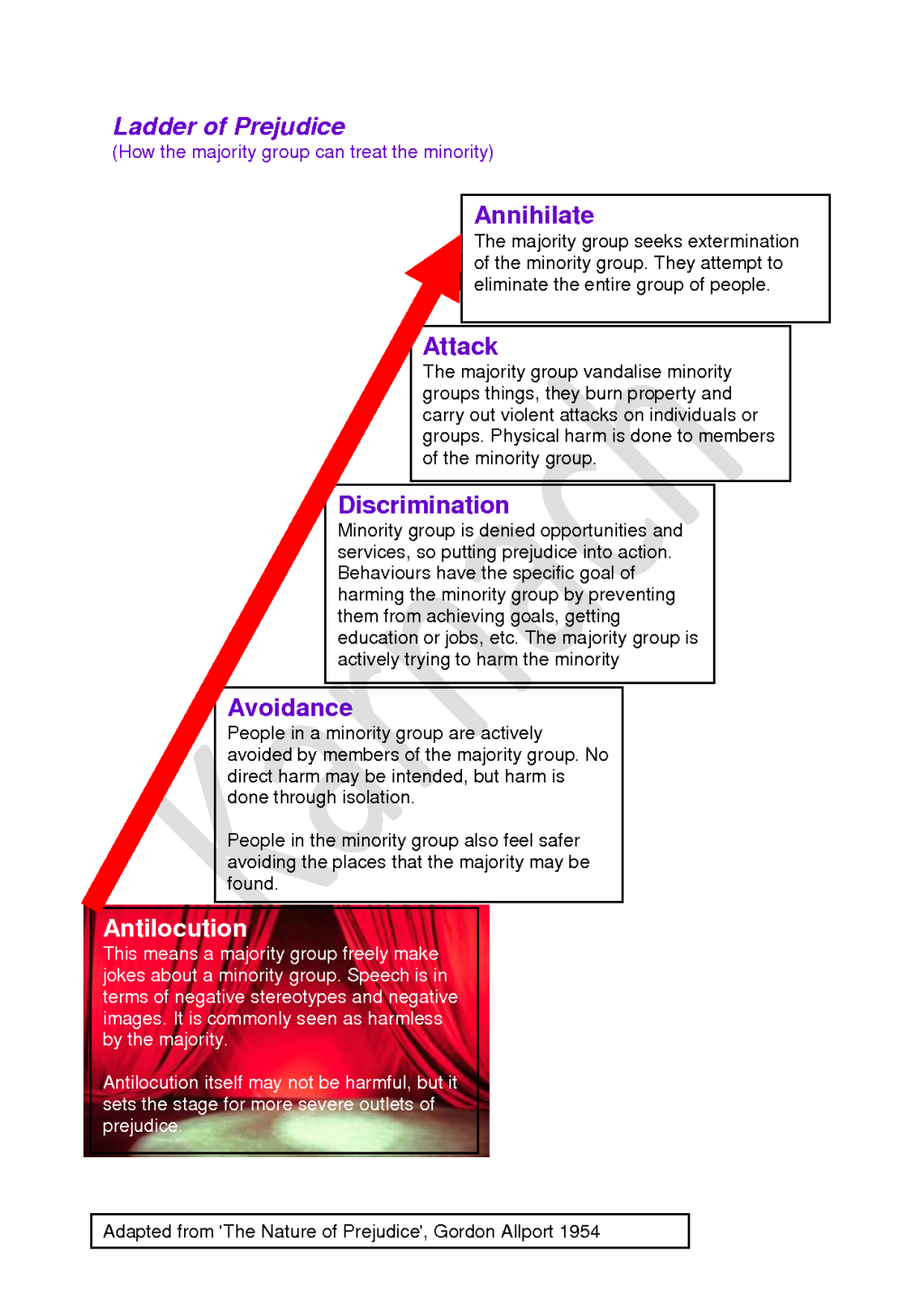
The second purpose of hate speech is to intimidate a targeted minority, leading them to question whether their dignity and social status is secure. In many cases, such intimidation is successful. Furthermore, hate speech is a gateway to harassment and violence. (See Allport’s scale of prejudice, which shows clearly how the Nazis used “freedom of speech” to incite hatred and then to incite genocide.)

As Allport’s scale indicates, hate speech and incitement to genocide start from often subtle expressions of prejudice. The dignity, worth and equality of every individual is the axiom of international human rights. International law condemns statements which deny the equality of all human beings. This process advances by almost inscrutable degrees. The public become bystanders, because they don’t fully understand what is happening. Until a group is attacked. Someone is murdered. Then someone else.

Article 20(2) of the ICCPR requires states to prohibit hate speech. Hate speech is prohibited by international and national laws, not because it is offensive, but rather, because it amounts to the intentional degradation and repression of groups that have been historically oppressed.

The most effective way to diffuse prejudice is an early preventative approach via dialogue: education and debate. Our schools, media and public figures have a vital part to play in positive role-modelling, in challenging bigotry, encouraging social solidarity, respect for diversity and in helping to promote understanding and empathy with others.

Hate speech categories are NOT about “disagreement” or even offence. Hate speech doesn’t invite debate. It’s about using speech to intentionally oppress others. It escalates when permitted, into harassment and violence. We learned this from history, and formulated human rights as a consequence. UKIP would have us unlearn the lessons of the Holocaust so that people can say “I’m not being  racist, but…” or “It’s not wrong to say immigrants should be sent home…” and so on.

There are recognisable effects of social norms and conformity on prejudice: Minard (1952) investigated how social norms influence prejudice and discrimination. The behaviour of black and white miners in a town in the southern United States was observed, both above and below ground.

Results: Below ground, where the social norm was friendly behaviour towards work colleagues, 80 of the white miners were friendly towards the black miners. Above ground, where the social norm was prejudiced behaviour by whites to blacks, this dropped to 20.

Conclusion: The white miners were conforming to different norms above and below ground. Whether or not prejudice is shown depends on the social context within which behaviour takes place. See also Milgram experiment on conformity – Milgram showed that people tend to conform, in groups and defer to authority even when it means behaving immorally. It’s very depressing reading, but it’s important to recognise the role of conformity and obedience in the genocides we’ve witnessed, and Allport’s work is also important here too. Asch came up with more optimistic results, showing that an objection from just one  person could change the behaviour of the whole group.

And that’s our responsibility, surely.

UKIP are not simply a collective of classist, sexist, xenophobes and  homophobes: they are omniphobes. Political has been reduced to simplistic, crude dichotomies which provoke arguments instead of rational debate, the populist themes trade on fear, and fear provokes strongly emotive responses. You can’t reason with those, they don’t lend themselves well to rational discourse.

I am so appalled and horrified at the public stage that UKIP and other far right groups have gained, at how the right generally have pushed back our boundaries of decency and rationality and are cultivating prejudice and fear towards politically constructed Others, which share common themes with Nazi ideology, and worse, some people don’t see these terrifying connections. The poorest and most vulnerable citizens are being turned into Outsiders by both the Conservatives and UKIP. And that is NOT okay.

Disabled people are dying because of Conservative neoliberal policies. The public and much of the media seem to be looking the other way

Farage demands that “We want our country back.” So do I. But my vision is very different to the shrunken patriotic neo-imperialism of Farage. No one hates his own country more that the resentful nationalist – and how they complain that  “Things ain’t what they used to be”.

My country is multicultural, rich and diverse, it is one that has learned from history and evolved. It is founded on progress and civil rights movements, past battles of the oppressed fought and won – our hard-earned freedoms to be who we are without fear.

We have a government that reduces benefits so that poorly paid workers can feel a little better about being so poorly paid. It’s a government that is all about lowering standards, and crucially, our expectations, and our regard of each other. So much mean spirited resentment has been kindled and perpetuated by the Coalition among the oppressed, redirected and aimed at the oppressed.

I recognise political themes of oppression and repression, and it is NOT okay. How can anyone think it is?

This governments’ schadenfreude – motivation for the vindictive policies that we’ve seen this past 4 years, which target the most vulnerable citizens most of all, is debated. Some people believe that the policies are a consequence of a redistribution of wealth from the poorest to the wealthy ‘rather than being malicious acts’. But the Tories laughed on hearing the accounts of suffering of the poorest people because of the bedroom tax and the food banks in parliament, for all to see. And surely the act of handing out money from the public purse to those who already have the most can’t possibly be construed as anything other than vindictive.

But entertaining the idea for a moment that the inflicted suffering isn’t a motivation but a consequence, well that would make the Government at the very least indifferent, callous and unremorseful, since they show a supreme lack of concern for the plight of those least able to defend themselves against injustice and inflicted poverty.  

The shock and anger at the recognition that all of those principles and beliefs we held dear – such as justice, fairness, cooperation, democracy, freedom, government accountability, equality (at least in terms of the worth of each life), institutionalised philanthropy – all trodden under foot by this Social Darwinist aristocratic elite in just 4 years. And the faith we each had in those collective ideals undermined by the constant perpetuation of divisive and hateful propaganda tactics from the right wing.

Dividing people by using blame and prejudice only weakens our opposition to oppression.

We must each take some responsibility and work to put right the terrible mistakes and inhumane acts that we’ve allowed to be written into our collective history. Our starting point must be founded on an egalitarian doctrine that maintains that all humans are equal in fundamental worth and social status. We have to learn and evolve.

If we remain silent and indifferent, if we look the other way, that makes us complicit in a growing evil.164204381
We can forgive children who are afraid of the dark, the real tragedy of life is when men and women become afraid of the light.

Related

DEFINING FEATURES OF FASCISM AND AUTHORITARIANISM 

Nigel Farage schooldays letter reveals concerns over fascism

Techniques of neutralisation: Cameron says keep calm and carry on climbing Allport’s ladder

Winston McKenzie, organiser for UKIP, Croydon, defending normalisation and legitimisation of racism and racist language in the UK. Radio 4 PM, discussion with Sunny Singh; Friday May 23rd, 2014.

Remarkable linguistic bullying, from McKenzie and a Godwin’s law type of approach to the word ‘racism’, which UKIP seem to have adopted to shut down critical debate about racism. Racism and other forms of prejudice are normalised gradually, almost inscrutably and in stages, as Allport’s ladder demonstrated all too well as an explanation of how the Holocaust happened. Allport describes social processes, and how the unthinkable becomes acceptable, by a steady erosion of our moral and rational boundaries.   The prejudice happens on a symbolic level first – language – and it starts with subtlety, such as the use of phrases like ‘immigrants “swamping” our shores’ in the media, as part of political rhetoric and so on. Racists very seldom own up to being racists. They also quite often employ linguistic bullying strategies that makes challenging them very difficult. But as history has taught us, we must challenge them.


The targeting, severity and impact of sanctions on benefit claimants needs urgent review

486294_4737578711832_1816039541_n
Posted originally by Michael Meacher, MP here  on April 3rd, 2014

This is the edited text of a speech I made today in the House of Commons, in a debate I initiated on the many cases of sanctions being wrongfully applied to benefit recipients, calling on the Government to review the targeting, severity and impact of such sanctions.

The process of sanctioning benefit recipients is now being used on an enormous scale—almost 1 million sanctions a year. Even the right-wing Policy Exchange think-tank acknowledged in a report published last month that about 68,000 benefit claimants each year are having their welfare payments stopped unfairly. Given that the penalty for the first infringement is the loss of benefit for four weeks, for the second the loss of benefits for three months and for the third the loss of benefits for three years, the number of people being driven into destitution by administrative diktat is enormous. Even the Policy Exchange admits that 8% of that number should never have been sanctioned.

I presume that everyone accepts that fall-back sanctions have to be applied in extreme cases where there is deliberate and real non co-operation with the obligation to try to find work and where no good reasons have been found for such behaviour. Those sanctions should be proportionate and reasonable and not exercised punitively or with a view to achieving targets or objectives—whatever we call them—for removing people from the unemployment list.

From the evidence that I have collected from my constituency surgery, Citizens Advice, YMCA, the excellent Work and Pensions Committee report on this issue and the Library, it is abundantly clear that the standards that the DWP likes to claim always apply in sanctioning cases far too often certainly do not. I wish to cite a number of cases drawn directly from those sources.

A security guard at a jobcentre turned away a man with learning disabilities who had arrived 20 minutes early to sign on. The man then returned two minutes late to sign on and had his JSA sanctioned for 4 weeks.

A man was sanctioned for four weeks because he had not known about an appointment as the letter had been sent to an address that he had left a year ago, even though Jobcentre Plus was aware of his current address.

A woman claiming employment and support allowance had been diagnosed with cervical cancer and had given the back-to-work scheme provider a list of her hospital appointments. She was sanctioned for failing to attend an appointment on the middle day of her three-day hospital stay. The woman had two daughters but her ESA was reduced to £28 a week. She asked for reconsideration, but had heard nothing five weeks later.

A woman was sanctioned for failing to attend provider-led training when the receptionist had rung to tell her not to come in because the trainer was ill. She was subsequently told that she should have attended to sign the attendance register.

A woman whose ESA was sanctioned had her benefit reduced from £195 to less than £50 per fortnight because she missed a back-to-work scheme appointment owing to illness. Her sister had rung two days beforehand to say that she could not attend and arranged another date, when she did attend.

An epileptic man had his JSA sanctioned for four weeks because he did not attend a back-to-work scheme meeting as his two-year old daughter was taken ill and he was her sole carer that day. He rang the provider in advance, but was told this would still have to be noted as “did not attend”. During the four-week sanction he suffered hunger, hardship, stress and an increase in epileptic attacks, but he was not told about hardship payments or food banks or how to appeal the sanction decision.

Lastly, a man in Yorkshire and Humber was sanctioned for allegedly failing to attend back-to-work scheme events. He had in fact attended, and the provider had no record of any failures. His hardship request was not processed, his housing benefit was stopped, and he fell into rent arrears and had no money for food, gas or electricity.

These are not isolated or exceptional cases. Jobcentres Plus have the right to “reconsider”, which is a euphemistic term, and they sometimes do, but appeals often take three or more months, and are extremely bureaucratic, long-winded and difficult. Far more effort should be put in before the decision is taken to sanction, so that we get sensible decisions and long appeal procedures are not required.

Before I turn to what should be done to change policies and procedures that are patently not working properly, I want to make two wider points. First, everyone who can do so should seek work. The overwhelming majority of the jobless are desperate to find work. However, when 2.4 million people are on the dole queues today and there are only 558,000 vacancies, three out of every four simply cannot find a job whatever they do. A report in the Financial Times this week says that there are 3 million under-employed people who would be keen to work full time if only the jobs were available. The real problem in Britain today is not people failing to try to get work, but the Chancellor’s obsessional austerity policies that contract the economy and fail to provide the job opportunities that people are desperately looking for.

I do not object to the use of sanctions in the tiny number of cases in which they might be needed as long as they are proportionate and reasonable. However, I do object to the hounding of some of the most vulnerable people in our society, often for trivial, ill-considered or utterly unjustified reasons, and driving them into destitution when those who caused the financial crash and the longest recession in this country for 140 years get no sanction at all. It is a classic case of one law for the rich and another for the poor.

What should be done? Plenty. Sanctioning is being used on far too large a scale. The practice is not only unduly harsh and, obviously, causes severe hardship, but is often counter-productive. The YMCA cites three people’s comments about its effects. One says:

“I was unable to look for work as much as I could before”.

Another says:

“It stopped me from searching for work as I had no money to get to different employers”.

A third person says:

“My focus turned to survival rather than gaining employment”.

Citizens Advice makes the crucial observation that front-line advisers do not have sufficient time to get to know a claimant and understand their needs. That explains why there are so many reports of cases such as that of a person with no computer skills being required to apply for work online, a person with no driving licence who is required to apply for a job for which driving is essential, and a wheelchair user who is required to apply for a job that is physically demanding.

Benefit off-flow—a horrible bureaucratic phrase that treats human beings like counters—is, perversely, the key performance measure used by Jobcentre Plus. Disallowances—that is the euphemism used by the Department for Work and Pensions—are included in the off-flow data for people coming off the unemployment list, so staff have an in-built incentive to use them to achieve what they perceive their management expect of them.

Much more could be done to prevent situations that cause sanctioning from arising in the first place because it is clear that in a great many cases people simply do not understand what is required of them. Regrettably, there is a toxic yet pervasive culture in Jobcentre Plus of “Sanction first; think later”, as is shown by the shockingly large number of sanctions against young people—there were 39,000 last year—that are subsequently overturned or, to use that wonderfully euphemistic word, “reconsidered”. Serious, thoughtful effort is needed to do everything possible to secure compliance, with which we all agree, without a sanction being necessary. There should be more common-sense discretion and much less of a rush to action: action should be taken only as a last resort.

Much more attention should be paid to the impact of sanctioning on claimants. An Oxfam report published last May estimated that 500,000 people were reliant on food aid—I suspect that that figure has now nearly doubled—and that more than half of people who turned to food banks did so a direct result of having their benefit payments delayed, reduced or withdrawn altogether. In 21st century Britain, can forcing hundreds of thousands of people onto food aid, which is usually associated with third-world countries, conceivably be justified when the root cause of the problem is the Chancellor’s failure to grow the economy and create jobs because of his obsession with prolonged austerity? I think not, which is why I submit to the House that there is an urgent need, as my motion demands, to review the targeting, severity and impact of sanctioning as it is currently applied.

Related posts on Michael Meacher’s blog:

A Guide to JSA sanctions

Originally posted on Benefits and Work.

JSA sanctions

Sanctions against claimants have reached record levels and it is very clear that they are being imposed for the tiniest deviation from agreements or even for no good reason whatsoever. They are now affecting not just JSA claimants but also ESA claimants – particularly those forced onto the work programme.

Below we’ve given our top tips for avoiding sanctions and some of the most outrageous examples of unfair sanctions that we have come across.

We also explain how to sue the DWP or work programme provider if they make an activity mandatory and it is unreasonable because of your health condition or disability

But we’d very much like to hear from you about your experience of sanctions, or threats of sanctions, and also any advice you can give fellow claimants on how to avoid or challenge unfair sanctions.

Top tips for avoiding sanctions

Don’t assume that your personal adviser has any knowledge at all about your health conditions or disabilities, if you have any. Instead, give full details in writing of the effect your health has on your everyday activities and your ability to move towards employment.

Ensure that your jobseeker’s agreement or claimant commitment is as realistic as possible and takes into account any specific health or disability-related limitations you have. Be as confident as you can be in negotiating the agreement – take a friend or relative for support if possible. Make an official complaint if your adviser won’t reach an agreement with you.

Try to get to every appointment early. People are unfairly sanctioned just for being a few minutes late.

Always ask for everything in writing, where possible. It’s much harder for the DWP or private sector provider to blame you for their mistakes if you have evidence that, for example, an appointment time was changed.

If something is agreed over the telephone, write or email confirming it. When you write confirming what has been agreed ask for an immediate response if your understanding is not correct.

Keep every bit of paper, text and email you receive. You might need them as evidence.

Record every telephone call if you can. It’s not illegal and you don’t have to inform the DWP or private sector provider that you are doing it.

If you’re given an unreasonable instruction, use the jobcentre plus complaints procedure immediately. Most people don’t complain, possibly because they think it will make things worse. But all the evidence is that Jobcentre Plus staff have targets to meet and they are looking for easy victims, not people who will cause them problems.

If you’re unfairly threatened with a sanction, or actually sanctioned, immediately complain in writing to your MP’s office. Send a copy to jobcentre plus and the private sector provider so that they know that your MP’s office is now involved. Complaints where an MP is known to be involved are taken much more seriously.

If you are unfairly sanctioned then challenge the decision via the mandatory reconsideration and appeal process. There is a very high success rate for appeals against sanctions, around 50% are successful and it’s likely that many more are resolved in the claimant’s favour before they ever get to a tribunal hearing.

If you don’t do something in your agreement which was mandatory, always explain in writing if you had good cause for not doing it. The decision maker has to take your explanation into account when deciding whether to impose a sanction. However, personal advisers are instructed that they should never ask if you have good cause, but only take details if you volunteer the information without being prompted. Good cause for not carrying out a mandatory activity could include, for example: a medical appointment; caring responsibilities; transport problems; unreasonably high travelling or childcare costs if you did as required.

How to sue the DWP or private sector provider

If an activity is made mandatory even though you will struggle with it because of sickness or disability, or if a reasonable adjustment is refused, get advice about suing immediately – don’t delay. There is still legal aid available for discrimination cases. Examples of discrimination could include:

• being forced to travel long distances by public transport to attend group activities with strangers, even though you have a mental health condition that makes travelling alone and interacting with strangers extremely distressing for you;

• being forced to attend appointments in the late afternoon even though you suffer from severe fatigue and your condition is at its worst at that time of time of day;

• being kept waiting for long periods of time, even though your condition makes this difficult or painful for you;

• being obliged to provide information over the telephone even though you have great difficulty in concentrating because of your health condition and would rather be able to give information in writing;

• being expected to discuss your health condition in an open-plan office where you can be overheard by other people, no matter how distressing you find this.

It’s vital that you get advice as early as possible, because it takes time to work through the legal aid system. So don’t wait until you’ve been sanctioned. As soon as you are told that something is mandatory and you think that this amounts to discrimination seek advice – the act of threatening you with a sanction can be discrimination, whether the sanction is applied or not. According to insiders in the legal profession, actions like this are virtually always settled by the DWP and the only ones that don’t succeed are those that are out of time because advice is sought too late.

Use the Civil Legal Advice gateway to find out if you are eligible for legal aid and to get help with bringing a claim.

Examples of unfair sanctions

Just in case you think we are being over cautious, below are some examples of sanctions being utterly unfairly applied. Many thanks to Birmingham Against the Cuts for compiling most of them.

You’ve been unemployed for seven months and are forced onto a workfare scheme but can’t afford to travel to the shop. You offer to work in a different branch you can walk to but are refused and get sanctioned for not attending your workfare placement. (Source: Caroline Lucas MP)

You attend a family funeral and miss your jobcentre appointment so you get sanctioned. (Source: Derek Twigg MP)

You retire on the grounds of ill health and claim ESA. You go to your assessment and during the assessment you have a heart attack, so the nurse says they have to stop the assessment. You get sanctioned for withdrawing from your assessment. (Source: Debbie Abrahams MP)

You have a training appointment at the same time as your jobcentre appointment, you tell the jobcentre you won’t be coming but they say you have to, and to get a letter from your new training organisation. Your training organisation says they don’t provide letters. (Source: Russell Brown MP)

It’s Christmas Day. You don’t do any jobsearch, because it’s Christmas Day. So you get sanctioned. For not looking to see if anyone has advertised a new job on Christmas Day. (Source: Poverty Alliance)

You’ve got no money to travel to look for work so you get sanctioned . (Source: CAB)

You apply for more jobs than required by your jobseeker’s agreement, but forgot to put down that you checked the local paper (which you’ve been specifically instructed to do via a jobseeker’s direction) so you get sanctioned. (Source: Steve Rose on twitter)

You’re on a workfare placement, and your jobcentre appointment comes round. The jobcentre tells you to sign on then go to your placement which you do. The workfare placement reports you for being late and you get sanctioned for 3 months. (Source: DefiniteMaybe post on Mumsnet forums)

You get given the wrong forms, get sanctioned for not doing the right forms. (Source: Adventures in Workfare blog )

You’re sick and miss an appointment, but you’ve already missed one so you get sanctioned. (Source: @thinktyler on twitter)

You’re five minutes late for your appointment, you show the advisor your watch which is running late, but you still get sanctioned for a month. (Source: Clydebank Post)

You get an interview but it’s on the day of your nan’s funeral. You have 3 interviews the day before, and you try to rearrange the interview, but the company reports you to the jobcentre and you get sanctioned for failing to accept a job.(Source: @TSAAPG on twitter – part 1 . part 2)

Tell us your experience of being sanctioned or avoiding a sanction.

Elections: Labour discusses how to help Britain while other parties fight among themselves

Mike Sivier's avatarMike Sivier's blog

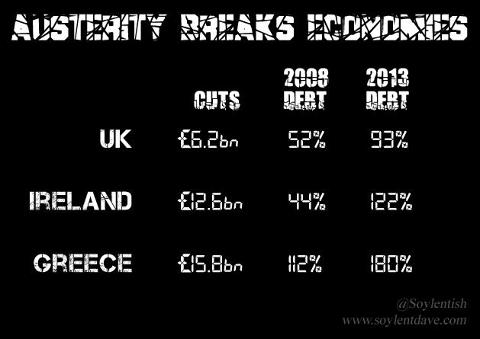
austeritybreakseconomies

Say what you like about Ed Miliband, at least he hasn’t descended into the morass of smears, accusations and counter-accusations that typify the Tory and Liberal Democrat election campaigns.

Labour’s approach seems to be focused on the national situation, rather than local areas – perhaps Mr Miliband is leaving local campaigning to local representatives, who know exactly what they’re talking about. Good policy.

By concentrating on the overarching issues – especially ahead of next week’s launch of the Coalition’s future legislative programme – he’s telling the country what Labour stands for, right now: Action on jobs, tax, housing and training, and cutting household bills.

I don’t know about you but I’m in favour of all of that.

Labour would provide a jobs guarantee for the long-term unemployed. People out of work would be obliged to take up those jobs (which might seem draconian, but remember, these people have been out…

View original post 513 more words

Once you hear the jackboots, it’s too late.

556770_138948196256237_144572172_n

Dr. Lawrence Britt examined the fascist regimes of Hitler (Germany), Mussolini (Italy), Franco (Spain), Suharto (Indonesia) and several Latin American regimes. Britt found 14 defining characteristics common to each, and it is becoming increasingly difficult to overlook some of the parallels with increasingly authoritarian characteristics of our own right wing government here in the UK.

Controlled mass media is one example of such a defining feature of fascism, with “news” being directly controlled and manipulated by the government, by regulation, or via sympathetic media spokespeople and executives. Censorship is very common. And then there is an obsession with “National Security” –  with fear being used as a “motivational tool” by the government on the public.

In June 2013, a visit by Government national security agents to smash computer hard drives at the Guardian newspaper offices hit the news surprisingly quietly, when Edward Snowden exposed a gross abuse of power and revealed mass surveillance programmes by American and British secret policing agencies (NSA and GCHQ) last year. (More detailed information here).

David Miranda, partner of Glenn Greenwald, Guardian interviewer of the whistleblower Edward Snowden, was held for 9 hours at Heathrow Airport and questioned under the Terrorism Act. Officials confiscated electronics equipment including his mobile phone, laptop, camera, memory sticks, DVDs and games consoles. 

This was a profound attack on press freedoms and the news gathering process, and as Greenwald said: “To detain my partner for a full nine hours while denying him a lawyer, and then seize large amounts of his possessions, is clearly intended to send a message of intimidation.”

Absolutely. Since when was investigative journalism a crime?

Even the Telegraph columnist Janet Daley remarked that these events were like something out of East Germany in the 1970s.

This certainly raised critically important legal and ethical issues, for those involved in journalism, especially if some kinds of journalism can be so easily placed at risk of being politically conflated with terrorism.

Once again, the mild and left wing/liberal Guardian is under attack by our Tory-led government. In an extraordinary and vicious attack on The Guardian newspaper, Department for Work and Pensions (DWP) communications chief and senior government spin doctor, Richard Caseby, has called for the newspaper to be “blackballed” and prevented from joining the new press regulatory body, because “day after day it gets its facts wrong.” Remarkably, “ineptitude or ideology” were to blame for what he deemed “mistakes” in the paper’s coverage of the DWP’s cuts to benefits. He called for the broadsheet to be kept out of the new Independent Press Standards Organisation (IPSO), set up after the Leveson Inquiry into media standards. 

As a former journalist at the Sun and The Sunday Times, Caseby certainly has an axe to grind against the paper that revealed how those right wing papers’ stablemate, the News Of The World, had hacked the voicemail of murdered teenager Millie Dowler, sparking the phone hacking scandal that prompted Rupert Murdoch to close the tabloid down.

richard caseby

Richard Caseby, pictured when giving evidence to MPs as managing editor of The Sun.

In July 2011 it emerged that Cameron met key executives of Murdoch’s News Corporation 26 times during the 14 months that Cameron had served as Prime Minister. It was also reported that Murdoch had given Cameron a personal guarantee that there would be no risk attached to hiring Andy Coulson, the former editor of News of the World, as the Conservative Party’s communication director in 2007. This was in spite of Coulson having resigned as editor over phone hacking by a reporter. Cameron chose to take Murdoch’s advice, despite warnings from Nick Clegg, Lord Ashdown and the Guardian. Coulson resigned his post in 2011 and was later arrested and questioned on allegations of further criminal activity at the News of the World, specifically regarding the News International phone hacking scandal.

The Culture, Media and Sport Committee of the House of Commons served a summons on Murdoch, his son James, and his former CEO Rebekah Brooks to testify before a committee on 19 July. After an initial refusal, the Murdochs confirmed they would attend after the committee issued them a summons to Parliament. The day before the committee, the website of the News Corporation publication the Sun was “hacked”, and a false story was posted on the front page claiming that Murdoch had died. Murdoch described the day of the committee “the most humble day of my life.”  He argued that since he ran a global business of 53,000 employees and that the News of the World was “just 1%” of this, he was not ultimately responsible for what went on at the tabloid. 

On 1 May 2012, the Culture, Media and Sport Committee issued a report stating that Murdoch was “not a fit person to exercise the stewardship of a major international company.”

On 3 July 2013 Exaro and Channel 4 news broke the story of a secretly recorded tape. It had been recorded by Sun journalists, and in it Murdoch can be heard telling them that the whole investigation was “one big fuss over nothing”, and that he, or his successors, would “take care” of any journalists who went to prison.

He said: “Why are the police behaving in this way? It’s the biggest inquiry ever, over next to nothing.” Murdoch believes that he doesn’t have to be accountable. His initial refusal to testify, despite being summonsed, is extraordinarily indifferent and arrogant.

In connection with Murdoch’s testimony to the Leveson Inquiry “into the ethics of the British press,” editor of Newsweek International, Tunku Varadarajan, referred to him as “the man whose name is synonymous with unethical newspapers.”

Not a shred of concern raised about any of this or Murdoch’s nasty and corrupt myth industry, and right wing scapegoating empire, coming from our government, a point worth reflecting on for a moment. Miliband said the phone-hacking was not just a media scandal, but it was a symbol of what was wrong with British politics.  He called for cross-party agreement on new media ownership laws that would cut Murdoch’s current market share, arguing that he has “too much power over British public life.He said: “If you want to minimise the abuses of power, then that kind of concentration of power is frankly quite dangerous.” 

Meanwhile, Iain Duncan  Smith is “monitoring” the BBC for any “left wing bias”. Gosh, I just bet that took the jolly well-known ardent commie Chris Patten by complete surprise…

The BBC Trust said that a programme called the “Future of Welfare”, written and presented by John Humphrys, breached its rules on impartiality and accuracy. It found that the programme had failed to back up with statistics claims that there was a “healthy supply of jobs”.

Iain Duncan Smith, the Work and Pensions Secretary, defended Humphrys as a “robust broadcaster” and said the documentary was “thoughtful and intelligent”. And perhaps most importantly, it endorsed the Governments’ punitive and callous welfare  “reforms.”

Duncan Smith was infuriated by the BBC’s coverage of the ruling, which he felt gave “too much airtime to campaigners.” Too much for what, exactly, we have to wonder. Perish the thought that anyone may dare to poke at the half-timbered facade of Tory ideology – Duncan Smiths’ rhetoric is a painful parody of fact that loudly dismisses – and intentionally obscures – the private despair and ruined lives of so many of those least able to speak up for themselves.

He said: “I have just watched reporting on the BBC about the Government winning a High Court judgement on the Spare Room Subsidy (that’s the Bedroom Tax to you and I) that once again has left me absolutely staggered at the blatant Left-wing bias within the coverage. And yet the BBC Trust criticise John Humphrys’s programme, which was thoughtful, intelligent and born out of the “real” life experience of individuals.”  The same Duncan Smith, who chooses to deny the all too painful and impoverished real life experiences his policies have inflicted on many. He prefers to lie them away from public attention. Or dismiss them as merely “anecdotal”.

Duncan Smith’s credibility doesn’t stand up to much scrutiny here, as someone attempting to verify “accuracy” and er…  statistical claims. Ah, yes. The Department of Work and Pensions – Iain Duncan Smiths’ Department – has a long track record of misusing statistics, making unsubstantiated inferences and stigmatising claimants, and it’s clear these are tactics used to attempt to vindicate further welfare cuts. In fact several minsters, including Cameron, have been officially rebuked by the Office of National Statistics for telling lies, and in Duncan Smith’s case – on at least 3 occasions this past 12 months despite warnings regarding his dishonest claims in the media, as well as in parliament. 

So considering all of this, it was with some incredulity that I read Caseby’s comments in the Huff Post earlier: “Should the new IPSO members accept (editor Alan Rusbridger) as a johnny-come-lately? No, rather he should be blackballed. Sorry, but the Guardian isn’t fit to become a member of IPSO until it starts valuing accuracy.”

And: “In the end, of course, it’s IPSO’s decision. But should the new standards body be so gracious as to invite him in, I guess I’ll be waiting to lodge the first complaint.” He said an MP had complained to the Office for National Statistics over The Guardian’s reporting of its data. I bet that was said without a trace of irony, too.

So, if alleged (and improbable) benefits inaccuracies “should get [The] Guardian blackballed,” what is this spin doctor’s recommendation for the perpetual propagandarising, lying, right wing media and a lying government minister’s serial offensive “benefits inaccuracies”?

Oh … of course, this is Iain Duncan Smiths’ relatively new pet guard dog.

An interesting choice of word from Caseby – “blackballing”, which is a rejection in a traditional form of secret ballot, where a white ball ballot constitutes a vote in support and a black ball signifies opposition. This system is typically used where a club (or Lodge) rules provide that, rather than a majority of the votes, one or two objections are sufficient to defeat a proposition. Since the seventeenth century, these rules have commonly applied to elections to membership of many gentlemen’s clubs and similar institutions such as in Freemasonry. It’s an apt term because of its association with conservatism, tradition and secrecy. 

In contrast, and unlike many whistleblowers who remain anonymous, Edward Snowden chose to be open and go public. Snowdens’ sole motive for leaking the documents was, in his words, “to inform the public as to that which is done in their name and that which is done against them.”  He believes that the global public is due an explanation of the motives of those who act outside of the democratic process.

To “protect democracy” we have governments that are subverting the law. This is a fundamental paradox, of course and Snowden saw this could lead to the collapse of democracy and critically endanger our freedom. And Snowden reminds us that what no individual conscience can change, a free press can. It has to be one that is free enough to allow a diverse range of political commentaries, rather than a stranglehold of right wing propaganda from the Murdoch empire and its ideological stablemates.

I think that the process of dismantling democracy started in May 2010 here in the UK, and has been advancing incrementally ever since, almost undetected at first, because of pervasive government secrecy and a partly complicit, dominant right wing media.

But once you hear the jackboots, it’s far too late.

994763_494550317281168_1024248164_n

With big thanks to Robert Livingstone

Related 

The Transparency of Lobbying, non-Party Campaigning, and Trade Union Administration Bill is a calculated and partisan move to insulate Tory policies and records from public and political scrutiny, and to stifle democracy. The Government’s Lobbying Bill has been criticised by bloggers and campaigners from right across the political spectrum, with the likes of Owen Jones and Guido Fawkes united in agreement over this issue: that the Bill is a “Gagging Act”. Five Conservatives – Douglas Carswell, Philip Davies, David Davis, Zac Goldsmith and David Nuttall – voted against the Bill, whilst others also expressed concerns.

The Bill will treat charities, think tanks, community groups and activists of every hue as “political parties”. From small groups addressing local matters to big national organisations, all equally risk being silenced in the year before a general election, to avoid falling under electoral law. Any organisation spending £5,000 a year and expressing an opinion on anything remotely political must register with the Electoral Commission. Since most aspects of our public life are political, (and a substantial proportion of our private life has been increasingly politicised under this authoritarian government) this stifles much essential debate in election years when voters should be hearing and evaluating policy choices.

The ‘Let Lynton Lobby Bill’: Grubby Partisan Politics and a Trojan Horse 


I  don’t make any money from my work. But you can help Politics and Insights if you like by making a donation to help me continue to research and write free, informative, insightful and independent articles, and to provide support to others. The smallest amount is much appreciated – thank you.

DonatenowButton

The Government’s Legal Aid Cuts Are Leaving Vulnerable People With Nowhere to Turn

“Ministers keep using the mantra that their proposals are to protect the most vulnerable when, quite obviously, they are the exact opposite. If implemented their measures would, far from protecting the most vulnerable, directly harm them. Whatever they do in the end, Her Majesty’s Government should stop this 1984 Orwellian-type misuse of language.”  – Lord Bach, discussing the Legal Aid Bill.

Source: Hansard, Column 1557, 19 May, 2011.

Sadiq Khan Posted by , Shadow Lord Chancellor, Shadow Justice Secretary and Member of Parliament for Tooting, on 19 May 2014 In Huff Post Politics blog.

Solicitors, barristers, judges, legal advisors, campaigners and others will today take part in the London Legal Walk. Thousands of people will snake their way from the Royal Courts of Justice to Hyde Park and back to raise money in support of free legal advice charities in London and the South East. Last year, 7,500 walkers raised a staggering half a million pounds. With this year being the tenth anniversary, and the need for free legal advice being as great as ever, the London Legal Walk is aiming to surpass last year’s fantastic total.

Given this is a really important cause I was determined to find time in this week’s busy election campaign schedule to join the walk. Today, I’ll be walking with colleagues from the excellent Justice Gap. Please do find time to sponsor them, and help the cause. The work of the London Legal Support Trust, who organise the walk, supports access to justice across London and the South East for many people who would be adrift without it. Similar charities are doing sterling work in other parts of the country. And their efforts are more important than ever as the growing crisis in our legal system threatens to undermine access to justice.

Our legal system functions on a crucial principle – that every single person is equal before the law. It’s deemed so important, it’s enshrined as Article 7 of the Universal Declaration of Human Rights. Without it, our legal system would become unfair, biased and arbitrary, and would lose the confidence of the millions of people it is there to protect.

When the welfare state was created by the post-war Labour government they had the wisdom to deem access to justice equally important as access to healthcare and social security. This gave birth to legal aid, providing assistance to those without the financial means to defend themselves in legal disputes.

We shouldn’t ever forget how important this is. In criminal cases, the state prosecutes and brings to bear the full weight of the government, procuring the finest legal minds money can buy. A defendant faces a potential inequality of arms as a result, and legal aid was designed to bring about a level playing field.

This is crucial because it ensures justice is done. Without it, the guilty may go free and the innocent may be convicted. No one wants miscarriages of justice, least of all victims of crime. They want the truly guilty convicted and punished, not walking the streets. Legal aid is crucial in achieving this.

Legal aid was also crucial in enabling people facing problems with welfare benefits, debt, housing and other social welfare problems having access to expert advice who could help the vulnerable appeal and challenge decisions by faceless bureaucrats employed by the state and it’s agents.

But legal aid has faced an onslaught from the current Government. In 2011, civil legal aid was decimated, leading to Law Centres and CABs closing down or facing the threat of closure and the creation of advice deserts. Many vulnerable people were left with nowhere to turn, something I’ve witnessed first-hand in my surgeries as people at the end of their tether turn up with bags and bags of paperwork.

More recently, the Government unveiled plans to shave a further £220million off criminal legal aid, generating considerable opposition from across the profession and in charities and campaign groups.

Ministers have fought a clever guerrilla campaign. They’ve salami sliced bit by bit to mitigate the short-term impact of their plans. They successfully divided and ruled the legal profession. They’ve smeared legal aid lawyers as fat cats and made out legal aid is only used by unworthy criminals.

Needless to say, the truth is rather different. Ministers were in hot water when the UK Statistics Authority dismissed the Government’s use of dodgy earnings data for lawyers. Legal aid isn’t just about bad people – it supports defendants at the stage when they are still innocent and helps many to subsequently prove their innocence. What’s more, it helps right wrongs. Without it, miscarriages of justice like the Guildford Four or Birmingham Six would never have been corrected. It also helps people who have wrongly had benefits removed or facing housing evictions appeal poorly made decisions, saving them misery and the State further money down the road.

Come 2015, £600million of the 2010 legal aid budget of £2.1billion will have been cut. Labour, as a sensible opposition, has challenged & questioned ministers. We’ve scrutinised their plans and exposed the foolhardiness and impacts of Government policies.

Alternative savings were put forward but just ignored. Instead, Ministers cut legal aid without doing anything to reform the system. Our warnings – and those of many others – were ignored. The result is an ever diminishing service – advice deserts have been created, junior lawyers have left the profession, access to justice had been denied to thousands and most recently we saw the collapse of the Operation Cotton serious fraud trial, with the fear other trials may also be affected.

But today’s sensible opposition is, I hope, tomorrow’s Government. If I have the privilege of becoming justice secretary in 2015, I’ll inherit a shell-shocked legal system. And I know there’s a hunger to hear from Labour what we will do to rebuild.

I admit it’s a daunting task taking over a decimated department. The scale of the challenge, whoever wins the next election, is enormous. The Ministry of Justice budget to run prisons, probation, courts, tribunals, coroners, youth justice, the Parole Board and legal aid will be approaching £6billion, down from £10billion five years before.

Simply committing to reinstate in its entirety what is being cut by the current Government is unrealistic. It’s not credible to pretend that all the money cut can be found from elsewhere. I can’t simply close prisons or shut down the youth justice system to completely reinstate legal aid. What’s more, the landscape is changing all the time and will change more by 2015. Lawyers and advisors have left and premises vacated. The way we used to deliver civil legal aid and the expertise that surrounded it will be gone in many parts of the country. There won’t be the people and organisations.

That’s why we’re going to have to think radically and differently about the way we do justice in both crime and civil if we are going to make any attempt to widen access to justice. Recently, the Lord Chief Justice, Lord Thomas, spoke about the need to uphold the rule of law within squeezed budgets. He said “we can only do that by radically examining how we recast the justice system so that it is equally, if not more, efficient and able to carry out its constitutional function”. He’s fired the starting pistol in a crucial debate.

And I have already begun work on how we can repair some of the damage done to access to justice. Big ideas are bubbling up. I’ve read the report of the Low Commission, and I’m heartened at the optimism in their recommendations. The work of Roger Smith and Richard Susskind and their ideas for using IT to provide low-level legal advice offers real opportunities. It means we could widen access to justice to areas not covered at the moment or in the recent past. And what about more inquisitorial ways of working? Making greater use of the ombudsman model for dealing with civil disputes before they escalate to the expensive courtroom? That being said the harsh reality is we’ll have to work within existing budgets.

Between now and the election, I’m working closely with colleagues on constructing a set of ideas which we can implement if we win the next election. We’ll need to hit the ground running, given the dramatic deterioration we’re witnessed in the legal system. But believe me, Labour’s starting point will be how to maximise access to justice – not like this Government, who’ve shown scant regard for the rule of law and the integrity of our precious legal system.

Related: The Coming Tyranny and the Legal Aid Bill 

legal Aid

Thanks to Robert Livingstone

Rising ESA sanctions: punishing vulnerable citizens for being vulnerable

The number of sanctions applied to ESA claimants rose 334% between December 2012 and December 2013, according to new Department of Work and Pensions statistics.

The report shows that since the new Employment Support Allowance (ESA) sanctions regime was introduced on 3 December 2012, there has been a steady increase in the number of sanctions applied, from 1,102 in December 2012 to 4,789 in December 2013.

The total number of adverse sanction decisions over the period 3 December 2012 to 31 December 2013 was 28,702:

  • 5,889 were applied for failure to attend a mandatory interview and
  • 22,814 were applied for failure to participate in work related activity

In addition, the statistics show that, of the 28,702 decisions:

  • 13,994 were reviewed and in 8,508 cases, the decisions were overturned. This equals a “success” rate of nearly 61% and
  • 331 cases were appealed, 90 of those (27%) were overturned on appeal

Since the new Job Seekers Allowance (JSA) sanctions regime was introduced on 22 October 2012, there have been a total of 1,028,819 adverse JSA sanction decisions up to the end of December 2013.

Of those 1,028,819 decisions:

  • 317,411 were reviewed – 146,486 were overturned
  • 34,503 were appealed – 6,158 were overturned at appeal

The Department of Work and Pensions statistical release is available on the .Gov website

Six out of every ten sanctioned ESA claimants are extremely vulnerable people with a mental health condition or learning difficulty, according DWP figures, obtained under the Freedom of Information Act. The proportion has risen from 35% of sanctioned claimants in 2009 to 58% in 2013. The statistics demonstrate that sanctions are now overwhelmingly aimed at the most vulnerable individuals by a government department which is using a policy of institutional discrimination to cut benefits costs.

Sanctions of £71.70 a week are imposed when ESA claimants in the work-related activity group are forced onto the work programme and then fail to meet mandatory conditions imposed on them by private sector companies.

However, for a person to get into the ESA work-related activity group on mental health grounds, they need to score a minimum of 15 points at assessment for problems with issues such as:

  • planning new activities,
  • changes in routine,
  • going to new places,
  • talking to new people,
  • avoiding behaving aggressively or inappropriately when stressed.

So, it’s pretty obvious that many will struggle to cope with regular and punctual attendance on training courses and work-experience placements with strangers in unfamiliar places. Even if some people manage to attend, they may not succeed in participating to the satisfaction of those running the courses or placements. People are being coerced by the DWP to engage in activities that they are simply not well enough to undertake.

Debbie Abrahams, a Labour MP, and a member of the Work And Pensions Committee, has been leading the calls for an inquiry into the issue of sanctions. She said:

“As a member of the work and pensions select committee I’ve been very concerned about the growing evidence of inappropriate sanctioning and demanded that that a second independent inquiry into the issue is established.

“When I made my demands face-to-face with Esther McVey at a Committee session back in November she agreed to set up an independent investigation into the ‘appropriateness of sanctions’ and her offer was welcomed by the Committee in their following report. But, in a deliberate snub to the Committee, the Government have now said they won’t set one up.

“My question is this: If sanctions are currently being applied correctly, an independent review will testify to that, so just what are Ministers trying to hide?

“It’s just another example of how Iain Duncan Smith and Esther McVey are using smoke and mirrors to avoid any criticism about the mess and misery they are creating in the social security system.

“No-one is arguing with the fact that anyone who is on work related benefits should do all they can to find appropriate employment. But there is a growing body of evidence that the way the government is implementing sanctions means vulnerable people are being targeted disproportionately and suffering terribly as a result.

“The last thing Iain Duncan Smith and Esther McVey want is for that uncomfortable truth to be uncovered by a focussed and independent investigation.”

You can download a copy of the freedom of information response here

995658_494538353949031_779653065_n
Thanks to Robert Livingstone.

The Coalition has deliberately financially trashed the NHS to justify its privatisation

9686687899_74d73c6216_o

Years before Andrew Lansley was to begin the dismantling of the National Health Service, Conservative Oliver Letwin told a private meeting in 2004 that the NHS would cease to exist within five years of a Conservative victory.

In the 6 years before the Tory Health and Social Care Act became law the NHS ran a budget surplus of a combined total of more than £10 billion. This can be confirmed on page 9 of the report document Tough times, tough choices – An overview of NHS finances.  Of that £10 billion surplus, more than £2 billion of the surplus came from NHS Trusts in the years preceding 2012.

After the passing of the Tory Health and Social Care Act, however, the combined surplus in the NHS Trust Sector has declined sharply. For example, in the most recent year, the NHS Trust surplus halved. This is confirmed on page 20 of the report. 

In addition, since the Tory NHS Act came into effect, an increasing number of NHS Trusts have reported that they are suffering financial difficulty. In fact, as an overall percentage of the NHS Trust Sector, the number of NHS Trusts “failing” due to financial difficulty has more than doubled since 2010. 

The picture looks even more dire when we focus on “acute” or hospital Trusts, and not just the NHS Trust Sector as a whole. In 2012-3,  8% of hospital trusts warned of financial difficulty – see here. By December 2013, however, this figure of 8% has soared to a massive 44% of Acute Trusts in financial trouble. 

It is clear that our NHS Hospital Sector is in severe financial trouble and evidence would indicate that the Tory Health and Social Care Act has caused it.

The Department of Health has disclosed that 4,620 frontline staff were made compulsorily redundant between 2010-11, and an  overall total of 7,000 key NHS clinical staff made redundant amid Government enforced cuts. The Labour Party also released a ministerial response to a parliamentary question which showed that a total of 7,435 fewer training places for nurses have been commissioned by the NHS in England over the last three years compared with 2009-10, when they were in power. In that year there were 20,829 training places available for would-be nurses, but that fell to 20,092 in 2010-11, then 17,741 in 2011-12 and then 17,219 in 2012-13.

A further 250,000 plus NHS and Social Care jobs have been axed or converted to zero hours contracts under David Cameron. There are 132,095 fewer staff employed in the NHS and Social Care services by the state today than there were in 31 March 2010. This is verified by the Office for National Statistics here and here. Overall, NHS staff headcount has been cut by 37,000 since April 2010. Other Health & Social Care Staff have been cut by 95,000.

It’s worth considering that the Information Commissioner Christopher Graham launched a scathing rebuke on the decision to exercise the Government’s veto, in a report on the case of the Health reforms risk register to Parliament in 2012. Blocking the publication of the report into the risks of the NHS reforms was also a sign that ministers want to downgrade freedom of information laws, a watchdog warned.

Health Secretary Andrew Lansley deployed the veto when an Information Tribunal ruled that he should meet Labour demands to disclose the document. The risks that the Health Bill impose on our health service remain undisclosed. This is an unacceptable state of affairs, especially given that we are a so-called democratic nation.

The UK Statistics have also rebuked the Government over NHS spending claims – David Cameron famously promised he would cut the deficit, not the NHS. We have it in black and white: he is cutting the NHS, not the deficit. There could be no clearer evidence of the failure and deceit of this Prime Minister and his Government.

The watchdog called on ministers to correct the claims the coalition has made that they increased NHS spending in England. The UK Statistics Authority upheld a complaint by Labour about government claims that the NHS budget had increased in real-terms in the past two years.

The watchdog found the best-available Treasury data showed that real-terms health spending was lower in 2011-12 than in 2009-10. The coalition lied and said during its spending review the NHS budget had gone up.

“For months, David Cameron’s Government have made misleading boasts about NHS spending, misrepresenting the true financial difficulties he has brought upon the NHS. At the same time they have recently begun to try to distance themselves from these problems which David Cameron has created, trying to shift the blame to the NHS and its staff.” – Andy Burnham

Labour have pledged to repeal the Coalition Health and Social Care Act.


List of MPs with links to private healthcare firms

252299_486936058042594_609527550_n

 Big thanks to Robert Livingstone

Iain Duncan Smith used false statistics again to justify disability benefit cuts

486294_4737578711832_1816039541_n
The Department of Work and Pensions has a long track record of misusing statistics, making unsubstantiated inferences and stigmatising claimants, and it’s clear these are tactics used to vindicate further welfare cuts.

The Tories have peddled the lie that he UK was “on the brink bankruptcy” and claimed the solution to is to cut government spending with a painful programme of austerity cuts. Of course, the UK economy was growing in 2010 when the Tories took over and was subsequently plunged back into recession by Osborne’s austerity policies, which have meant that the economy has not grown at all under the coalition; and for much of their tenure has been contracting. Despite the fact that Osborne was officially rebuked for this lie, the Goebbels-styled repetition propaganda technique employed by the conservatives has embedded this lie in the minds of the public.  However, our current problems are the result of a global financial crisis that we and not the banks that caused it, continue to pay for.

Austerity is a smokescreen – the Coalition has used the deficit as an excuse to do what they have always wanted to do: shrink the state, privatise the NHS, and hand out our money to the wealthy minority. We cannot trust them. 

It’s become clear that the Tories have seized an opportunity to dismantle the institutions they have always hated since the post-war social democratic settlement – institutions of health, welfare, education, culture and human rights which should be provided for all citizens. The Tories also attempt to destroy fundamental public support for the health, education and welfare of its people by a divisive scapegoating of vulnerable groups, perpetuated via the media, and by offering and inflicting only regressive, punitive policies and devastating cuts. 

The  Official statistics watchdog (UKSA) has found that the Department for Work and Pensions (DWP) have repeatedly made false claims about the numbers of people living on disability benefits.

Ministers claim that the majority of people claiming disability living allowance (DLA) were given benefits for life, and without any supporting medical evidence. This is untrue.

According to DWP press releases:

“More than 50% of decisions on entitlement are made on the basis of the claim form alone, without any additional corroborating medical evidence.”

However, the UK Statistics Authority (UKSA) found that the real percentage of claims passed without supporting medical evidence was just 10%.

The DWP also claimed that “Under the current system of Disability Living Allowance, 71% of claimants get indefinite awards without systematic reassessments.” However the UKSA found that in the last two years, just 23% and 24% of claimants were given indefinite awards of DLA.


The DWP accept that their claims were “ambiguous” and “had not been re-checked by the Department’s analysts, as is the usual practice.”

The findings were uncovered by an investigation by Channel Four News following complaint by the charity Parkinson’s UK.

 Parkinson’s UK policy advisor Donna O’Brien said:

“People with Parkinson’s who claimed DLA have told us supporting medical evidence was crucial due to a woeful knowledge of the condition amongst assessors, and it is absurd that the Government was trying to imply that anyone going through the system had an easy ride.”

This is the third time in the past year that Iain Duncan Smith has come under fire for the use of false statistics to justify cuts to benefits.

Last year Duncan Smith was rebuked by UKSA for misuse of benefit statistics. He claimed that 8000 people who had been affected by the benefits cap had “moved back into work.”

The UKSA found that this figure was “unsupported by the official statistics.”

Another statement by Duncan Smith later in the month also drew criticism and a reprimand. The minister said around 1 million people have been stuck on benefits for at least three of the last four years “despite being judged capable of preparing or looking for work”.

However, the figures cited also included single mothers, people who were seriously ill, and people awaiting their assessment.

Grant Shapps was also rebuked by UK Statistics Authority for misrepresenting benefit figures – Shapps joined his fellow Conservatives in the data hall of shame. In March, the Tory chairman claimed that “nearly a million people” (878,300) on incapacity benefit had dropped their claims, rather than face a new medical assessment for its successor, the employment and support allowance (ESA).

The figures, he said, “demonstrate how the welfare system was broken under Labour and why our reforms are so important”.  The claim was faithfully reported by the Sunday Telegraph  but as the UK Statistics Authority has now confirmed in its response to Labour MP Sheila Gilmore (the complainant), it was entirely and intentionally fabricated.

In his letter to Shapps and Iain Duncan Smith, UKSA chair Andrew Dilnot writes that the figure conflated “official statistics relating to new claimants of the ESA with official statistics on recipients of the incapacity benefit (IB) who are being migrated across to the ESA”.

Of the 603,600 incapacity benefit claimants referred for reassessment as part of the introduction of the ESA between March 2011 and May 2012, just 19,700 (somewhat short of Shapps’s “nearly a million) abandoned their claims prior to a work capability assessment in the period up to May 2012. The figure of 878,300 refers to the total of new claims for the ESA closed before medical assessment from October 2008 to May 2012.

Thus, Shapps’s suggestion that the 878,300 were pre-existing claimants, who would rather lose their benefits than be exposed as “scroungers”, was entirely wrong. As significantly, there is no evidence that those who abandoned their claims did so for the reasons ascribed by Shapps. However, he did at least honestly reveal his own prejudices regarding disabled people, at least. But he did so without a trace of shame and remorse.

At the time Iain Duncan Smith dismissed the findings, saying that he “believed” that he was “right”, anyway. It seems that Iain Duncan Smith has some disdain for evidence-based policy.

“I believe this to be right, I believe that we are already seeing people going back to work who were not going to go back to work,”  he said.

This is a remarkable claim, given that the Department for Work and Pensions does not track the destination of people no longer entitled to benefits. Simply measuring how many people no longer claim benefits does not accurately reflect the numbers of those actually moving into employment. The DWP off-flow figures will inevitably include many having their claim ended for reasons other than securing employment, including sanctions, awaiting mandatory review, appeal, death, hospitalisation, imprisonment, or on a government “training scheme” (workfare). 

In 2011, the Work and Pensions Select Committee warned the Department for Work and Pensions (DWP) needed to take more care when releasing and commenting on benefit statistics, to make sure media stories were “accurate.”

It seems unlikely, however, that accuracy will replace Duncan Smith’s “gut feelings” and ideologically-driven rhetoric – which is aimed at presenting excuses for the steady reduction of support for the most vulnerable citizens – any time soon.

36626_217452248405831_532419169_n

Pictures courtesy of Robert Livingstone