Category: Campaign

Soul-breaking government scheme to provide ‘expert’ employment ‘support’ to young people in schools

430835_148211001996623_1337599952_n (1)


The so-called ‘small state’ government have pledged to intrude schools to place ‘demand-led, Jobcentre Plus staff to supplement careers guidance and help schools deliver their statutory duty to provide high-quality, independent and impartial careers advice.’

See government press release: Jobcentre Plus support rolled out to schools.

Isn’t all existing careers advice impartial?

Ah, I see that impartial now means: ‘to inform independent choice,’ according to the newly introduced Careers and Enterprise Company, who will work with Jobcentre Plus staff ‘to ensure schools receive a coherent and aligned offer.’

Aligned to what? 

The needs of local businesses and the neoliberal labour market and not the needs of young people.

To inform independent choice. That’s a bit like saying “If you do everything I say, you will be truly free to make your own choices.  

The Tories are experts in linguistic behaviourism, telling lies and social control freakery, but not very much else.

Impartial. It’s another one of those Tory definitions that mean something else completely. Like helping or supporting people into work, which actually means a crude type of punitive behaviourism  – the imposition of  punitive financial sanctions if you don’t do exactly what you are told, and actually, quite often, even if you do. I’ve never understood how starvation and destitution can ever help or incentivise anyone to find a job, especially when experience and empirical evidence tells us otherwise. The welfare state has been weaponised against the people it was designed to support: a penultimate, vindictive Tory tactic before they completely dismantle it once and for all.

In 2015, the government’s Earn or Learn taskforce announced a new 3-week programme to give young jobseekers an ‘unprecedented level of support that will help them find work within 6 months.’  Personally, I shudder at the very thought of the Tories supporting my own children. I don’t want them anywhere near young people more generally. Regressive and Orwellian Tory ‘support’ has killed adults. There is no conceivable way that this bunch of tyrants can ever be trusted with our children’s future.

From 2017, the new programme will offer ‘an intensive curriculum’ involving practicing job applications and interview techniques as well as extensive job searches, and is expected to take 71 hours over the first 3 weeks of the claim. Welcome to the ultimate libertarian paternalist’s dystopic ‘education’ programme.

This ‘expert employment support to young people’ has been launched by two utterly inept, lying, dogmatic Conservatives with a history of formulating extremely nasty, punitive approaches to state defined ‘welfare and wellbeing’ – Iain Duncan Smith and Priti Patel.

Someone should put them straight: education includes the opportunity to attend college and university. Curiously, the Conservative brand of ‘impartial’ career advice seems to be all about big business ‘leading the way’ by instilling the protestant work ethic in our children. Life and learning is about working for people who make profits. That is the order of the world. 

Children from the age of twelve are to be coached to undertake ‘work experience.’ To clarify, that’s work fare – stacking shelves at Poundland or sweeping floors at your local McDonald‘s, for no pay.

It’s difficult to see what kind of educational process such a Conservative ‘curriculum’ entails, although it does include a sequence of instruction: a barely concealed hidden curriculum which reinforces existing social inequalities by ‘educating’ students according to their class, promoting the acceptance of a social pre-destiny of exploitation without promoting rational and reflective consideration.

A veritable pedagogy of the oppressed.

Duncan Smith babbles:

This scheme is fundamentally about social mobility and social justice – ensuring we give all young people the best chance to get on in life.

Someone should tell this idiot that social justice is all about the fair and just relationship between the individual and society. This is measured by the distribution of wealth, resources, opportunities, freedoms for personal activity and social privileges. It is about removing barriers to social mobility, the creation of social safety nets and economic justice. There is no mention of work fare for adults and children, exploitation, corporate profits and Tory donors in any standard definition of social justice anywhere.

Steve Bell cartoon

It’s not as if the Conservatives have historically shown the slightest interest in and recognition of realising human potential. That’s far too progressive and would require the capacity for democratic dialogue instead of paternalist preaching and lofty class-contingent, traditionally prejudiced, moralising. The Tories have always prefered a steeply hierarchical world, comprised of ascribed social status.

What the Conservatives plan is a blatant programme of indoctrination and political micromanagement to ensure that young people learn their place and accept a future of exploitative, low paid, insecure jobs, without the prospect of real opportunities or the chance to go to university. It’s more psychoregulation and authoritarian politics and has nothing to do with genuine needs-led or evidence-based policy.

And it’s to be delivered in our schools: transforming them from Ideological State Apparatuses – ideologies have the function of masking the exploitative arrangements on which class societies are based – into unmasked Repressive State Apparatuses. Hidden in plain view.

Authoritarianism tends to become more visible and frankly expressed over time.

demcracy


I don’t make any money from my work. I am disabled because of illness and have a very limited income. But you can help by making a donation to help me continue to research and write informative, insightful and independent articles, and to provide support to others. The smallest amount is much appreciated – thank you.

DonatenowButton

The UN Inquiry into the Rights of Persons with Disabilities in the UK – Commons Briefing


disability_2218977b

The House of Commons Library have issued a research briefing, published on Wednesday January 13, 2016, regarding the UN Inquiry into the Rights of Persons with Disabilities in the UK:

“The UN Committee on the Rights of Persons with Disabilities is conducting an inquiry into the impact of the UK Government’s policies on people with disabilities in relation to their human rights obligations. This briefing paper provides information on the Committee, details of the inquiry and an overview of the Government’s policies in relation to people with disabilities.

The inquiry is being conducted under the Optional Protocol to the Convention on the Rights of Persons with Disabilities, to which the UK has been a signatory since 2007. The Optional Protocol allows the UN Committee to investigate a State Party if they have received reliable evidence of ‘grave and systematic violations of the Convention’.

Investigations by the Committee are confidential, and the process, extent and scope of this inquiry are unknown. However, it is believed the inquiry will consider policies introduced by the Coalition Government since 2010 in relation to welfare and social security benefits, and in particular their compatibility with Articles 19 and 28: the rights of persons with disabilities to live independently and to enjoy an adequate standard of living.

The UK is the first country to be investigated by the UN in relation to this Convention.

This paper gives some background to the UN Committee on the Rights of Persons with Disabilities and the Convention, as well as providing an overview of what we know about the UN inquiry. It then outlines a selection of policies introduced under the Coalition Government which have had an impact on people with a disability covering housing, education, welfare, justice, healthcare and employment.

The UN Committee report, along with the UK Government’s response, is not expected to be published until 2017.”

You can read the briefing in full here –The UN Inquiry into the Rights of Persons with Disabilities in the UK

It’s also worth reading the two submissions to the inquiry from the Equality and Human Rights Commission, summarised by the UK Administrative Justice Institute and linked on hereEvidence of the impact of welfare reforms on disabled people

Many thanks to Samuel Miller for flagging this up and for all of his outstanding work.

Universal Credit “in-work progression” inquiry launched – call for evidence

ImageVaultHandler.aspx

The Work and Pensions Committee opened an in-work progression in Universal Credit inquiry on the 9th December.

Background of the inquiry

The Department for Work and Pensions (DWP) intends to establish an “in-work service”, designed to encourage individual Universal Credit claimants on very low earnings to increase their income. Benefit payments may be stopped if claimants fail to take action as required by the DWP. The DWP is conducting a range of pilots to test different approaches but there is very little detail about these. The new regime might eventually apply to around one million people.

The Committee is considering the Department’s plans and options for a fair, workable and effective approach.

These measures will make benefit payments to people who are in work, but on low earnings, conditional on them taking certain steps to increase their pay or hours.

Scope of the inquiry:

Written submissions are invited addressing the following points:

    • DWP’s plans for in-work progression pilots in 2015/16, and how they should be evaluated
    • Which organisations are best-placed to deliver the in-work service for DWP e.g. Jobcentre Plus/other providers from the private, public or voluntary sectors?
    • What should in-work progression support entail and how should it be delivered (e.g. regularity and nature of contact with claimants)?
    • Which groups of claimants should be included and which should be exempt?
    • How should employers be encouraged to facilitate progression?
    • In what circumstances would it be appropriate to sanction a Universal Credit claimant who is in work?
    • Is there any UK or international evidence on effective ways of encouraging in-work progression?

The deadline for submissions is Monday 18 January 2016.

Chair’s comment

Rt Hon Frank Field MP DL, Chair of the Work and Pensions Committee, said:

“The welfare-to-work strategy of successive governments has begun to crack the dependency on out-of-work benefits that had appeared to be an almost intractable problem. Efforts now also need to be focused on a welfare-to-work strategy that not only moves claimants off out-of-work benefit, but more importantly helps them move up the pay ladder and out of poverty. Too many people on low benefit incomes have been encouraged into low-paid jobs whose rewards are only brought up to a more acceptable income level by tax credits and other in-work benefits. I hope our Committee therefore will examine the available evidence and carefully develop an approach to in-work support which is effective, and which people accept as fair.”

I will publish my own submission, prompted by Frank Field’s spectacularly misguided and conservative statement, in due course. Here are a few of the issues and concerns I will be raising: 

Field refers to the Conservative “dependency” myth, yet there has never been any empirical evidence to support the claims of the existence of a “culture of dependency” and that’s despite the dogged research conducted by Keith Joseph some years ago, when he made similar claims. In fact, a recent international study of social safety nets from The Massachusetts Institute of Technology (MIT) and Harvard economists categorically refutes the Conservative “scrounger” stereotype and dependency rhetoric. Abhijit Banerjee, Rema Hanna, Gabriel Kreindler, and Benjamin Olken re-analyzed data from seven randomized experiments evaluating cash programs in poor countries and found “no systematic evidence that cash transfer programmes discourage work.”

The phrase “welfare dependencydiverts us from political discrimation via policies, increasing inequality, and it serves to disperse public sympathies towards the poorest citizens, normalising prejudice and resetting social norm defaults that then permit the state to target protected social groups for further punitive and “cost-cutting” interventions to “incentivise” them towards “behavioural change.”

Furthermore, Welfare-to-Work programmes do not “help” people to find jobs, because they don’t address exploitative employers, structural problems, such as access to opportunity and resources and labor market constraints. Work programmes are not just a failure here in the UK, but also in other countries, where the programmes have run extensively over at least 15 years, such as Australia.

Welfare-to-work programes are intimately connected with the sanctioning regime, aimed at punishing people claiming welfare support. Work programme providers are sanctioning twice as many people as they are signposting into employment (David Etherington, Anne Daguerre, 2015), emphasising the distorted priorities of “welfare to work” services, and indicating a significant gap between claimant obligations and employment outcomes.

The Conservatives have always constructed discourses and shaped institutions which isolate some social groups from health, social and political resources, with justification narratives based on a process of class-contingent characterisations and the ascribed responsiblisation of social problems such as poverty, using quack psychology and pseudoscience. However, it is socioeconomic conditions which lead to deprivation of opportunities, and that outcome is undoubtedly a direct consequence of inadequate political decision-making and policy.

It’s worth bearing in mind that many people in work are still living in poverty and reliant on in-work benefits, which undermines the libertarian paternalist/conservative case for increasing benefit conditionality somewhat, although those in low-paid work are still likely to be less poor than those reliant on out-of-work benefits. The Conservative “making work pay” slogan is a cryptographic reference to the punitive paternalist 1834 Poor Law principle of less eligibility.

The government’s Universal Credit legislation has enshrined the principle that working people in receipt of in-work benefits may face benefits sanctions if they are deemed not to be trying hard enough to find higher-paid work. It’s not as if the Conservatives have ever valued legitimate collective wage bargaining. In fact their legislative track record consistently demonstrates that they hate it, prioritising the authority of the state above all else.

There are profoundly conflicting differences in the interests of employers and employees. The former are generally strongly motivated to purposely keep wages as low as possible so they can generate profit and pay dividends to shareholders and the latter need their pay and working conditions to be such that they have a reasonable standard of living.

Workplace disagreements about wages and conditions are now typically resolved neither by collective bargaining nor litigation but are left to management prerogative. This is because Conservative aspirations are clear. They want cheap labor and low cost workers, unable to withdraw their labor, unprotected by either trade unions or employment rights and threatened with destitution via benefit sanction cuts if they refuse to accept low paid, low standard work. Similarly, desperation and the “deterrent” effect of the 1834 Poor Law amendment served to drive down wages.

In the Conservative’s view, trade unions distort the free labor market which runs counter to New Right and neoliberal dogma. Since 2010, the decline in UK wage levels has been amongst the very worst in Europe. The fall in earnings under the Coalition is the biggest in any parliament since 1880, according to analysis by the House of Commons Library, and at a time when the cost of living has spiralled upwards. And whose fault is that?

It’s certainly not the fault of those who need financial support to meet their basic survival needs despite being in employment.

Send a written submission through the in-work progression in Universal Credit inquiry page.

Don’t forget the deadline is Monday 18 January 2016.

8+Ways+to+Protect+Yourself+From+Emotional+Manipulation

The Department for Work and Pensions don’t know what their ethical and safeguarding guidelines are but still claim they have some

dc308-media_http1bpblogspot_yzchd

I have recently written quite extensively about problems with how the government conduct “research,” I’ve also highlighted the many official rebukes the Conservatives have faced because of their tendency to invent statistics to “verify” their ideologically-driven, value-laden “hypotheses.”

Who could ever forget the Department for Work and Pension’s fake testimonials from fake benefit claimants telling us all how fakely beneficial the fakesters had found having their fake lifeline benefits withdrawn for fake non-compliance, leading to fake improvements of behaviour, presumably after a bout of fake starvation and destitution.

The new Work and Health Programme, aimed at reducing the number of people claiming Employment and Support Allowance (ESA), is currently still at a research and trialing stage. Part of the experimental nudge element of this research entails enlisting GPs to “prescribe” job coaches, and to participate in constructing “a health and work passport to collate employment and health information.”  (See The new Work and Health Programme: the government plan social experiments to “nudge” sick and disabled people into work.)

This raised some serious ethical concerns for me, which I addressed in a Freedom of Information (FoI) request to the Department for Work and Pensions (DWP). The most important part of the request was:

I should like to ask what ethical guidelines are in place regarding the use of behavioural theory on claimants. What guidelines are in place to protect claimants from any potential adverse effects of trials and experiments using methods aimed at changing behaviours of claimants? And what method of gaining claimant consent (to be used as a subject in trials and experiments ) is used by the Department and by job centres?

I did ask a further three brief and reasonable questions, citing a source of information – The Government Communication Service guide to communications and behaviour change quoting from it and explaining the questions.

My request was refused.

The DWP response

I can confirm that we hold information falling within the description specified in your request. However, we estimate that the cost of complying with your request would exceed the appropriate limit for central Government, set by regulations at £600. This represents the estimated cost of one person spending 3½ working days in determining whether the Department holds the information, and locating, retrieving and extracting it.

Under section 12 of the Freedom of Information Act the Department is not therefore obliged to comply with your request and we will not be processing it further.

images

Firstly, something as fundamentally important as safeguarding and ethical guidelines regarding government behavioural/psychological experimentation should actually be available for public access and scrutiny, not hidden away in a place that allegedly takes so much time, effort and money to locate.

Anyone would think those comments are simply an obstructive tactic, if the DWP can confirm that they have the information, then surely that reduces the cost and time spent retrieving and extracting it to comply with my request. Wouldn’t you think?

Someone who is earning £600 for 3½days work is on a very generous annual salary of around £45K. Unless this person is being paid to be intentionally incompetent and obstructive, their job skills suck, it has to be said. So do the logic and reasoning skills of the person who wrote that response.

I also know from experience that the DWP regularly respond only partially. They had the option of answering some of my request, at least. After all, they claim to have the information, seems a shame not to share some of it.

However, because the ethical considerations of government experiments and trials on people needing welfare support are so very important, I have pursued this request further by taking the option of simplifying it.

I wrote:

Dear DWP CAXTON HOUSE Communications,

You confirm that you have the information that I requested, but then claim that it would exceed the £600 limit to provide that
information which you state is because of the “estimated cost of one person spending 3½ working days in determining whether the Department holds the information, and locating, retrieving and extracting it.”

If you confirm you have the information, then surely that reduces the cost and time spent retrieving and extracting it to comply with my request.

I will however simplify my request. Most people would expect that ethical guidelines, safeguards and the important matter of client consent to participating in Government trials and experiments on people needing welfare support is something that the DWP would have to hand – easy to retrieve and very important information that one would expect to be in the public domain in any case. But I can’t find it.

I refer again to the The Government Communication Service guide to communications and behaviour change –
https://gcn.civilservice.gov.uk/wp-conte…

In particular, I refer to page 5: “Behavioural theory is a powerful
tool for the government communicator, but you don’t need to be an experienced social scientist to apply it successfully to your work.”

I should like to ask:

  • What ethical guidelines are in place regarding the use of behavioural theory on claimants?
  • What guidelines are in place to protect claimants from any potential adverse effects of trials and experiments using methods aimed at changing the behaviours of claimants?
  • And what method of gaining claimant consent (to be used as a subject in trials and experiments ) is used by the Department for Work and Pensions and by job centres?

Yours sincerely,

Susan Jones

Link to the request

Here is the FoI request and response in full: Use of behavioural theory to change behaviours of people claiming benefits.

Under Section 16 of the FoI Act the DWP should assist me in helping to narrow my request so that it may fall beneath the cost limit. I have narrowed my request and submitted a shorter, simplified version, focussing on the ethical issues only. It is reasonable to expect the DWP, whose remit includes face to face work with some of our most vulnerable citizens, to have ethical and safeguarding guidelines and consent forms to hand without having to pay someone hundreds of pounds for days of work to “find and retrieve” information that ought to be in the public domain anyway. 

In the event of that request being refused, I will be pursuing this further via the Internal Review Mechanism, and if need be, I shall be contacting the Information Commissioner’s Office.

gcs-guide-to-communications-and-behaviour-change1

I wonder if the response was influenced by this

Update

My second amended request has been refused. I have therefore asked for an Internal Review. I said:

Dear DWP CAXTON HOUSE Communications,

I refer to your first response: “Under section 16 of the Act we
should assist you in helping you narrow your request so that it may fall beneath the cost limit. It may help to reduce the number of questions by refocusing it to only a few elements of the presently broad request. We will consider a fresh any revised request however we cannot guarantee that any revised request will fall within the cost limit.”

I subsequently submitted a narrowed and focussed request in
response, with just 3 basic questions from the initial FOI request. You responded by refering to my original request, and completely ignored my amended and narrowed down, shorter request.

I am therefore making a formal complaint that you did not address the reduced, simplified and narrowed down request. I am asking for an internal review.

I wrote:

“I should like to ask what ethical guidelines are in place
regarding the use of behavioural theory on claimants.

What guidelines are in place to protect claimants from any
potential adverse effects of trials and experiments using methods aimed at changing the behaviours of claimants?

And what method of gaining claimant consent (to be used as a
subject in trials and experiments ) is used by the Department for Work and Pensions and by job centres?”

You have stated that you do have this information. As I have
considerably narrowed down the request to 3 very basic questions, the costs involved in retrieving and providing it ought to be quite minimal. It’s also a very reasonable request. The DWP works with some of our most vulnerable citizens. It is especially important that in light of the current experimental nature of behavioural theories, and the current trialing of the new government health and work programme, that there are ethical guidelines and safeguards in place to protect vulnerable clients, and also, that there is a mechanism for gaining informed consent from clients who are subjects of trials and experiments.

These are issues that researchers within the medical sciences and social sciences have to consider every day. Using behavioural modification (“behavioural change theory”) methods on citizens without their consent and without engaging their deliberative processes has enormous ethical implications.

The British Psychological Society , for example, has strict code of
conduct and human research ethics –
http://www.bps.org.uk/sites/default/file…

And I refer to the Helsinki Declaration regarding medical research http://www.ncbi.nlm.nih.gov/pmc/articles…

The Geneva Declaration – https://en.wikipedia.org/wiki/Declaratio…

And the the Nuremberg code includes such principles as informed consent and absence of coercion; properly formulated scientific experimentation; and beneficence towards experiment participants – https://en.wikipedia.org/wiki/Nuremberg_…

These are just a few examples of codes of ethics regarding human research.

There are a wide range of legal and Human Rights implications
connected with experimentation and research trials conducted on social groups and human subjects. My request for clarification that there are ethical guidelines, safeguards and protections for subjects and basic consent mechanisms in place and the details of what they are is therefore a very reasonable one.

Yours sincerely,

Susan Jones

Link to this

I also added that Section 16 of the FoI Act places a duty on public authorities to provide reasonable advice and assistance to applicants. I was not provided with “advice or assistance.” I was not asked if I prefer to narrow my request in an alternative way to reduce costs (this is a breach of the section 16 duty to advise and assist). Nonetheless I did narrow my request, and that was completely ignored, the second response I received was related entirely to the initial request. In fact it was exactly the same response. I also challenged the DWP’s estimate of the costs of meeting my request. The rest of the grounds for my request for an Internal Review may be viewed here.

Independent Commission on Freedom of Information call for evidence. You have until November 20th

demcracy

The matter of Government transparency and accountability is so important to David Cameron that the Conservatives would like to end our right to ask questions via the Freedom of Information Act (FoI).

The Act gives us the right to ask for information from public bodies, rather than depending on what the government is prepared to let us see. Such information allows us to make informed decisions and to challenge the government with evidence when policies have adverse outcomes. Any attempt to curtail public access to information will have profound implications for government openess, transparency, accountability and for democracy.

Many campaigners have voiced fears that government proposals could make it more difficult, and costly, for the media and public to use the Act to access information held by public bodies.

Chris Grayling, Tory tyrant extraordinaire, along with others in his party, has a history of altering and editing laws that he regards an inconvenience. He claims that it is wrong that the Freedom of Information Act was being used as a research tool to generate stories for the media and that is not acceptable.” 

But surely research, investigation, providing evidence and sharing information and news with the public is what we ought to expect from the media, it’s precisely those criteria that establish high quality journalism.

Grayling’s outrageous remarks were condemned by Tom Watson, the deputy leader of the Labour party, who believes the FoI Act should be strengthened, not undermined. I agree.

Watson said: “Chris Grayling’s assertion that the Freedom of Information Act is ‘misused’ to generate stories for the media betrays a greater truth about this government’s thinking. 

“What they’d really like to see is less open government. It is the job of journalists to hold the government to account on behalf of the public. The Freedom of Information Act is a vital tool in their armoury which should not and must not be removed or weakened.”

Grayling said it should be used for “those who want to understand why and how government is taking decisions”. It is, and that includes by journalists who inform the public about those decisions and the likes of bloggers such as me – a lot of my work wouldn’t be possible without the FoI Act, I use it frequently so I can share crucial information, as do many other bloggers.

Many of us submitted a FOI regarding the mortality rates of sick and disabled people undergoing the controversial work capability assessment, after the government refused to publish the information after 2011, and fellow blogger Mike Sivier from Vox Political fought in court to ensure that this important information was finally released.

And who can forget Steven Preece’s request from Welfare Weekly, that revealed the Department of Work and Pensions (DWP) had lied about the “success” of the punitive sanction regime, using fake characters giving fake testimonies, which the DWP published in a leaflet and were subsequently forced to retract it. Steven’s FoI, details of which were widely shared by the mainstream media, (as were the details of Mike Sivier’s FoI) highlighted that the government is not above shameful lying to get its own way.

There’s a strong element of cooperative work amongst bloggers. I submitted a subsequent request for further detailed information about sanctions recently, which has yielded a lot of information that I’m researching around, so I can also share information and analysis, too. Writers frequently draw on other people’s FoIs to analyse, cross reference and to share important information.

I was memorably refused information about the government risk register regarding the Health and Social Care Bill back in 2012, and despite being ordered by the Information Commissioner and a tribunal to release that information, we have yet to see it. The claim behind the refusal was that it isn’t “in public interests”that the information is released. I beg to differ.

We clearly have a government that doesn’t like democratic processes, dialogue and public engagement regarding its policies and impacts and any kind of critical appraisal and challenge.

The very short timescale of the public consultation regarding the future of the Freedom of Information Act also indicates an utter lack of respect for democratic process and the public’s right to access information that they feel is in their best interests to know. The call for information was published on the November 9, and the closing date for submissions is November 20. That’s scandalous.

The Independent Commission on Freedom of Information’s terms of reference require it to consider the implications for the Freedom of Information Act 2000 of the uncertainty around the Cabinet veto and the practical operation of the Act as it has developed over the last 10 years in respect of the deliberative space afforded to public authorities. The Commission is also interested in “the balance between transparency and the burden of the Act on public authorities more generally.”

The Independent Commission on Freedom of Information invites anyone to submit evidence on the questions raised in the call for evidence paper. See: Independent Commission on Freedom of Information: call for evidence

Ways to respond:

The government response to the WoW petition is irrational, incoherent nonsense on stilts

disability_2218977b

Preamble

The Government has persistently ignored calls for a full assessment of the impact of Welfare, Social Care and NHS reform on disabled people and their families. The number of households with a disabled family member living in “absolute poverty” increased by 10% between 2013 and 14. Absolute poverty isn’t the same as relative deprivation – our usual measure of poverty – absolute poverty means that people can’t meet their basic needs, such as access to food, fuel or shelter.

Since the WoW petition collected 104,000 signatures, the Government has claimed the Institute for Fiscal Studies (IFS) have said it was too difficult to do a Cumulative Impact Assessment (CIA), the IFS subsequently contradicted the claim and said it could be done. EHRC and the Social Security Advisory Committee have also called for a CIA of how cuts have affected disabled people and their families. A CIA undertaken by Landman Economics, the National Institute of Economic and Social Research and The Centre for Welfare Reform have demonstrated that disabled people have been hit the hardest by austerity cuts.

 You can sign the petition here.

Here is the Government’s blustering, inadequate and importantly, unevidenced response to the WoW petition:

“The Government is committed to a fair tax and welfare system where everyone contributes to reducing the deficit, and where those with the most contribute the most. Every individual policy change is carefully considered, including looking at the effect on disabled people in line with legal obligations.

However, it is not possible, using the Government’s existing analytical tools, to produce a cumulative assessment of the impact of policies on disabled people. HM Treasury has a world-leading distributional model, which it has used since 2010 to publish analysis of the impacts of policy decisions on households across the income distribution. This model uses the Living Cost and Food Survey (LCF), which does not have information on disability status. It contains expenditure information which allows analysis of the impacts of indirect taxes such as VAT and fuel duty, and underpins a unique model of public service usage; both of these enable HMT to consider the impacts of all of the Government tax and spending decisions which directly affect households.

As well as the inability to identify who has a disability in the data, most analysis of the impacts of welfare reforms tend to be limited in that they take static snapshots of benefit changes. Fundamental reforms are designed to support people in to employment and will therefore enable people to generate more income for themselves. Analysis needs to take account of behaviour change of reforms rather than the more limited approach of focusing solely on benefit changes

This analysis shows that the proportion of welfare and public service spending which benefits poorer households has not changed since 2010-11, with half of all spending on welfare and public services still going to the poorest 40% of households in 2017-18. At the same time, the richest fifth of households will pay a greater proportion of taxes than in 2010-11 as a result of government policy – and more than all other households put together.

The Government spends around £50 billion on disability benefits and services annually, and expenditure on sick and disabled people is higher than the OECD average. Welfare changes since 2010 have included protections for key vulnerable groups least able to increase their earnings, including those who need additional support as a result of disability. In the Welfare Reform and Work Bill 2015:
• Many disability-related elements of the benefit system are still uprated by the Consumer Price Index
• The additional component for those in the Support Group of Employment and Support Allowance and Universal Credit (UC) equivalents has been maintained
• Households which include a member who is in receipt of Disability Living Allowance, Personal Independence Payment, the Support Component of Employment and Support Allowance or UC equivalents are exempt from the benefit cap.

Overall, reforms are focused on supporting people to find and keep work where appropriate. Growing evidence over the last decade shows work can keep people healthy as well as promote recovery which is why, as part of the Government’s objective to achieve full employment, it aims to halve the disability employment gap. Last year 226,000 more disabled people found work and to continue this success the Government has extended Access to Work to provide support to more disabled people in pre-employment, launched Specialist Employability Support to provide intensive, specialist support to the disabled people who need the most help and has extended Work Choice, providing tailored support to disabled people, to 2017. The Disability Confident campaign is working with employers to ensure that they understand the benefits of recruiting and retaining disabled people in work

Sickness Absence in the workplace is also a major issue, with employees off sick for four weeks or more being at greater risk of not returning to work. The Government recognises the importance of early support which is why Fit for Work has been developed; giving access to free, impartial work-related health advice to help employees on sick leave get back to work.

In terms of Social Care and NHS reforms, the Government is committed to supporting the most vulnerable. The Care Act 2014 introduces a modern system to promote and maintain the wellbeing of those with care and support needs so they can live independently. This includes introduction of a new national eligibility threshold which allows local authorities to maintain previous levels of access for service users. This threshold is set out in Eligibility Regulations, and local authorities cannot tighten eligibility beyond this threshold. The Act also provides new legislative focus on personalisation by placing personal budgets into law for the first time for people and carers, increasing opportunities for greater choice and control, so that people can choose social care best suited to meet their needs.”

Department for Work and Pensions

The government is quietly rewriting our protective laws

Under the Equality Act, provision was made by the Labour government to ensure that legislations didn’t discriminate against protected social groups, which included disabled people. However, the need for public bodies in England to undertake or publish an equality impact assessment of government policies, practices and decisions was quietly removed by David Cameron in April 2011. The legal requirement in the Equality Act that ensured public bodies attempt to reduce inequalities caused by socio-economic factors was also scrapped by Theresa May in November 2010, who said she favoured a greater focus on “fairness” rather than “equality.”

The Conservatives have since claimed to make welfare provision “fair” by introducing substantial cuts to benefits and introducing severe conditionality requirements regarding eligibility to social security, including the frequent use of extremely punitive benefit sanctions as a means of “changing behaviours,” highlighting plainly that the Conservatives regard unemployment and disability as some kind of personal deficit on the part of those who are, in reality, simply casualties of bad political decision-making and subsequent policy-shaped socio-economic circumstances.

Semantic shifts – how Glittering Generalities are being used to mask political acts of discrimination

The word “fair” originally meant “treating people equally without favouritism or discrimination, without cheating or trying to achieve unjust advantage.” Under the Conservatives, we have witnessed a manipulated semantic shift, “fair” has become a Glittering Generality – part of a lexicon of propaganda that simply props up Tory ideology in an endlessly erroneous and self-referential way.

It now signposts an intentionally misleading Conservative narrative, constructed on the basic, offensive idea that people claiming welfare do so because of “faulty” personal characteristics, and that welfare creates problems, rather than it being an essential mechanism aimed at alleviating poverty, extending social and economic support and opportunities – social insurance and security when people need it.

The government claims to be “committed to supporting the most vulnerable” and ensuring “everyone contributes to reducing the deficit, and where those with the most contribute the most.” That is blatantly untrue, as we can see from just a glance at Conservative policies:-

The following cuts, amongst others, came into force in April 2013:

  • 1 April – Housing benefit cut, including the introduction of the ‘bedroom tax’
  • 1 April – Council tax benefit cut
  • 1 April – Legal Aid savagely cut
  • 6 April – Tax credit and child benefit cut
  • 7 April – Maternity and paternity pay cut
  • 8 April – 1% cap on the rise of in working-age benefits (for the next three years)
  • 8 April – Disability living allowance replaced by personal independence payment (PIP)
  • 15 April – Cap on the total amount of benefit working-age people can receive 

Here are some of the Tory “incentives” for the wealthy:

  • Rising wealth – 50 richest people from this region increased their wealth by £3.46 billion last year to a record £28.5 billion.
  • Falling taxes – top rate of tax cut from 50% to 45% for those earning over £150,000 a year. This is 1% of the population who earn 13% of the income. The wealthiest had a tax cut of £170, ooo each per year.
  • No mansion tax and caps on council tax mean that the highest value properties are taxed proportionately less than average houses. Meanwhile, those previously exempt from council tax claiming social security now have to pay due to reductions in their benefit.
  • Benefited most from Quantitative Easing (QE) – the Bank of England say that as 50% of households have little or no financial assets, almost all the financial benefit of QE was for the wealthiest 50% of households, with the wealthiest 10% taking the lions share
  • Tax free living – extremely wealthy individuals can access tax avoidance schemes which contribute to the £25bn of tax which is avoided every year, as profits are shifted offshore to join the estimated £13 trillion of assets siphoned off from our economy.

As a consequence of the highly discriminatory and blatantly class-contingent Tory policies, inequality in the UK has risen to the highest level amongst all EU countries, and tops even the US. Rampant socio-economic inequality apparently is the new Tory “fair”.

The rise in the need for food banks in the UK, amongst both the working and non-working poor, over the past five years and the return of absolute poverty, not seen since before the advent of the welfare state in this country, makes a mockery of government claims that it supports the most vulnerable. 

Income tax receipts to the Treasury have fallen because those able to pay the most are being steadily exempted from responsibility, and wages for many of poorer citizens have fallen, whilst the cost of living has risen significantly over this past five years.

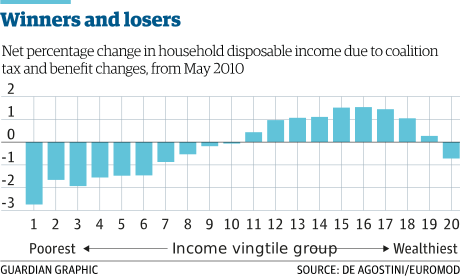
The ideologically motivated transfer of funds from the poorest half of the country to the more affluent has not contributed to deficit reduction. It doesn’t take a genius to work out that the cumulative impact of Tory tax and welfare changes, from out-of-work and in-work benefits to council tax support, to the cut in the top rate of income tax and an increase in tax-free personal allowances, has been extremely regressive and detrimental to the poorest.

The revenue gains from the tax changes and benefit cuts were offset by the cost of tax reductions, particularly the increase in the income tax personal allowance, benefitting the wealthiest.

The Treasury response to this is to single out the poorest yet again for more cuts to “balance the books” – which basically translates as the Conservative “small state” fetish, and deep dislike of the gains we made from the post-war settlement. Yet for a government that claims a non-interventionist stance, it sure does make a lot of interventions. Always on behalf of the privileged class, with policies benefitting only the wealthy minority.

How can Conservatives believe that poor people are motivated to work harder by taking money from them, yet also apparently believe that wealthy people are motivated by giving them more money? This is not “behavioural science,” it’s policy-making founded entirely on traditional Tory prejudices.

The government claim that “Every individual policy change is carefully considered, including looking at the effect on disabled people in line with legal obligations,” but without carrying out a cumulative impact assessment, the effects and impacts of policies can’t possibly be accurately measured.

May I suggest that the government listens to disabled people, instead of dismissing our evidenced, valid accounts of the negative impacts of policy as “anecdotal” and attempting to invalidate our experiences. Policies ought to be about meeting identified public needs, that’s what we elect governments to do in democracies. Democracy means that the voices of citizens, especially members of protected social groups, need to be included in political decision-making, rather than so frankly excluded and rather than having their experiences negated by a bullying, aggressive political denial strategy. Public policy is not an ideological tool for a so-called democratic government to simply get its own way.

The government have persistently simply denied any accounts of the adverse consequences of their policies on disabled people, and have refused to effectively monitor policy impacts, indicating plainly that it values perverse ideology much more than it values the lives of real people.

Furthermore, the claim that “it is not possible to carry out a cumulative assessment of the impact of policies on disabled people” doesn’t stand up to scrutiny in the face of the various assessments carried out by a variety of under-resourced organisations, academics and campaign groups.

I suggest that the government pays attention to the findings of these important pieces of research, and learns from them, especially concerning how to research effectively, how to formulate evidence-based policies and how to budget for impact assessments, because if severely underfunded organisations and charities can manage that, so can the government. It’s a matter of priorities.

If the government had paid attention to laws, including international ones, as claimed, instead of trying to edit out the parts that are inconvenient to them, then there would be no need for the United Nation’s inquiries into human rights violations of disabled people, and the negative social, economic and cultural impacts of their welfare “reforms” on vulnerable social groups

Someone please put Iain Duncan Smith out of our misery

The persistent denial from the Secretary of State for Work and Pensions that there is a correlation between the government’s welfare cuts and an increase in mortality, including suicide, flies in the face of evidence presented by the Work and Pensions Committee earlier this year, when the cross-party Committee of MPs said that since 2012 there have been at least 40 cases of people taking their own lives because of problems with welfare payments

The MPs called for an independent review into benefit sanctions, and said that they were “causing severe financial hardship” and are behind the rise in food banks. It was reported that the Department for Work and Pensions has investigated 49 cases where a claimant has died.

Of these, 40 involved a suicide, the Work and Pensions Select Committee said. But the DWP was unwilling to say how many of the deaths were a result of benefit sanctions or say if it had changed its policies as a result.

The statement: “Analysis needs to take account of behaviour change of reforms rather than the more limited approach of focusing solely on benefit changes”  is another indication of this government’s perverse ideological commitment as opposed to any commitment to upholding political obligation towards meeting the needs and promoting the wellbeing of citizens.

We elect governments to meet public needs, not to “change behaviours” of citizens to suit government needs.

The government’s undeclared preoccupation with behavioural change through personal responsibility, not to be found in their manifesto, is just another revamped version of Samuel Smiles’s bible of Victorian and over-moralising hobby-horse: “thrift and self-help” – but only for the poor, of course. Smiles and other powerful, wealthy and privileged Conservative thinkers, such as Herbert Spencer, claimed that poverty was caused largely by the irresponsible habits of the poor during that era. But we learned historically that socio-economic circumstances caused by political-decision making creates poverty.

This government endorses the proliferation of insecure, low paid work, welfare that punishes people to the point of desperation, with no regard for their life or wellbeing, in order to “incentivise” them to take  any job, (no matter how poorly paid and unsuitable it is) and removing income from the poorest more generally, whilst handing out our money to the wealthy. That’s not citizens behaving “fecklessly” or irresponsibly: that’s the government.

If punishing people actually worked to “help” (yet another Tory euphemism) people into work, the Department of Work and Pensions would have had no need to write fake testimonials from fake characters to attempt a nasty and ludicrous justification of benefit sanctions.

The “making work pay,” approach, which is Toryspeak for retrogressive policy-making, based on the 1834 Poor Law principle of less eligibility again.  The reality is that sick and disabled people are being coerced by the state into taking any very poorly paid work, regardless of whether or not they can work, and to translate the Tory rhetoric further, Duncan Smith is telling us that the government will continue to ensure the conditions of claiming social security are so dismal and brutal that few people can survive it.

When we inform this government that people are dying, and that this is correlated with Tory policies, they simply deny it without any evidence to substantiate their claims. The lack of concern and instant dismissal of concerns about this correlation is not the kind of behaviour one would expect from government in a first-world liberal democracy.

Making work pay for whom?

Recent research indicates that not all work serves to “keep people healthy as well as promote recovery.” The assumption that work can promote recovery in the case of people with disability is both unfounded and absurd. We have yet to hear of a single case involving a job miracle entailing people’s limbs growing back, vision being restored, or a wonder cure for heart failure, cerebral palsy, multiple sclerosis and lupus, for example.

The government’s Fit for Work scheme is founded on exactly the same misinformative nonsense. It supports profit-making for wealthy employers, at the expense of the health and wellbeing of employees that have been signed off work because of medically and professionally recognised illness that acts as a barrier to work capabilities.

Furthermore, there is no proof that work in itself is beneficial. Indeed much research evidence strongly suggests otherwise.

And where have we heard these ideas before: “Arbeit macht frei“?

The Behavioural Insights Team (Nudge Unit) is an arm of government that influences and shapes experimental policies which act UPON as opposed to FOR the population, without their consent, to CHANGE PEOPLE’S BEHAVIOUR. That’s a branch of the government controlling or attempting to control people’s everyday actions without them knowing about it. Or consenting to it.

It’s a dangerous road to travel down – the political notion that citizens should be totally subject to an absolute state authority is the basis of totalitarianism.

The government frequently bandy around phrases and terms like “behavioural change” and “incentivising” but this is the new policy marketingspeak – as irritating and cringeworthy as meaningless corporatespeak, including soundbites – empty generalities – like “blue sky thinking,” and “upskilling.” The Nudge Unit’s behaviour theories (not “science”) are nothing more than psycho-linguisticbabble that is constructed as a prop for Tory small state ideology, and to support their aim of steadily dismantling the gains of our post war settlement. Cut by cut.

It’s unacceptable in a so-called liberal democracy that a government endorses  “incentivising” people (a psychocratic euphemism for state coercion) to take any insecure, poorly paid work that doesn’t alleviate poverty, by the use of sanctions, which entail the removal of people’s lifeline benefits originally designed to meet basic survival needs – food, fuel and shelter – making people desperate and placing them in situations of crisis and absolute poverty. How on earth is that “fair” and how does it “make work pay”? It’s morally repugnant, ethically reprehensible, academically nonsensical and democratically untenable.

It’s not possible to “incentivise” people by starving them.

Cruelty is the new “help”

The claim that “Government is committed to supporting the most vulnerable” also doesn’t stand up to scrutiny, given the Conservative policy record, including cruelly scrapping the Independent Living Fund, which as had a hugely negative impact on those trying their best to lead independent and dignified lives, and the Access To Work funding has been severely cut, this is a fund that helps people and employers to cover the extra living costs arising due to disabilities that might present barriers to work. 

Finally, I feel obliged to point out that the welfare “reforms” have cost far more to implement than they have saved the “tax paying” public, indicating once again that the welfare “reforms” and other austerity measures are not because of economic necessity: they are entirely ideologically motivated.

I strongly suggest that We reduce the Welfare Budget by billions: by simply getting rid of Iain Duncan Smith.

 —

Related

The government just delivered a massive ‘F*ck you’ to sick and disabled people across Britain – Kerry-Anne Mendoza

More about the WoW campaign:

WoW petition’s success is an incredible result for Britain’s sick and disabled as they campaign against Tory War on Welfare

Who is WoW?

Wow petition and campaign site

Update: Today – 3rd November – The WOW campaign have published their own response to the government: WOWpetition Press Release 3Nov2015.pdf

37079_433060243430176_1848475368_nCourtesy of Robert Livingstone

This article was written as a guest post on Political Sift


Welfare must not be seen as the Treasury’s disposable income

In the 2010 Coalition emergency budget, David Cameron claimed that austerity measures were to be introduced only to reduce the deficit.

Doesn’t anyone else remember that since then, David Cameron stood up at a Lord Mayor’s banquet in London, in front of the financial elite, in November 2013 and ostensibly admitted – and from an ostentatious golden throne, no less – that austerity was not an emergency response to difficult economic events after all, but a permanent disassembling of the state, signalling that he had no intention of resuming public spending once the structural deficit has been eliminated.

Many of us had already recognised that the cuts were ideologically driven. But not enough of us to make a difference in May and to vote and prevent an unforgivable betrayal of future generations. It’s also a grievous betrayal of the previous generations who fought to establish universal suffrage and fought to secure the post-war settlement. Our Social Security, Legal Aid and National Health Service. These are civilising and civilised prerequisites for a fair, human rights-based first world democracy.

proper Blond
There was another fall in income tax receipts that sent Britain’s deficit
spiralling to £12.1bn in August, the widest shortfall in government funding since 2012. So where is our money going exactly?

For a government whose raison d’etre is deficit reduction, the Conservatives aren’t very good at all. And the rigid emphasis on a series of self-imposed fiscal moving goalposts is distracting the government from the social, moral and democratic obligations it is also expected to uphold.

The Office for National Statistics said low wages and a dip in corporation tax receipts were to blame for the worsening situation, which will put pressure on George Osborne ahead of “tough” expenditure decisions due in November when Whitehall agrees its five-year spending targets.

But if you look at Conservative policies, which are designed to redistribute and privatise public wealth, it’s easy to see why this has happened.

The Conservatives regard the income of the poorest as somehow dispensable – the compensatory and disposable income of the Conservative state. Yet the very mention of raising taxes for the rich is met with shrieks of outrage and threats to leave the country. This is always justified in advance by a fresh mainstream narration of the puritan work ethic and the myth of meritocracy.

What’s yours is mine, what’s mine is my own.

What did the imperturbable chancellor promise before the election? True to Tory form, more of the same: austerity for the poor, more public services cuts, and tax breaks for the wealthiest. No mention of tax credit cuts, though, even when Conservatives were asked directly about those. Several times.

But further cuts to lifeline benefits and public services are surely untenable. Absolute poverty has risen dramatically this past four years, heralding the return of Victorian illnesses that are associated with malnutrition. People have died as a consequence of the welfare “reforms”. Supporting the wealthy has already cost the poorest so very much, yet this callous, indifferent, morally nihilistic government are casually discussing taking even more from those with the very least.

Our welfare state arose as a social security safety net – founded on an assurance that as a civilised and democratic society we value the wellbeing and health of every citizen.

There was a cross-party political consensus that such provision was in the best interests of the nation as a whole at a time when we were collectively spirited enough to ensure that no one should be homeless or starving in modern Britain.

As such, welfare is a fundamental part of the UK’s development –  our progress – the basic idea of improving people’s lives was at the heart of the welfare state and more broadly, it reflects the evolution of European democratic and rights-based societies.

A welfare state is founded on the idea that government plays a key role in ensuring the protection and promotion of the economic and social wellbeing of its citizens. It is based on the principles of equality of opportunity, equitable distribution of wealth, and both political and social responsibility for those unable to avail themselves of the minimal provisions for wellbeing.

It was recognised that people experienced periods of economic difficulty because of structural constraints such as unemployment and recession, through no fault of their own. It was also recognised that poor health and disability may happen to anyone through no fault of their own.

The welfare state arose in the UK during the post-war period, and following the Great Depression, for numerous reasons, most of these were informed by research carried out into the causes of poverty, its effects on individuals and more broadly, on the UK economy. There were also political reasons for the Conservatives and Liberals supporting the poorer citizens – the newly enfranchised working class.

Charles Booth in London and Sebohm Rowntree in York carried out the first serious studies of poverty and its causes. They both discovered that the causes were structural – casual labour, low pay, unemployment, illness and old age – not laziness, fecklessness, drunkenness and gambling, as previously assumed. The poverty studies raised awareness of the extent of poverty in Britain and the myriad social problems that caused it, and that it caused.

The Boer war of 1899-1902 highlighted the general poor state of health of the nation. One out of every three volunteers failed the army medical due to malnutrition, other illnesses due to poor diet and very poor living conditions. The military informed the government at the time of the shockingly poor physical condition of many of those conscripted.

We learned that the effects of poverty were potentially damaging to  the whole of society. Health problems and infectious disease – rife in the overcrowded slums – could affect rich and poor alike. It was recognised that the economy suffered if large numbers of people were too poor to buy goods and social problems such as exploitation, debt, crime, prostitution and drunkenness were a direct result of poverty, and not the cause of it.

Related image
The discovery of  widespread poor health as a consequence of poverty raised concerns about Britain’s future ability to compete with new industrial nations such as Germany and the USA. National efficiency would only increase if the health and welfare of the population improved. It was recognised that welfare is about extending opportunities, not “dependency”.

At the same time, the growth of the Labour Party and Trade Unionism presented a threat to the Liberals and the Conservatives. The new working class voters were turning to these organizations to improve their lives. The traditionally laissez-faire Liberals recognised this and supported the idea of government support for the working class.

Yet since 2010, there’s been an unprecedented, historic assault on the very ideal of social security, and it’s sustained and systematic: it didn’t stop with the 2012 welfare cuts.

As I’ve said elsewhere, welfare has been redefined by the Conservatives: it is pre-occupied with assumptions about and modification and monitoring of the behaviour and character of recipients, rather than with the alleviation of poverty and ensuring economic and social well-being.

Policies aimed at restricting support available for families where parents are either unemployed or in low paid work are effectively class contingent policies.

The vast total of around £25bn in benefit cuts already set in motion by the chancellor brings in less than he has freely handed out in personal tax allowances, generous tax breaks, petrol duties and corporation tax cuts. To govern is to make choices. It’s worth noting that the Conservative’s “difficult choices” are resolved by targeting the same social groups, over and over.

Cuts to welfare have been offset by the cost of tax cuts higher up income scale, with no overall contribution to paying down deficit, according to an unsurprising comprehensive study of social policies.

Professor John Hills, director of the London School of Economics (LSE) Centre for Analysis of Social Exclusion, said: “Protection of some of the core parts of the welfare state from the greatest cuts, and initial protection of the value of benefits, meant that those at the bottom, and important services, were initially shielded from the worst effects of the recession.

“But in the second part of the coalition’s period, selective cuts to benefits and to unprotected services have begun to take their toll, leaving the next government … with much greater social policy challenges than the coalition inherited.”

If David Cameron had been honest and declared that his government intended to dismantle our social infrastructure; the welfare state (and yes, that means in-work benefits too), the NHS, legal aid, and to refuse to honour any meaningful legal commitment to human rights, whilst handing out the money generated from this unravelling of our civilising institutions and services, in the form of handsome rewards to feckless millionaires, would he be in office now?

The Tory mantra “Making work pay” is a doublespeak soundbite version of the 1834 Poor Law principle of less eligibility, which is founded on the atrocious idea that poverty is caused by people simply refusing to work, and it can be “cured” if it is made as unbearable as possible. People will work if they are shamed and psychologically coerced. The whole idea of less eligibility is that “workless” people have to be kept in penury to “teach” them value of the work ethic and to discourage others from becoming an “idle pauper.”

But many poor people are in work.

The tax credit cuts proposed by the Conservatives exposed the “shirker” myth for what it is: a lazy, barely coherent narrative – a cover story for an ideologically driven and increasingly irrational government that is happy to reintroduce Dickensian levels of absolute poverty so that a few rich people can increase their wealth. Punishing poor people and creating a desperate class that are prepared to work for next to nothing rather than starve on a grossly inadequate and punitive social security system serves to drive wages down further, reduces working conditions and removes constraint from private sector profit-making.

It serves to dampen down collective bargaining. It changes the relationship between employers and employees, as well as between the state and citizens, turning increasingly desperate, impoverished people into a reserve army of cheap labour.

The welfare “reforms” were never about “making work pay.”

Unless, of course, you ask “for whom, precisely?” 

1379986_541109785958554_2049940708_nCourtesy of Robert Livingstone

Related

The Tories’ war on welfare has caused untold suffering. Here are three ways we can stop it

The New New Poor Law

Conservatism in a nutshell

Osborne’s tax credit omnishambles reveals the profound elitism of the Tories

Chancellor George OsborneI don’t know a single person on low pay that is happy about the Conservative proposals to cut their tax credits and subsequently, their living standards, further. This policy was deliberately left out of the Tory manifesto, and when asked directly if his government was going to cut tax credits, Cameron chose to lie and said no. Now the Conservatives are claiming that this policy, never declared before the election, is suddenly somehow a “central plank” of the budget. The claim that Conservatives had declared cuts to welfare doesn’t stand up to scrutiny, either, because they claim to be a party that is all about “making work pay”. 

The Conservatives are claiming that the cuts were “democratically voted” through in the House of Commons, yet their majority in the lower House may not have happened at all, had they been honest prior to the election and declared their intention to cut people’s tax credits. 

Furthermore, the cuts were presented in the form of secondary legislation – as a Statutory Instrument – which notoriously receive little scrutiny and very limited debate time in the Commons. Statutory instruments are intended to be used for simple, non-controversial measures, in contrast to more complex items of primary legislation (known as Bills.) The Government always ensure they have a majority on any Statutory Instrument committee and the MPs are chosen by Whips. This enables government to push through their legislative programme with very little scrutiny, exacerbating a lack of democratic transparency and accountability of the Executive.

The threats issued to the Upper House from the government arose because the Conservatives are facing probable defeat on what is an extremely unpopular reform, even amongst their own party ranks, and are truly remarkable, showing a contempt for democratic process and a lack of willingness to engage in genuine, transparent democratic dialogue.

Earlier this year, the Institute for Fiscal Studies (IFS) asked George Osborne to specify how he will reach targets announced in the budget, given that the poorest had been the hardest hit by draconian benefit cuts already. The IFS said that the worst of the UK’s spending cuts are still to come.

I said at the time that it’s not that Osborne can’t answer the IFS challenge: he won’t.

David Gauke, the Treasury secretary at the time was pressed repeatedly on the BBC’s Daily Politics to explain if the Tories would detail their planned welfare cuts beyond the £3billion previously specified.

He replied: “We will set it out nearer the time which will be after the election.”

Pre-general election television comments have exposed Prime Minister David Cameron’s lies about his party’s proposal to reduce child tax credits. During a special episode of BBC’s Question Time, aired in April, presenter David Dimbleby asks: “There are some people that are worried about you cutting child tax credits, are you saying absolutely as a guarantee that you’d never have it?”

To which the Prime Minister responds: “First of all child tax credit we increased by 450 pounds…” Dimbleby interjects: “And it’s not going to fall?” to which the PM clearly replies: “It’s not going to fall.”

As Simon Szreter, Professor of history and public policy at the University of Cambridge, points out about the party claiming “A Britain that rewards work” as its slogan:

It is a measure of just how much George Osborne’s post-election attack on tax credits represents an assault of genuinely historic proportions on Britain’s poor that his PM has made reference to the 1911 Parliament Act in his railing against popular protest and his fear of blocking measures in the House of Lords. Let us remember why the act was brought in by the Liberal government of Asquith and Lloyd George.

The landed wealth elite, including men such as George Osborne’s direct ancestors, the Anglo-Irish baronets of Ballentaylor, dominated the House of Lords. They rejected the elected government’s policy – democratically tested at the bar of two general elections in 1910 – to impose new progressive forms of taxation on the super-wealthy to help fund such basic social security measures for the working poor as pensions and the first National Insurance Act.

He goes on to say:

Mr Cameron is darkly mentioning the Parliament Act of 1911 to cow the House of Lords into compliance because the upper chamber is no longer exclusively the club of the wealth elite as it was in 1911. The alternative, as Mr Cameron’s timely recollection of the 1911 Parliament Act reminds us all, is for parliament to ensure that the financial elite pay their way more fully in our society, a case that is all the more compelling considering their undisputed role in punching a hole in the nation’s finances in 2008.

The problem today is not control over the House of Lords. Today’s financial elite have found that it is much more efficient to exert their control over the House of Commons itself. This they do though a Tory party that is almost entirely funded by them and whose administration is safely in the hands of a chancellor who fully appreciates the importance of looking after the interests of the nation’s wealth elites. After all, he is the future 18th baronet of Ballentaylor.

Even Conservative MPs, such as Heidi Allen, have pointed out the hypocrisy of the proposed tax credit cuts. But as I’ve pointed out previously, the slogan “making work pay” has a lot in common with the 1834 Poor Law principle of less eligibility, rather than it being a genuine statement of intent from the Tories. Unless of course, you ask “Making work pay for whom?”

Further cuts to provisions, services and welfare – support for the poorest – is unthinkable and untenable, especially when there are other choices that the government could have made.

For example, the prime minister made it clear that lavish tax cuts for the better off will be the £7bn prize for returning him to Downing Street. This came after a £48bn in public service cuts, the like of which the country has never known.

“The people whose hard work and personal sacrifices have got us through these difficult times should come first,” Cameron said.

So who exactly worked hardest and took the heaviest burdens – and what exactly will be their reward? Certainly not those who made most sacrifices – the same low earners whose working tax credits and benefits George Osborne will happily cut again by another £12bn.

ed wealthRelated

Tax Credits Cuts ‘Will Widen The Gap In Inequalities’

Cuts To Tax Credits Could Breach Children’s Rights, Warns Commissioner

Follow the Money: Tory Ideology is all about handouts to the wealthy that are funded by the poor

There is no such thing as a ‘one nation’ Tory: they always create two nations

Conservatism in a nutshell

The word “Tories” is an abbreviation of “tall stories”

Jeremy Corbyn is being stalked by a pantomime horse

3359686

In a recent stage production called “Closing The Barn Door after the Chicken Coup,” a well-known actor who plays the rear end of a horse has complained how much he dislikes Labour party leaders, just on principle. He’s a Labour MP; he says that it’s good to have a hobby in his spare time.

“I hate them all. But more than any of them, I really feel that Corbyn is just too beardy, and I simply can’t get behind him,” says the sullen actor.

“I say neigh, neigh and thrice neigh. How very dare he. He’s only gone and appealed to the tens of thousands of new party recruits, enthusing them by his pesky kid anti-austerity messages. I’m worried that the electorate will spot what a sham Tory austerity is soon, because of such strong opposition from the extremists amongst them who are sick of being made poorer. That simply must not happen.

We can’t have a Labour party that is just about social things for any Tom, Dick or Harry. We need to look after big business. I know all about trickle down economics, being the back end of a mule. In the 1800s it was called the “horse and sparrow” theory. You feed the big horse all the oats and the many little sparrows get to feed in its wake. That’s what it’s all about. I say give all the money to the big private horses.”

I think he means that the public are being fed horse shit.

The actor claims to be a long-standing supporter and member of the Labour party, as well as a part-time MP. However, earlier this year he complained bitterly to the Daily Mail that the then party leader, Ed Miliband, is “a f****** knob.”  As Labour’s new self-appointed publicist, the actor has become famous for his nonsensical outbursts, controversial business interests and excessively large luvvie ego, which is the impressive size of a cathedral.

He told the Mail on Sunday: “I would be prepared to stand as a stalking horse against Jeremy Corbyn.”

“My only intention is to secure a better leader for the Labour party as they’re all rubbish, none of them are ever good enough, in my very important opinion. They need to be nagged. The person to do it is me me me!”

Although the actor says “We know that Labour only wins when it is united and when it is patriotic and speaks for the whole country,” he has nonetheless decided that unbridled disunity and carping about the party is the best way forward. From the back.

He says: “The only way forward for the Labour party is for them to stop opposing the Conservatives completely, especially on welfare cuts and austerity. This crazy left wing politics is nonsense and needs to stop.  And it would do us no harm to behave like blue-collar UKIP supporters. I say we should bring back hanging as well, that would get us elected as most of the public like reality TV entertainment and punishing the poor. We should do what the public want.”

When asked about his leading role as the rear end of a horse, he replied: “Farce doesn’t begin to describe my position any more, it’s the political equivalent of all the slapstick staples and stables rolled into one. But I make hay while the sun shines from my back end.”

He wouldn’t disclose the identity of the front end of the horse, despite the truth being right under his nose. But he has never been one to bury his head in the … sand, and said his real ambition was to progress and play the rear end of a rocking horse.

The actor complained that during the pantomime, the horses head kept pitching abruptly further and further to the right, whilst he couldn’t see where he was going. It made him feel very un-stable. But he added “It’s much better than turning left I suppose.”

He went on to say: “It’s a night mare. Sometimes it’s better to laugh than cry. Because the inescapable truth from here is painfully hard to countenance.”

It must be difficult to keep a tight reign from his position, which lends a form to his pressing sense of inadequacy. Yet despite his own unfortunate position, with his nose pressed firmly to the grind, the actor, left in the dark and certainly left behind, went on to say that “Corbyn should let his trousers fall down and John McDonnell plant a custard pie in his face.”

“The world’s my stage and I’m a horse’s ass”, he added.

A recent Gallop poll showed that many agree. He is.

images

Government turns its back on international laws, scrutiny and standards: it’s time to be very worried

564882_438358886199493_1982719183_n

Concerns have been raised by lawyers and legal experts that Conservative ministers have quietly abandoned the longstanding principle that members of the government should be bound by international law.

The rewritten ministerial code, which was updated on October 15  without any announcement, sets out the standard of conduct expected of ministers. It has been quietly edited. The latest version of the code is missing a key element regarding the UK’s complicity with international law. 

The previous code, issued in 2010, said there was an “overarching duty on ministers to comply with the law including international law and treaty obligations and to uphold the administration of justice and to protect the integrity of public life”.

The new version of the code has been edited to say only that there is an “overarching duty on ministers to comply with the law and to protect the integrity of public life”.

Legal experts say key issues affected by the change could include decisions about “whether to go to war or use military force, such as the use of drones in Syria, any decision made by an international court about the UK and any laws not incorporated into English law, such as human rights legislation and the Geneva conventions.

Ministerial code changes between 2010 and 2015.
Photograph: Government handout – courtesy of the Guardian

This comes as the UK government is facing another United Nations inquiry regarding widespread allegations that the Conservative welfare reforms breach the Human Rights of disabled people. It also comes following the government announcement this week that there are plans to scrap the Human Rights Act by next summer, to replace it with a controversial “British Bill of Rights.”

Raquel Rolnik, the UN’s special rapporteur for housing, found the bedroom tax to contravene human rights and in 2013, she called for the Tory “spare room subsidy” to be suspended immediately. In a wide-ranging report she also calls for the extension of grants to provide more social housing, the release of public land, build-or-lose measures to target landbanks and increased private rented sector regulation. None of these are recommendations which the Conservatives have been remotely willing to entertain, instead they have directed hostility towards the United Nations.

The Conservatives have already taken away access to legal aid from the poorest and most vulnerable citizens, in a move branded contrary to the very principle of equality under the law. Last year, Grayling, then the Justice Secretary, was accused of turning legal aid into an instrument of discrimination by a court, because of his attempt to introduce a residency test to legal aid access, a move which exceeded his statutory powers when he devised it.

He has also tried to dismantle a vital legal protection available to the citizen – judicial review – which has been used to stop him abusing his powers again and again. Judicial review is the mechanism by which citizens can hold the government to its own laws. With the Criminal Justice and Courts Bill, the justice secretary tried to put it out of reach.

Grayling, suffered a defeat in the House of Lords vote on his plans to curtail access to judicial review, which would have made it much harder to challenge government decisions in court.

Peers voted by 247 to 181, a majority of 66, to ensure that the judges keep their discretion over whether they can hear judicial review applications after a warning from a former lord chief justice, Lord Woolf, that the alternative amounted to an “elective dictatorship”.

He has tried to restrict legal aid for domestic abuse victims, welfare claimants seeking redress for wrongful state decisions, victims of medical negligence, for example.

It’s very worrying that this is a government that wants to leave Europe behind and sever the connection with the European Convention on Human Rights.  It’s a government that wants to do as it pleases, free from international scrutiny and what it clearly sees as the constraints of international law and the judgments of international courts.

The Conservatives have demonstrated an eagerness to take away citizens’ rights to take their case to the European court, with many of their actions clearly based on an intent on tearing up British legal protections for citizens and massively bolstering the powers of the state.

The Guardian reports that a legal challenge against the change will be lodged on Friday by Rights Watch, an organisation which works to hold the government to account. Yasmine Ahmed, its director, said:

“This amendment to the ministerial code is deeply concerning. It shows a marked shift in the attitude and commitment of the UK government towards its international legal obligations.”

In his preamble to the new ministerial code, David Cameron says: “People want their politicians to uphold the highest standards of propriety. That means being transparent in all we do.”

However, I reported last year that in terms of international standards of conduct, the Conservatives are not doing well. Transparency International flagged up many areas of concern in their report: A mid-term assessment of the UK Coalition Government’s record on tackling corruption

The Cabinet Office has of course denied there was any intention to weaken international law and the administration of justice by omitting the phrases from the new code.

A spokesman said:

“The code is very clear on the duty that it places on ministers to comply with the law. ‘Comply with the law’ includes international law.

The wording was amended to bring the code more in line with the civil service code. The obligations remain unchanged by the simplified wording. The ministerial code is the prime minister’s guidance to his ministers on how they should conduct themselves in public office.”

However, a Conservative party policy document promises that the ministerial code will be rewritten in the context of the UK withdrawing from the European convention on human rights. In order to help achieve these aims the document says:

“We will amend the ministerial code to remove any ambiguity in the current rules about the duty of ministers to follow the will of Parliament in the UK.”

Lord Falconer, Labour’s shadow lord chancellor, said:

“If this is what ministers are planning to do it is shocking. We are a country that prides itself on operating in accordance with the rule of law. That has always meant both domestic and international law.

This is a message we have sent out both internally and externally. If we are now regarding compliance with international law for ministers as optional that is staggering. If ministers breach international law it will no longer be misconduct.”

The Guardian cites Ken Macdonald QC, the former director of public prosecutions, who said:

“It is difficult to believe that this change is inadvertent. If it’s deliberate, it appears to advocate a conscious loosening of ministerial respect for the rule of law and the UK’s international treaty obligations, including weakening responsibility for the quality of justice here at home.

In a dangerous world, the government should be strengthening its support for the rule of law, not airbrushing it out of the ministerial code. On every level, this sends out a terrible signal.”

Ironically, on the same day that the new code was quietly released, the attorney general, Jeremy Wright, gave a keynote address about the importance of international law to an audience of government lawyers at the Government Legal Service International Law Conference.

Wright said:

“The constitutional principle to respect the rule of law and comply with our international obligations is reflected in the ministerial code – which applies to me as much as to any other minister. The code states that there is an overarching duty on ministers to comply with the law, including international law and treaty obligations and to uphold the administration of justice and to protect the integrity of public life.”

It is not clear whether or not the attorney general was informed about the changes to the ministerial code at the time of his speech. Both the Cabinet Office and the attorney general’s office have declined to answer this question.

Tory ministers are a major source of national embarrassment when they denounce the European Court of Human Rights whilst instructing the rest of the world, including other European states, to respect our collective international human rights obligations and “the rule of law.” Human Rights legislation exists throughout the free world. Free speech, the right to a fair trial, respect for private life and the prohibition on torture are values which distinguish democratic societies from despotic states.

There is no justification for editing obligations to upholding international laws, human rights or for repealing the Human Rights Act: that would make Britain the first European country to regress in the level and degree of our human rights protection. It is through times of recession and times of affluence alike that our rights ought to be the foundation of our society, upon which the Magna Carta, the Equality Act and the Human Rights Act were built – protecting the vulnerable from the powerful and ensuring those who govern are accountable to the rule of law.

Update: Former head of government’s legal service says obligation that ministers must comply with international law – dropped from revised ministerial code – had irritated PM: No 10 ‘showing contempt for international law’


I don’t make any money from my work and I am not funded. I am disabled because of illness and struggle to get by. But you can help me continue to research and write informative, insightful and independent articles, and to provide support to others, by making a donation. The smallest amount is much appreciated – thank you.

DonatenowButton