Category: Conservatives

Is hypocritical PM a ‘terrorist sympathiser’? He called for Osama Bin Laden to face trial in 2001.

Boris

Boris  Johnson, a grubby liar and hypocrite.

Yesterday, I was the person who spent just two minutes researching Boris Johnson’s position and previous comments in the media on Osama Bin Laden. While researching, I found the Telegraph article that the Johnson wrote in 2001. The Conservatives have condemned Jeremy Corbyn’s statement that Bin Laden should have faced a trial. 

Grubby, nasty quote mining and giant unverifiable inductive leaps over the amoral void, by habitual hypocrits and liars. That sums up Conservative propaganda.

In 2011, a special forces raid on the al-Qaida chief’s Pakistan compound resulted in Bin Laden and four others being shot dead.

George Osborne, among other Conservatives, claimed a Labour Party led by Corbyn would “pose a threat to national security” because, he claimed, Corbyn “sympathises with terrorists”.

This claim has been made by the Tory party many times. 

David Cameron has described Jeremy Corbyn a “security threat” and “terrorist sympathiser”. In the Corbyn interview from which Cameron quoted without context, the Labour leader had already described the New York bombings as a “tragedy”, and was explaining that the “tragedy” of Bin Laden’s death was that he was assassinated and did not face trial.

More recently, an unscrupulous and dishonest Boris Johnson accused Jeremy Corbyn of seeking to “legitimate the actions of terrorists” in his speech after the 2017 Manchester bombing, 

However, in 2001, Boris Johnson said that he also supported Bin Laden facing a trial. Curiously, no-one has yet called him a terrorist sympathiser or a threat to national security. The media have slavishy amplified the Conservatives’ propaganda without any fact checking whatsoever.

I did some fact checking because I was sick of seeing the Conservatives’ deceitful and ruthless quote mining of Jeremy Corbyn’s comments, which are taken out of context then used to prop up outrageous political claims such as “Corbyn hates the UK”. The Tories are so full of this kind of unscrupulous, flimsy propaganda shit. They’ve got away with it for far too long. This is not the standard of political discourse and debate we should expect to see in a healthy democracy. The Tories have raced to the bottom of the pit marked “amoral”, dragging a mostly unresistant media with them.

I posted Boris Johnson’s Op-Ed article in the Daily Telegraph on December 13, 2001 – just three months after the 9/11 terrorist attacks – on Twitter, to expose his sheer hypocrisy and dishonesty. It went viral.

Job done. Exposing lies and hypocrisy used to be the job of our paid journalists, but that is no longer the case here in the UK, with few notable exceptions.

RT  have run an article on this issue. I don’t expect that the UK media will.

Another under-reported matter is that Boris Johnson called for the “break up” of the NHS back in 2002. The Prime Minister made the speech in 2002 while a backbench Tory MP, criticising Labour’s refusal to consider breaking up the NHS. It comes as Donald Trump flies into the UK amid concerns of a US trade deal which would damage the health service. Johnson has previously said that the government should examine “the experience of other countries that have a far better record of health care provision … because they do not rely exclusively on a top-down monopolistic health service of the kind we have in this country.”

That’s Tory-speak for privatisation. The so-called libertarian right wing see the NHS as the last bastion of a collectivist tradition that they want to eradicate completely from British society. 
NHS

They loathe it because they see it as a form of decadence, and as antithetical to the fundamentalist principles of ‘competition; and the vulture capitalist’s right to make money out of anything – an idea that has driven more than four decades of neoliberal elitist ‘reform.’

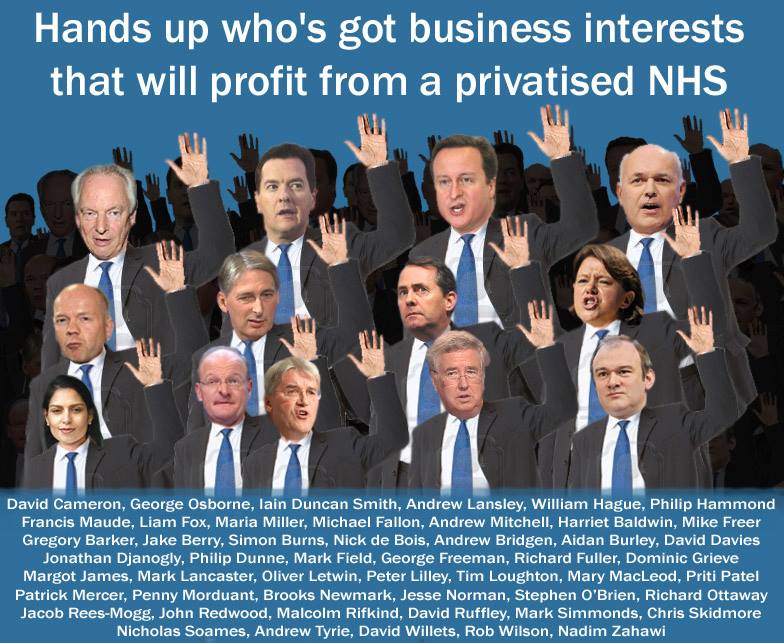
Some of the Tories have direct connections to companies that want to make money out of NHS privatisation (see above). I wonder if that has some bearing on their view.  

Boris Johnson probably didn’t want you to see this. Or perhaps he simply has a very poor long term memory.

Boris Johnson was blocked from accessing state secrets as foreign secretary because Downing Street felt he was a security risk

The Conservatives have repeatedly claimed that HM’s opposition leader is a “risk to national security”, but don’t produce any evidence of this.

However, the party had to restrict Boris Johnson’s access to intelligence because he was such a liability:

  • Theresa May tried to restrict Boris Johnson’s access to secret intelligence when he was foreign secretary.
  • The then prime minister wanted Johnson not to be shown some secret intelligence when he was appointed in July 2016, BBC News reported.
  • Sources said Downing Street’s decision was based on a variety of factors, including a lack of trust in Johnson, and personal enmity between him and May
  • The report followed claims in 2017 that British spy chiefs were “wary” of sharing information with Johnson because they didn’t trust him.

Theresa May repeatedly withheld sensitive intelligence from Boris Johnson when he was foreign secretary, because they believed he would leak the information.

May wanted the then foreign secretary to not to be shown certain sensitive secret intelligence when he was appointed in July 2016, BBC News reported, citing multiple security sources.

Downing Street’s move is said to have worried security chiefs at the time because of the foreign secretary’s role in authorising sensitive operations.

Johnson was aware of Downing Street’s decision at the time and was “very unhappy about it,” it was reported. Sources close to Johnson insisted there was no row about information access and claimed he saw everything he needed to for his role.

Johnson first visited the headquarters of MI6, the government’s foreign intelligence service, as foreign secretary three months after his appointment when he was shown around by its chief Alex Younger.

Johnson praised the work of the security services and said: “Even from my relatively short period as foreign secretary I can testify to how vital the work they do is.”

But at the same time a row was taking place about whether Johnson should have access to all the intelligence produced by the UK’s spies, the BBC reported, despite the fact ministerial responsibility lay with Johnson for MI6 and GCHQ, another branch of the intelligence service.

The New Statesman reported at the time that multiple diplomats had doubts over Johnson’s personal style as foreign secretary.

A month previously, he had said the ISIS stronghold of Sirte, the Libyan city, could be “the next Dubai” once they “clear the dead bodies away.” It may be a sentence that would be appropriate down the pub with a few of the boys, but it isn’t a statement that reflects a prime minister of calibre.

 Boris Johnson is not fit to be prime minister. 

People like me have increasingly taken on the role of public interest journalism and research to fill the void, and most of us are unpaid.

I became too ill to work in 2010. I have lupus, which is progressive, and in my case, has many and complex symptoms. The illness has had a huge impact on my mobility, for example, and my immunity to infection. I rely on the state support that I paid into over my working life, but frequently struggle to get by, like far too many others.

I don’t like asking people for money. I rarely do, though like other independent writers, I have a donate button at the foot of most of my articles. I write first and foremost because I feel I must. We need reliable sources of information in an era of fake news and authoritarian state propaganda. Our mainstream media has badly let the UK public down. It does not hold the government to account, as a rule. This has seriously undermined the UK’s democracy. 

However, if you feel you would like to support my site so I can keep on keeping on, you can always make a donation. The smallest amount is always valued. It helps me pay for my site, for a WordPress plan that doesn’t allow advertising, and my broadband bills. I also have to pay to access research sometimes.

I would also thank those who have made generous donations over the last few years to support my work and help me keep going.

Much love and solidarity X

#VoteLabour2019


My work is unfunded and I don’t make any money from it. But you can support Politics and Insights and contribute by making a donation which will help me continue to research and write informative, insightful and independent articles, and to provide support to others.

DonatenowButton

Research shows ‘unprecedented’ rise in infant mortality linked to poverty in England

slide1

Slide from my presentation on neoliberalism, the still face paradigm and poverty at Beyond the Therapy Room psychology conference, 2019.

According to new research, an unprecedented rise in infant mortality in England is linked to poverty, according to new research. An additional 570 infant deaths, compared to what would have been expected based on historical trends, were recorded in the country from 2014-2017. Around one-third of those deaths, which related to children under the age of one, were linked to rising poverty.

The results of the new study by researchers from the University of Liverpool, University of Leeds and Newcastle University, which analysed data from 2000-2017, have now been released. In their report, published in BMJ Open, the researchers note that infant mortality rates often act as an indicator of the changing overall health of societies, as well as an early warning system for future adverse trends.

Rising infant mortality is unusual in wealthy, high income countries, and international statistics show that infant mortality has continued to decline in most wealthy countries in recent years. 

But in England, social security cuts in the last decade have taken their toll on the poorest communities.

In the study, the researchers grouped 324 local authorities into five categories (quintiles) based on their level of income deprivation, with Quintile 1 being the most affluent and Quintile 5 the most deprived.

Inferential testing – using a statistical model –  was used to quantify the association between regional changes in child poverty  and infant mortality during the same period. 

The researchers found that “a sustained and unprecedented rise” in infant mortality in England from 2014-2017 was not experienced evenly across the population.

In the most deprived local authorities, the previously declining trend in infant mortality had reversed and mortality increased. This led to an additional 24 infant deaths per 100,000 live births per year, relative to the previous trend.

There was no significant change from the pre-existing trend in the most affluent local authorities. As a result, inequalities in infant mortality increased, with the gap between the most and the least deprived local authority areas widening by 52 deaths per 100,000 births.

Overall from 2014-2017, there were a total of 572 “excess infant deaths” compared to what would have been expected based on historical trends, the report says.

The researchers estimate that each 1% increase in child poverty was significantly associated with an extra 5.8 infant deaths per 100,000 live births.

The findings suggest that about one-third of the increases in infant mortality between 2014 and 2017 may be attributed to rising child poverty, equivalent to an extra 172 infant deaths.

Professor David Taylor-Robinson of the University of Liverpool, the lead author on the research, said the study “provides evidence that the unprecedented rise in infant mortality disproportionately affected the poorest areas of the country, leaving the more affluent areas unaffected”.

“Our analysis also linked the recent increase in infant mortality in England with rising child poverty, suggesting that about a third of the increase in infant mortality from 2014-17 may be attributed to rising child poverty. 

“These findings are really concerning given that child poverty is rising. It is time for the government to reverse this trend establishing a welfare system that protects children from poverty.” 

Taylor-Robinson said child poverty has “a myriad of adverse impacts on other aspects of child health that will have repercussions for decades to come”.

“In the context of increasing health inequalities in England, policies that reduce poverty and social inequalities are likely to reduce the occurrence of infant mortality and that of many other adverse child health outcomes,” he added. 

Cuts to social security 

The report notes the impact of “sustained reductions” in social security benefits in England in the last decade. It states: 

“Since 2010, there have been sustained reductions in the welfare benefits available to families with children, including the abolition of child benefit and child tax credit for the third child or more; reductions in the value of tax credits and below-inflation up-rating of most working-age benefits; housing benefit reforms including the under occupancy charge (most commonly referred to as ‘bedroom tax’) and introduction of universal credit; and household caps on total benefit receipt (regardless of how many children are in the household).

“These welfare changes have disproportionately affected the most deprived local authorities and regions and have led to a rise in child poverty.”

Dr Paul Norman of the University of Leeds, who also worked on the research, noted that the findings show “an unprecedented rise in the deaths of children under one year of age”.

He said the researchers’ next step is “to examine the gestational age and the number of weeks at which infants die, to learn more about when key interventions may be needed or when they are being missed”.

“This will inform the urgent action needed by national and local governments, and help drive the health and social care policies needed to reduce infant mortality rates,” Norman said. 

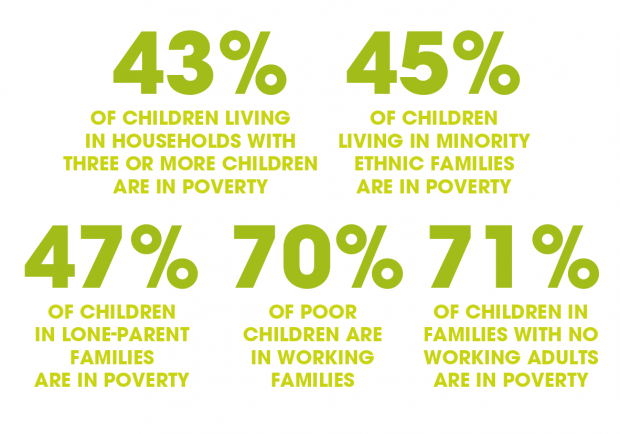
The facts and figures from the Child Poverty Action Group (CPAG) show the reality of child poverty in the UK, and which groups are affected most:CPAG Infographics July 2019 v1-04

Related

Studies find higher premature mortality rates are correlated with Conservative governments

Austerity is “economic murder” says Cambridge researcher

Suicides reach a ten year high and are linked with welfare “reforms

Conservative governments are bad for your health


I don’t make any money from my work. But you can support Politics and Insights and contribute by making a donation which will help me continue to research and write informative, insightful and independent articles, and to provide support to others. The smallest amount is much appreciated, and helps to keep my articles free and accessible to all – thank you. 

DonatenowButton

Matt Hancock mocked and scorned at his own hustings


A leaked video reveals that the West Suffolk Conservative MP and Health Secretary, Matt Hancock was roundly mocked as outraged constituents objected loudly to his appalling comments to divert attention from his party’s lies. Hancock has been MP for West Suffolk since 2010.  

Hancock raises scornful responses from constituents as he tries to reiterate the government’s lie about plans to employ 50,000 more nurses. He was shouted down. 

Clearly rattled, Hancock then falls back on the worn out Tory default position – slander the opposition as a desperate diversion strategy.

No-one fell for it. Instead, the insufferable Hancock drowned out by an outraged audience until the microphone was finally taken away from him.

Probably an act of kindness for all concerned, under the circumstances.

cock


I  don’t make any money from my work. But you can help if you like by making a donation to help me continue to research and write free, informative, insightful and independent articles, and to provide support to others. The smallest amount is much appreciated – thank you.

DonatenowButton

From the Zinoviev letter to Richard Dearlove’s comments about Jeremy Corbyn: MI6 have a long history of interfering with UK politics & democracy

dearove 2

Sir Richard Dearlove, controversial former head of MI6, who was “senior advisor” to the Monitor Group – a consultancy and private equity firm which has been scandalously implicated in undertaking three million pounds worth PR work for the Libyan regime and Muammar Gaddafi

The controversial former MI6 chief, Sir Richard Dearlove, claims that Jeremy Corbyn’s “far-left past” and “relationships with extremists” made him “unfit to enter number 10”. He said exactly the same thing just before the last general election.

Dearlove is a signatory of the right wing neo-Conservative Henry Jackson Society principles. He was also a “senior advisor” to the Monitor Group – a consultancy and private equity firm which has been implicated in undertaking three million pounds worth PR work for Libya and Muammar Gaddafi. In April 2013, it was announced that Dearlove joined the advisory board of Ergo, an intelligence, PR and advisory firm.

The Labour party pointed out that Dearlove lacks credibility because his own past raised questions about his judgement. 

And MI6 has a history of interfering in UK elections.

Dearlove wrote in the Mail on Sunday that the Labour leader would pose a “present danger to our country” if he became PM.

But a Labour source said: “As head of MI6 he was involved in the infamous dodgy dossier that helped take us into the illegal Iraq War.

“He has no credibility whatsoever on the subject of security.”

Dearlove wrote almost exactly the same thing in the Daily Telegraph in June 2017 – the day before the last general election. He’s the establishment’s ‘damage limitation’ PR wheel-out.

It’s a well-established fact that the opposition leader has always preferred the use of diplomacy in resolving conflicts, working to broker peace with all sides involved, in much the same way as others who were involved in bringing about the Good Friday agreement, for example.

In December 2017 Corbyn was one of three recipients awarded the Seán MacBride Peace Prize “for his sustained and powerful political work for disarmament and peace”.

Dearlove 1

Dearlove wants to expand NATO and increase its funding. Personally, if we were confronted with a threat, I’d prefer a Prime Minister who understands that the use of nuclear weapons are the VERY last resort, following exhaustive diplomatic efforts. It’s absurd and horrific that party leaders are expected to demonstrate they would press the nuclear button without any hesitation,  triggering the mass destruction of millions, and of our environment, as a ‘mark’ of ‘strength’.

Real strength is taking a pause for thought for citizens, for our planet, fostering good diplomatic relations in the first place – you know, talking to people with courtesy and respect, especially those you fundamentally disagree with. That takes strength and courage. Pressing a button while cowering in a bunker, and incinerating millions isn’t ‘strong leadership.’

On 29 November 2018 Dearlove co-signed an open letter, published in a British national newspaper, condemning Prime Minister Theresa May’s negotiated Withdrawal Agreement for the UK from the European Union after the 2016 Referendum on the issue, as the matter was passing through the House of Commons at the time to be voted upon. In its text, Dearlove alleged the Withdrawal Agreement as negotiated undermined MI6‘s nationally independent global intelligence power.

In a published response, dated the same day, the Prime Minister’s Office issued a public “rebuttal” to the letter’s content, singling out Dearlove personally from the named list of several signatories to the open letter, stating the Withdrawal Agreement “absolutely does not” compromise the national independence of the United Kingdom’s Secret Intelligence Service’s capacity.

However, in early December 2018, in a jointly authored text, Dearlove and Major-General Julian Thompson, published on the website ‘Briefings for Brexit’ an extensive reply to the Prime Minister’s Office’s statement entitled ‘The Prime Minister is misleading the country on defence and security’, citing a ‘worryingly poor understanding of the issues’ by the Prime Minister’s office.

On 8 January 2019, in an extraordinary intervention in the political sphere by figures from the S.I.S. and the military quarter, Dearlove sent a letter, co-signed by Field Marshal Lord Guthrie, to all Chairs of Conservative Party Parliamentary Constituency Associations with sitting Members of Parliament stating that the passage through the House of Commons of Prime Minister Theresa May’s European Union Withdrawal Agreement contained decisions which fundamentally undermined the integrity of the Defence of the Realm, and requested that they take measures to discourage their parliamentary representatives from voting for it imminently in the Commons.

The letter advocated as an alternative the case upon national security grounds that the United Kingdom should fully withdraw from the European Union without an Intergovernmental relationship between the two persisting after the process.

Senior allies of Jeremy Corbyn have previously suggested that the security services are attacking Corbyn, not out of security concerns, but self-interest in defending the establishment.

Dearlove in 2018, making the same claims about Jeremy Corbyn. He’s certainly persistent.

You can watch John McDonnell’s response to Dearlove’s comments about Jeremy Corbyn last year below. The comment about “every government has been loyally supported [by the Intelligence Services]” is untrue of course. There is a trail of documented evidence of MI6 and MI5 interference in political and democratic processes, from the first ever Labour government and the faked Zinoviev letter to the attempts to destabilise Harold Wilson’s government. 


Last year the Unite General Secretary Len McCluskey said he supported the view that “the security forces play an unhealthy role in the democratic processes that exist in our nation, both in trade unions and indeed in our political life”.

McCluskey is absolutely right. There are very good reasons why the public should never trust the pro-establishment interference in our democracy by MI6 or ANY account of ANY Labour party leader, not least because of the fact that the faked Zinoviev letter originated from MI6 and was ‘leaked’ to the Daily Mail, with the sole intention of bringing the first ever Labour party down. It succeeded.

Britain’s most senior security and intelligence officials had discussed the smearing of the Labour party just as it was emerging as a major political force according to previously secret documents.

The potential repercussions of attempts by the intelligence agencies to damage the Labour party were debated at length by the little-known Secret Service Committee, later research – now released at the National Archives – shows. You can read my extensively researched article on the Zinoviev letter here: From Spycatcher and GBH to the Zinoviev letter – an emergent pattern and the real enemy within.

There is a very long history of the Labour party’s struggle on our behalf against a monstrously ruthless and powerful establishment that is determined to maintain the status quo.

The real threat to our national security and democracy is the Conservative government in office

Dearlove’s comments about the opposition leader emerge as senior government officials are currently furious at “leaks” from the top-secret Intelligence and Security Committee (ISC), after details emerged of the committee’s investigation into allegations of Russian interference in UK democracy. The government has been accused of presiding over a cover-up after it emerged that No 10 refused to clear the publication of a potentially incendiary report examining Russian infiltration in British politics, including the Conservative party.

Downing Street indicated that it would not allow a 50-page dossier from the intelligence and security committee to be published before the election, prompting a string of complaints over its suppression.

The committee’s chairman, Dominic Grieve, called the decision “jaw dropping”, saying no reason for the refusal had been given, while Labour and Scottish National party politicians accused No 10 of refusing to recognise the scale of Russian meddling.

According to the BBC, the ISC took evidence from members of the intelligence services accusing the Kremlin of trying to influence the outcome of the EU referendum in 2016 and the following year’s general election. It also hit the news that Russian oligarchs with links to the Kremlin have been making massive donations to the Conservative party. Fresh evidence also emerged of attempts by the Kremlin to infiltrate the Conservatives by a senior Russian diplomat suspected of espionage, who spent five years in London cultivating leading Tories including Johnson himself. Sergey Nalobin – who has described the future prime minister as “our good friend” – lives in a Moscow apartment block known as the “FSB house” because it houses so many employees from the Kremlin’s main spy agency.

It is understood the dossier had already been approved by the intelligence agencies themselves as part of a long clearance process that began in late March. Downing Street was sent a final draft on 17 October and had been expected to sign off  before parliament was dissolved.

Grieve said: “The protocols are quite clear. If the prime minister has a good reason for preventing publication he should explain to the committee what it is, and do it within 10 days of him receiving the report. If not, it should be published.”

Allegations that Moscow money has flowed into the Conservative party via emigres living in the UK making high-profile donations, were also heard by the committee – although the party has consistently denied receiving money ‘improperly’.

In 2014, Lubov Chernukhin – the wife of the former Russian deputy finance minister – paid £160,000 to play tennis with Johnson and David Cameron. The match was the star lot at a Conservative summer party auction. Another guest at the 2013 fundraiser was Vasily Shestakov, Vladimir Putin’s judo partner.

Committee members were also briefed on an extraordinary – and for a while an apparently successful – attempt to penetrate Conservative circles by Nalobin, who instigated a pro-Kremlin parliamentary group, the Conservative Friends of Russia.

During his time in the UK, Nalobin went to exclusive Tory fundraising events and met senior Conservatives. In January 2014 he posed for a photograph with Johnson at an event at city hall in London. Nalobin posted it on Twitter, writing in a caption that the then mayor was “our good friend” who said “warm words” about Russians.

Conservative Friends of Russia held its 2012 launch party in the Russian ambassador’s Kensington garden, with about 250 Russian and British guests present, including Tories who went on to play a prominent role in the referendum campaign. One was Matthew Elliott, now chief executive of pro-Brexit group Vote Leave, alongside Dominic Cummings, now the prime minister’s chief strategist.

I have to say that I am almost surprised that Dearlove is so concerned about the ‘security threat” posed by a party leader who is not taking donations from Russian oligarchs with close ties to the Kremlin, while remaining supremely unconcerned about the PM who is.

Back in 2016, speaking to reporters at MI6’s headquarters in Vauxhall, central London, Alex Younger used his first major public speech as head of the Secret Intelligence Service to attack the Kremlin for creating a human tragedy in Syria and to warn of the threat to the UK from high tech subversion by Moscow. He said: “The connectivity that is at the heart of globalisation can be exploited by states with hostile intent to further their aims deniably. They do this through means as varied as cyber-attacks, propaganda or subversion of democratic process.

He went on: “The risks at stake are profound and represent a fundamental threat to our sovereignty; they should be a concern to all those who share democratic values.”

The role of the Secret Service is supposedly limited to countering genuine threats to national security, and controls are needed to govern how it may use, but not abuse, its powers. The service should not do anything which would favour one political party over another.

MI6 have a shameful history of subverting our democracy and Dearlove’s comments also call into question the Service’s claimed political impartiality.

It’s not such a big stride, after all from “protecting democracy” to stage managing it.

Related 

The biggest threat to our national security and safety is authoritarian Conservative posturing and their arms deals with despotic states

From Spycatcher and GBH to the Zinoviev letter – an emergent pattern and the real enemy within


I  don’t make any money from my work. But you can help if you like by making a donation to help me continue to research and write free, informative, insightful and independent articles, and to provide support to others. The smallest amount is much appreciated – thank you.
DonatenowButton

Opinion polls are being used to influence public opinion rather than simply measuring it

The wide variation of poll results on how the the two leaders were viewed following the ITV debate last night, and how the media cherry pick statistics to fit their framing and narratives of significant issues and events.

It’s curious that neither the BBC nor the ITV mentioned the other poll results. That would have provided a rather more “impartial” and democratic account of how people responded to the event.

I think we need to question exactly who the BBC and ITV are delivering “the news” for.

The ‘snap poll’, published by YouGov that the BBC and several other media outlets have drawn on to inform their ‘analysis’ of the leaders’ debate, found ‘viewers split on who won ITV general election debate‘ and states that Boris Johnson narrowly won among 1.646 respondents polled. It was apparently Sky news who commissioned that particular poll.

However, the date and time on the page highlighting the poll result is one hour and ten minutes before the debate started at 8pm.

The page has been archived here – and the SKWAWKBOX has made a video of the open page to show that the image above has not been doctored and that the page address is genuine. Read the rest of the article here.

YouGov has been contacted with a request for an explanation of the apparent anomaly. It will be interesting to see the poll company’s response.

Polls are controversial. Some of the major concerns that surround the current polling landscape: Are the polls accurate and scientific? Reliable? Can the questions be manipulated to get a particular answer? Can polls be used to influence rather than simply measure public opinion and voting behaviour? I think the last two concerns are the greatest, and threaten our democracy.

The outcomes of both political and marketing polls — and whether or not the public trusts the results — are influenced by many factors, including polling technology and methodology, how the question is worded, the perception of who is asking the question, when and how the polling sample is drawn, and who agrees to take the poll (the responders) and who decides not to (the non-responders).

 Burkean Conservative, Peter Hitchens, has said:

“Opinion polls are a device for influencing public opinion, not a device for measuring it. Crack that, and it all makes sense.”

It certainly does

Hitchens goes on to say that the establishment and the media are responsible for manipulation, based on the misuse of statistics. The overall purpose is to “bring about the thing it claims is already happening” (the “bandwaggon effect”).

In his book The Broken Compass, Hitchens cites contemporary examples of the media attacking Gordon Brown and the “predicted” win of the Conservative Party at the 2010 general election, although Hitchens also described Brown, as a “dismal Marxoid.”  Hitchens’ comments are based on his time as a reporter at Westminster. He says that political journalists are uninterested in serious political debate, and describes how a media reporting bias is attempting to facilitate a Tory general election win. 

Remarkably, as a social Conservative, Hitchens states one of his motivations for writing the book was to frustrate this exercise.

The current obsession with predicting election results doesn’t add much to our democratic practices. Polls give an apparency of “data-driven journalism” but it produces a reductive “horse-race” narrative, in which political and policy context is mostly ignored with the numbers, accurate or not, pretty much being framed as all that matters. This trivialises our democracy and obscures the importance of critical thinking and crucially, stifles informed choices regarding policies in influencing the public’s voting decisions. 

Roger Pielke Jr, professor of Technology Policy Research at the University of Colorado, says: Rather than trying to see the future, political science might serve us better by helping citizens to create that future by clarifying the choices we face and their possible consequences for policy.”

“In treating politics like a sporting event, we diminish the partisanship, the choices, and the fundamental values that lie at the core of politics. I fear that data journalists have diminished our politics.” 

When political opinion polls and the media appear to support one political party over another, there can be little doubt that this is intended to have some influence on the psychology of voters, because it’s akin to declaring election winners before the election is actually held. It works rather like a self-fulfilling prophecy. This is based on the bandwaggon propaganda technique. The basic idea behind the bandwagon approach is to appeal to the conformist tendency of the public, and the need to feel a part of wider society; to feel included.  The message the propagandist puts forward is that “everyone” or “most people”are doing/voting/behaving like this, or that almost “everyone” supports this or that person/cause. 

So bandwaggon propaganda is based on individuals rallying to the perceived majority opinion, because of a fairly widespread psychological need for feeling we are part of a social ingroup, and a general tendency towards normative compliance and social conformity.

And at a time when the strategically engineered and toxic social divisions of political outgrouping is widespread and affecting citizens’ fundamental sense of identity and self worth, this type of insidious call for a normative compliance and artificial consensus creates a false sense of security for some. 

Bandwaggon techniques work much better when the public is unaware that professional manipulators are at work.

We know that political opinion polls are certainly not always an accurate reflection of public opinion. Samples of the population selected to participate may be biased. For example, asking Daily Mail readers who they will vote for will almost certainly produce a majority right wing set of responses. However, if you ask the same question on Twitter, you are much more likely to get a Labour majority.

In the UK, some of the major polls cited widely in the media are run by:

  • Survation, pollster to The Mail on SundayDaily MirrorDaily Record and Sky News. They say: “Survation also have an active strategy and campaign advisory business helping clients better understand customers & members, appreciate & help shape public opinion. We help our clients improve customer engagement and effectiveness of campaigns – be they charitable, political or commercial.” 
  • ComRes, retained pollster for the BBC and The Independent. It says on their site: ComRes provides specialist research and insight to support reputation management, public policy and communications. For more than a decade we have used the latest developments in market and opinion research to inform strategies, change behaviours and define debates.
  • Ipsos MORI (formerly MORI). Ipsos MORI’s Social Research Institute works extensively for the government of the United Kingdom, looking at public attitudes to key public services, and so informing social policy. Issues such as identity, social cohesion, loyalty, physical capital and the impact of place on attitudes are all key themes of the Institute’s work. The company also specialises in mass media, brand loyalty, marketing and advertising research.
  • YouGov. – Stephan Shakespeare, the firm’s founder and CEO from 2010, once stood as a Conservative candidate for Colchester; he was also a Conservative Party pollster. The other founder, and CEO until 2010, is Nadhim Zahawi a British Conservative Party politician who has been the Member of Parliament (MP) for Stratford-on-Avon since 2010.
  • ICM. They have this to say: Understanding choice means you know how your audience feels, thinks and behaves. And how you can change that. We help influence choice in three areas. How do you energise your brand and communications? How do you improve your customers’ experience of you? How do you understand and influence citizens?  
  • Populus, official The Times’ pollster. They say“Our Reputation & Strategy team works with the boards of global companies and public institutions to help them understand, influence, and improve their reputations. We are specialists in reputation. We understand why it matters, how to measure it, what drives it, who influences it, how to align it with existing activity, and what you should do to improve it.”
  • TNS-BMRB. TNS changed their name to Kantar Public UK: a leading agency providing research and consultancy to UK policymakers and contracted to work for the government. The company is structured around specific areas of marketing expertise: Brand & Communication; Innovation & Product Development; Retail & Shopper; Customer Experience; Employee Engagement; Qualitative; Automotive; and Political & Social.

The bandwagon effect is part of a larger group of cognitive biases or errors in thinking that influence the judgements and decisions that people make. Cognitive biases are often designed to help people think and reason more quickly – “mental shortcuts” – but they often introduce miscalculations and mistakes. These cognitive biases are being manipulated by behavioural economists, the government, polling companies and the media.

Individuals may highly influenced by the pressure and norms exerted by groups. When it seems like the majority of the group is doing a certain thing, not doing that thing becomes increasingly difficult. The bandwagon effect is essentially the manipulation of a type of groupthink process The government know this and are designing communications strategies which play to this heuristic.

All of the polling  companies are commissioned and operate within a taken-for-granted neoliberal context, supporting various actors within the “global market place” paradigm, including governments, and therefore have a distinct ideological leaning and very clearly defined economic interests in maintaining the status quo.

“Behavioural economics shows that people don’t want to challenge the status quo. So if we see a poll telling us ‘what the majority thinks’, we will have a tendency to follow the herd.” Crawford Hollingworth, founder, The Behavioural Architects.

fake 2


I don’t make any money from my work. My site costs me to run. But you can contribute if you like by making a donation and help me continue to research and write free, informative, insightful and independent articles, and to continue to provide support to others who are going through traumatic social security disability assessments and appeals. The smallest amount is much appreciated – thank you.

DonatenowButton

National Audit Office to investigate DWP suicide monitoring of social security claimants

SUICIDE_PREVENTION

The National Audit Office is to demand information from Department for Work and Pensions (DWP) on a ‘serious and important’ issue after ministers refuse to provide figures on how many people claiming social security have taken their own lives. The watchdog is to investigate the government’s monitoring of suicides among welfare claimants amid longstanding concerns about links between welfare reforms and declining mental health.

The National Audit Office (NAO) said it would call on the DWP to reveal what information it held on the suicides, after ministers refused to provide an MP with figures on the number of people in the welfare system who had taken their own lives.

In a letter seen by The Independent, the watchdog said it was “clearly a very important and serious” topic and that it would consider trying to collate the information itself if the government could not provide it. 

It comes as charities raise concerns about links between welfare reforms and declining mental health among claimants, with an increasing number of self-inflicted deaths being associated with financial difficulties stemming from cuts to support. 

A number of studies have established links specifically between universal credit and an increased risk of suicide, with experts blaming the “complicated, dysfunctional and punitive” nature of the new benefit and the frequency at which it pushes people into hardship, debt and rent arrears.

In December 2017, for example, concern was also raised when an analysis of NHS data showed that attempted suicides among out-of-work disability support had more than doubled since the introduction of work capability assessments in 2008.

The survey revealed that 43 per cent of Employment and Support Allowance (ESA) claimants – and as high as 47 per cent of female ESA claimants – had attempted suicide in their lifetimes, compared with 7 per cent of the general population.

In response to the figures, Dr Jay Watts, a consultant clinical psychologist and member of the campaigning Alliance for Counselling and Psychotherapy, said at the time: “These results are staggering. It is difficult to overemphasise how large a jump in rates of attempted suicide this is. I cannot think of a greater jump in rates in any population. 

“If the Government has any real interest in suicide prevention, benefits reform must be the immediate priority. The UN has condemned the government’s treatment of disabled people as contrary to their human rights.

“The shame, guilt, anxiety and paranoia the current system provokes is a national scandal, that should be headline news. Making the workless feel worthless, and under-serving of support, has provoked a mental health emergency.”

A study by leading academics of claimants and support staff in Gateshead and Newcastle found the new benefit to be a “complicated, dysfunctional and punitive” system that forces people into debt and rent arrears and “simply doesn’t work” s claimed by the government.

The research, among the first to focus on the experiences of claimants in a universal credit full service area, also said it was making people increasingly anxious and depressed and worsening existing health problems. Catherine Donovan, deputy leader of Gateshead Council, said: “This report confirms the significant hardship we have seen people and families in Gateshead endure for some time now.

“Austerity is not over. The roll out of universal credit means people are having to choose between eating and heating. It is appalling that people in this study talked about feeling so low, they had considered suicide.

“They talked about the shame and stigma of using food banks. With Christmas coming, the impact on communities and families will be extremely hard. I’m calling on government to scrap universal credit as a matter of urgency.”

At the time the research was published, a DWP spokesperson said: “This survey of 33 claimants doesn’t match the broader experience of more than 9,000 people receiving universal credit in Gateshead, who are taking advantage of its flexibility and personalised support to find work.”

That is atrocious gaslighting. 

There are also serious concerns and individual case of premature mortality, within a short time of someone being deemed ‘fit for work’, as well as the increase in numbers of people having suicidal thoughts and taking their own life, raised by many disability campaigners since the implementation of welfare ‘reforms’.

The United Nations concluded in a formal inquiry that the welfare ‘reforms’ have ‘systematically and gravely’ violated the human rights of ill and disabled people. 

Government ministers, however, simply denied that this is so, and have accused us of “scaremongering” denying any “causal link” between their punitive policies and distress and harm of citizens. Yet studies have established a clear correlation. Without further investigation, the government have no grounds to dismiss the possibility of a causal link. 

Campaigners have said that it was “unacceptable” that the DWP does not appear to record suicides among people claiming social security support and that it was “vital” for it to start doing so in order to assess the impact of changes to the welfare system.

Kamran Mallick, from Disability Rights UK, said: “This is a crucial issue which demands a thorough review. The welfare benefits system is confusing and challenging to navigate at the best of times.

“The causes of suicide are complex and multi-layered. But there’s no doubt that few disabled people find the benefits system welcoming and supportive, and for some it induces high levels of mental and emotional distress.”

Deborah Coles, director of charity Inquest, said: “That people have been so desperate to take their own lives as a result of the punitive and cruel benefits system is a serious concern that requires much greater scrutiny.”

Frank Field MP, chair of the Work and Pensions Committee, who requested the data from ministers in a written question, said in his subsequent letter to the NAO: “I struggle to believe that, given the time it must take to put together evidence for inquests, attend court hearings, and internally review the decisions, that there is no record of such. 

“It shocks me even more that the DWP is apparently unconcerned with the most drastic efforts of its policies and conducts no internal monitoring of the tragedies in which it is complicit.”

Field told The Independent he was “pleased” to hear that the NAO was now looking into the issue, adding: “This for the first time will give us some concrete facts on the link between the current welfare system and suicide rates among claimants.”

In one suicide case, published in April in Derbyshire Live, a man who took his own life after running out of money for his electricity meter reportedly left a suicide note sarcastically “thanking” universal credit bosses.

In another, an inquest ruled last month that the mental health of a disabled man who took his life after his benefits were cut was “severely and adversely” affected after the DWP declared him fit for work, as reported by the newspaper.

Ayaz Manji, senior policy and campaigns officer at Mind, said: “Suicides are not inevitable, they can be prevented, and the DWP is responsible for making make sure its processes and policies are safe for those of us at our most unwell, and not causing serious harm.

“We still hear every week from people with mental health problems who have struggled to cope with the impact of sanctions, repeated and unnecessary fit-for-work assessments, and other changes to their benefits. 

“It’s important that the DWP is held to account when independent investigations cite problems with benefits as a factor in someone taking their life. We cannot continue to wait until someone else takes their own lives before change happens.

Sara Willcocks, head of communications at charity Turn2us, said: “It is disappointing that the DWP does not already know how many of its claimants have committed suicide. We believe it is vital that the department records this data so it can draw correlations between changes to the welfare benefits system and increases or decreases in suicide.”

A DWP spokesperson said: “The death of a claimant is always a tragedy and whilst this is not an inquiry, we will engage with the NAO on this important topic.”

However, an inquiry is long overdue.

How many people with chronic illness and disability have simply died because they can’t meet their most fundamental survival needs in light of austerity cuts?

What kind of government shows no concern or remorse that its policies are destroying some citizens’ lives?

And continually denies that this is happening?

This prompts another question;  the risk of suicide among support-dependent disabled people is now foreseeable. Does the government intentionally disregard us as economically “surplus to requirements” and ultimately disposable? When the evidence points so clearly to the relationship between austerity cuts, which have disproportionately been targeted at the poorest and most fragile citizens, and suicide, it’s hard to reason otherwise. Especially when the government shows nothing but supreme indifference to those of us raising these serious concerns.

The link between social security cuts and suicide cannot and must not be denied or ignored any longer.

welfare ref


If you’re feeling suicidal, you can contact your GP, call 999, go to A&E, call the Samaritans on 116 123, or email them at jo@samaritans.org


I don’t make any money from my work. But you can support Politics and Insights by making a donation which will help me continue to research and write informative, insightful and independent articles, and to provide support to others going through disability assessments and appeal. The smallest amount is much appreciated, and helps to keep my articles free and accessible to all, and helps towards the costs of runnimg this site – thank you. 

DonatenowButton


Authoritarians don’t do democracy

gettyimages-1007970946

“A great democracy does not make it harder to vote than to buy an assault weapon.” former President Bill Clinton.

In the US, civil rights groups opposed voter ID laws because, they say, they discriminate against low-income and minority voters — groups that tend to vote Democratic. About 25 percent of eligible black voters and 16 percent of Hispanic voters did not have photo ID, compared with 9 percent of whites, according to the Brennan Center for Justice at New York University.

The center says many poor voters can’t afford cars or vacations abroad, and thus don’t have driver’s licenses or passports, and will be unfairly burdened by the cost of obtaining birth certificates and travelling to a government agency to secure a photo ID. In a recent opinion condemning Wisconsin’s voter ID law, US Circuit Judge Richard Posner — a President Reagan appointee — compared the laws to the poll tax implemented to stop blacks from voting in the Jim Crow–era South.

“The only reason to impose voter ID laws”, said Posner, “is to discourage voting by persons likely to vote against the party responsible for imposing the burdens.” The available evidence indicates that voting fraud in the US was not a problem. In states such as Texas, citizens could apply for a “free election ID card”, but then have to pay for the official documents that are needed to apply for the cards. 

Voter suppression is an attempt to reduce the number of voters who might vote against a government. The tactics of voter suppression range from seemingly minor changes to make voting difficult or less convenient for some demographic groups, to psychologically and physically intimidating and attacking prospective voters, which is illegal.

Voter suppression works if a significant number of voters are intimidated or disenfranchised.  According to the Brennan Center for Justice, the US states most likely to enact voting restrictions were states with the highest African-American turnout in the 2008 election.

Gerrymandering isn’t confined to recognisably despotic regimes. The US – “the land of the free” has shown a proclivity towards making democracy conditional. So has the UK.

Any law that presents reduced choice and bureaucratic barriers to voting in elections for the poorest citizens – in this case, it may mean going without food or fuel in order to fulfil the conditions to vote – is not indicative of a functioning democracy.

Yet the wealthiest citizens tend to vote more frequently. Nonvoters are more likely to be poor, young, or from an ethnic background. Some research also indicates they’re more likely to align with the Democratic Party in the states, and the Labour party in the UK.

Currently in the UK, in order to vote, it is compulsory for members of a household to register before every election. The ‘head of the household’ (a Tory anachronism) is obliged to provide their National Insurance number, name other family members of voting age in the household and provide dates of birth for family members. Individual family members then also have to register to vote individually.

Voters must be on the electoral roll in order to vote in national, local or European elections. A fixed address is also required in order for an individual to vote in an election. To provide for persons who are considered ‘transient’, if an individual lacking a fixed address wants to vote, they may register by filling in a ‘Declaration of local connection’ form. This establishes a connection to the area based on the last fixed address someone had, or the place where they spend a substantial amount of their time (e.g. a homeless shelter).

Those eligible to vote are sent a confirmatory polling card with a voter ID number on it. When that is presented at the polling station, citizens’ details are already on a list there, and each person is ticked off once they turn up to vote, after providing their identifying details.

That is effectively a voter ID system, which is already in place. The card is an ID card, which the council issues when they know that you are authentic and eligible to vote.

The UK government has recently announced controversial plans to prevent people from voting unless they can provide photographic identification, prompting accusations it is attempting to “rig the next election”. These are reasonable allegations, on the premise that any barrier placed in front of the democratic right to vote of some groups in a population is discriminatory.

Current proposals by the Conservative Party to require one of several forms of expensive photo ID in order to vote are likely to reduce the turnout of young and poor voters, who are more likely to vote for the Labour party.

The government was previously told to ditch its controversial voter ID policy after new analysis found that it had stopped “thousands” of people voting in local elections in the limited trials in 2017 and 2018. Bearing in mind that this was a limited trial, that number proportionally replicated at a national level would fundamentally damage our democracy.

Charities including Age UK and Liberty have joined forces with groups such as the Electoral Reform Society to demand that the government stop the “dangerous and undemocratic” policy. The LGC analysis suggests that the number of people turned away could have influenced the election result in some areas. In Mid Sussex, 78 people were denied a vote and there were three cases in which a candidate won by less than 25 votes. 

Demanding a rethink of the policy in March last year, a group of 40 charities and academics said Electoral Commission figures showed there were only 28 allegations of impersonation out of almost 45 million votes in 2017, and one conviction.

“Decades of international studies show that restrictive identification requirements are particularly disadvantageous to certain voter groups who are less likely to possess approved ID for a variety of socio-economic and accessibility reasons,” said their letter, sent to the government.

“Voter ID reforms could therefore affect young people, older people, disabled people, transgender and gender non-conforming people, BAME communities and the homeless.”

Darren Hughes, chief executive of the Electoral Reform Society (ERS), said last year: “There is anecdotal evidence emerging from the pilot areas that people have been denied their democratic right to vote because of the voter ID requirements.

“Thousands of people were told they could not vote because of “draconian” ID requirements in five local election areas on 3 May 2018, according to analysis by the Electoral Reform Society (ERS). 

Based on figures released by electoral observers at ID trial area polling stations, the ERS estimate 3,981 people were denied a ballot paper across the five pilot areas (1.67 per cent of those who tried to vote).

Voter ID trials took place in Bromley, Woking, Gosport, Watford and Swindon in what the campaigners have branded a “dark day for politics.”

Hughes, Chief Executive of the Electoral Reform Society, said: “Britain prides itself on being a leading democracy – but it is a dark day for politics when thousands of blameless people turn out to vote only to be refused.

“Our estimates, based on evidence gathered by electoral observers, reveal the shocking scale of the problem. These trials have been shown up to be the chaotic, undemocratic mess many predicted.

“This is exactly what we feared: that this draconian measure would result in blameless individuals being disenfranchised.”

The Labour party said the figures proved that the voter ID trial should be “abandoned immediately” and accused the government of frank voter suppression.

In a country without universal, free or cheap access to ID, such a move is dangerous, misguided and profoundly undemocratic. The policy will make it harder for millions of ordinary citizens to vote. A 2015 Electoral Commission report, for example, pointed out that 3.5 million citizens in the UK do not have access to photo ID, while 11 million citizens do not have a passport or driving licence.

The government claims that the introduction of voter ID will tackle fraud and corruption, in particular “personation”. But this is a completely disproportionate response to the extremely rare incidence of personation at the polling station.

Official figures show that of the 266 cases of electoral fraud investigated by police in 2018, personation fraud at the polling station accounted for just eight of the allegations made. No further action was taken for seven of these allegations, and one was locally resolved.

At the last election, several Tory MPs claimed that many young people had voted more than once. However, following over a thousand formal complaints to the Electoral Commission, upon investigation there was no evidence found to substantiate these claims.

Some Conservatives claim very loudly that the Labour party have “double standards” since ID is required to attend Labour party meetings. However, this is a typical Tory diversion strategy. The proof of ID requirement is true of all parties, and a party membership card is issued free of charge to party members.

The request to present membership cards at Labour party meetings is reasonable, in any case, since the Conservatives have a track record of attempting to deceitfully infiltrate Labour party meetings to use illegal entrapment methods to fuel their own smear tactics and propaganda campaigns. 

The Tories have created a hostile environment for disadvantaged voters

We may debate whether election results would be different if the entire population voted, but voting determines more than which candidate or party wins or loses. It ultimately influences which policies elected officials enact and whose interests candidates ignore and acknowledge.

Research in the US  found that nonvoters are more likely, for example, to support a redistribution of wealth, affordable housing and expanded social safety net programmes, according to a Pew Research Center analysis of Census Bureau data. Many would-be voters face a range of barriers, including: voter ID laws, registration difficulty, being disabled or having criminal records. Hundreds of thousands of nonvoters want to vote, but can’t.

If you think the government’s new emphasis on further ID documentation for voting is a good idea, well, universal credit and the welfare ‘reforms’ were presented as good ideas. But the Tories are never honest about their real aims, and those aims are invariably much less than as honourable as they try to claim. 

After all, the last group of people who were asked to provide documentation of their ID – which had been placed in the care of the Home Office, under Theresa May – were the Windrush generation citizens. That didn’t end well.

This move for further costly ID evidence is simply another hostile environment designed to ensure that as few people as possible who would most likely vote for the  Labour party will be permitted to do so. Many people with low income can’t afford to drive or pay for/renew their passport.

There will be other as yet unforeseen problems too. The limited trial run at the last election saw thousands of people being turned away without being allowed to vote. At a national level, this would have massive implications for our democracy.

The authoritarianism of the Conservative has become increasingly apparent over the last nine years. From “dark ads”,  the development of hostile environments, grubby organisations that spend all their time smearing the opposition to the misuse of psychological behaviourism to alter and micromanage the perceptions of citizens concerning the government’s draconian austerity policies, to the increased use of secondary legislation, in the form of statutory instruments to sidestep democracy and hammer through very controversial legislation without adequate parliamentary scrutiny.

And of course, authoritarians don’t do rights or democracy. 


We don’t make any money from our work. But you can contribute by making a donation and help me continue to research and write informative, insightful and independent articles, and to continue to provide support for others.

My site is also advert free because I pay for an advert free WordPress plan. 

The smallest amount is much appreciated – thank you.

DonatenowButton

The Unsettled Status Of Alexander Boris de Pfeffel Johnson.

Windrush War Memorial Brixton

In a chaotic attempt to demonstrate how easy it is for European Union Citizens to obtain Settled Status, Alexander Boris de Pfeffel Johnson may find himself in a dawn removal, by the Home Office, from Number Ten. An unnamed Sauce at the Home Office explaining that Alexander might well have genealogical evidence of ancestry back to Prince Paul of Württemberg but he lacks basic records for the last thirty years living in the United Kingdom.

Home Office officials were concerned that Alexander had changed his name to Boris and dropped the de Pfeffel completely. Lacking a notarised Deed Poll document with the name change raises concerns that the name Boris Johnson may well be a, “Flag of convenience raised by some specie of Privateer,” Tallulah Brockman Bankhead said, and that, “raises concerns about the validity of the residence of Mister de Pfeffel Johnson,” and that, “the lack of an initial capital letter in de Pfeffel Johnson suggests it may well not be an English Name at all.”

The Spokesman for the Home Office, Tallulah Brockman Bankhead, stated with some degree of insouciance that none of these matters were definite cause to refuse Settled Status but the fact that Mister de Pfeffel Johnson lives in temporary accommodation does cause some worry among the Visa and Immigration Service Preferred Outsourcing Suppliers: Carpathia. Carpathia were unavailable for comment when contacted via their Tortuga based call centre due to high traffic volumes although Carpathia did confirm that a number of collisions with vehicles had occurred.

A Birth Certificate issued in New York might well prove to be as elusive as any of the other documents required to establish Settled Status. Given an employment record that includes at least more than one dismissal for making up facts, turning in copy late, and a series of adverse decisions in the Higher Courts, Mister de Pfeffel Johnson is not expected to proffer any believable Long Form Birth Certificate in time to avoid removal from his Downing Street Address. Former member of the Democratic State Committee of Pennsylvania and Birth Certificate Expert, Philip J. Berg, who brought action that alleged, “that Obama was born in Mombasa, Kenya,” was unavailable to answer questions. The Visa and Immigration Service cannot simply take on trust that the Long Form Birth Certificate is not subject to any kind of controversy. The chequered family background of international itinerance and peripatetic habit being one of the many alarm bells ringing at the Department.

The habit of Mister de Pfeffel Johnson of seeking Focus Group approval for public statements has proven difficult for much of the Application Process. Rumours of a Ghost Writer for the Settled Status Application Forms were dismissed as being, “as likely as being locked in a disused fridge” and of significant questions being the result of consultation not reality, such as his alleged marriage to a sixty one year old Molly Sugden at the age of nineteen. It is unlikely that the Late Molly Sugden would have been able to accommodate a bigamous marriage with an Old Etonian forty-two years her junior.

Following the Historical Method of Mister de Pfeffel Johnson the Home Office will be relying on the etymology of Pfeffel in making a determination. Unfortunately for Mister de Pfeffel Johnson, the name Pfeffel derives from the German pfaffe or “pope”. Given the recent misunderstanding about Privy Council Advice to the Monarch – who has her own Church – this determination may well be formatively adverse.

Concerns have been raised over 150,000 outstanding cases, as employers cite ‘ongoing issue’ of communicating with staff about visa changes, which might delay a complete determination of Mister de Pfeffel Johnson’s employment status and hence his entitlement status. With Mister de Pfeffel Johnson being in an occupation that probably requires an Exceptional Talent Visa, it is uncertain if his future employment can be maintained under present regulations. His sense of entitlement is undoubtable but remains undetermined. Home Secretary Pretty Patella was unavailable for comment, which is probably for the best.

On grounds of income it is unclear if Mister de Pfeffel Johnson would be eligible for a Teir One Investor Visa – particularly since his Brexit project has already cost £66Bn according to the Institute of Fiscal Studies. Which dwarfs any ostensible income from innovative Jams tomorrow or the £2m-£10m investment in the United Kingdom that the Visa usually requires. Chancellor of the Exchequer Savage Javelin was unavailable for comment, which is, again, probably for the best.

Unlike Damian Wawrzyniak, Celebrity and Royal Chef, or Magdalena Lyubomirova Filipova-Rivers, South Oxfordshire District Councillor, Mister de Pfeffel Johnson is unlikely to suffer from a hostile environment for anything. Like Dexter Bristol, Mister de Pfeffel Johnson will manage to die of natural causes but that will, likely, be uncomplicated by Coroners questioning the role of the Home Office into his demise. Mister de Pfeffel Johnson has, like many people in the richest postcodes, a life expectancy of eighty seven years. Exactly the same lifespan as the Late Molly Sugden.

Picture: African and Caribbean Memorial, initially unveiled 2014, unveiled at the 2017 Windrush Day (22nd June) Commemoration and Celebration.
Nubian Jak Community Trust and Madstone Limited.


We don’t make any money from our work. But you can contribute by making a donation and help me continue to research and write informative, insightful and independent articles, and to continue to provide support for others.

My site is also advert free because I pay for an advert-free WordPress plan. 

The smallest amount is much appreciated – thank you.

DonatenowButton