Category: Human Rights

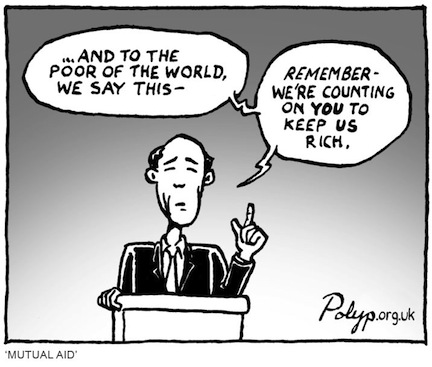
Welfare must not be seen as the Treasury’s disposable income

In the 2010 Coalition emergency budget, David Cameron claimed that austerity measures were to be introduced only to reduce the deficit.

Doesn’t anyone else remember that since then, David Cameron stood up at a Lord Mayor’s banquet in London, in front of the financial elite, in November 2013 and ostensibly admitted – and from an ostentatious golden throne, no less – that austerity was not an emergency response to difficult economic events after all, but a permanent disassembling of the state, signalling that he had no intention of resuming public spending once the structural deficit has been eliminated.

Many of us had already recognised that the cuts were ideologically driven. But not enough of us to make a difference in May and to vote and prevent an unforgivable betrayal of future generations. It’s also a grievous betrayal of the previous generations who fought to establish universal suffrage and fought to secure the post-war settlement. Our Social Security, Legal Aid and National Health Service. These are civilising and civilised prerequisites for a fair, human rights-based first world democracy.

proper Blond
There was another fall in income tax receipts that sent Britain’s deficit
spiralling to £12.1bn in August, the widest shortfall in government funding since 2012. So where is our money going exactly?

For a government whose raison d’etre is deficit reduction, the Conservatives aren’t very good at all. And the rigid emphasis on a series of self-imposed fiscal moving goalposts is distracting the government from the social, moral and democratic obligations it is also expected to uphold.

The Office for National Statistics said low wages and a dip in corporation tax receipts were to blame for the worsening situation, which will put pressure on George Osborne ahead of “tough” expenditure decisions due in November when Whitehall agrees its five-year spending targets.

But if you look at Conservative policies, which are designed to redistribute and privatise public wealth, it’s easy to see why this has happened.

The Conservatives regard the income of the poorest as somehow dispensable – the compensatory and disposable income of the Conservative state. Yet the very mention of raising taxes for the rich is met with shrieks of outrage and threats to leave the country. This is always justified in advance by a fresh mainstream narration of the puritan work ethic and the myth of meritocracy.

What’s yours is mine, what’s mine is my own.

What did the imperturbable chancellor promise before the election? True to Tory form, more of the same: austerity for the poor, more public services cuts, and tax breaks for the wealthiest. No mention of tax credit cuts, though, even when Conservatives were asked directly about those. Several times.

But further cuts to lifeline benefits and public services are surely untenable. Absolute poverty has risen dramatically this past four years, heralding the return of Victorian illnesses that are associated with malnutrition. People have died as a consequence of the welfare “reforms”. Supporting the wealthy has already cost the poorest so very much, yet this callous, indifferent, morally nihilistic government are casually discussing taking even more from those with the very least.

Our welfare state arose as a social security safety net – founded on an assurance that as a civilised and democratic society we value the wellbeing and health of every citizen.

There was a cross-party political consensus that such provision was in the best interests of the nation as a whole at a time when we were collectively spirited enough to ensure that no one should be homeless or starving in modern Britain.

As such, welfare is a fundamental part of the UK’s development –  our progress – the basic idea of improving people’s lives was at the heart of the welfare state and more broadly, it reflects the evolution of European democratic and rights-based societies.

A welfare state is founded on the idea that government plays a key role in ensuring the protection and promotion of the economic and social wellbeing of its citizens. It is based on the principles of equality of opportunity, equitable distribution of wealth, and both political and social responsibility for those unable to avail themselves of the minimal provisions for wellbeing.

It was recognised that people experienced periods of economic difficulty because of structural constraints such as unemployment and recession, through no fault of their own. It was also recognised that poor health and disability may happen to anyone through no fault of their own.

The welfare state arose in the UK during the post-war period, and following the Great Depression, for numerous reasons, most of these were informed by research carried out into the causes of poverty, its effects on individuals and more broadly, on the UK economy. There were also political reasons for the Conservatives and Liberals supporting the poorer citizens – the newly enfranchised working class.

Charles Booth in London and Sebohm Rowntree in York carried out the first serious studies of poverty and its causes. They both discovered that the causes were structural – casual labour, low pay, unemployment, illness and old age – not laziness, fecklessness, drunkenness and gambling, as previously assumed. The poverty studies raised awareness of the extent of poverty in Britain and the myriad social problems that caused it, and that it caused.

The Boer war of 1899-1902 highlighted the general poor state of health of the nation. One out of every three volunteers failed the army medical due to malnutrition, other illnesses due to poor diet and very poor living conditions. The military informed the government at the time of the shockingly poor physical condition of many of those conscripted.

We learned that the effects of poverty were potentially damaging to  the whole of society. Health problems and infectious disease – rife in the overcrowded slums – could affect rich and poor alike. It was recognised that the economy suffered if large numbers of people were too poor to buy goods and social problems such as exploitation, debt, crime, prostitution and drunkenness were a direct result of poverty, and not the cause of it.

Related image
The discovery of  widespread poor health as a consequence of poverty raised concerns about Britain’s future ability to compete with new industrial nations such as Germany and the USA. National efficiency would only increase if the health and welfare of the population improved. It was recognised that welfare is about extending opportunities, not “dependency”.

At the same time, the growth of the Labour Party and Trade Unionism presented a threat to the Liberals and the Conservatives. The new working class voters were turning to these organizations to improve their lives. The traditionally laissez-faire Liberals recognised this and supported the idea of government support for the working class.

Yet since 2010, there’s been an unprecedented, historic assault on the very ideal of social security, and it’s sustained and systematic: it didn’t stop with the 2012 welfare cuts.

As I’ve said elsewhere, welfare has been redefined by the Conservatives: it is pre-occupied with assumptions about and modification and monitoring of the behaviour and character of recipients, rather than with the alleviation of poverty and ensuring economic and social well-being.

Policies aimed at restricting support available for families where parents are either unemployed or in low paid work are effectively class contingent policies.

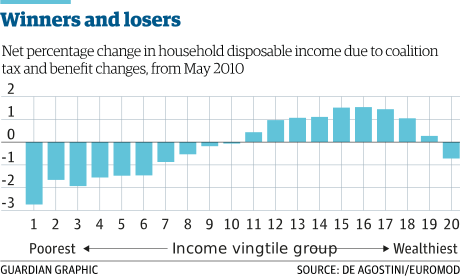
The vast total of around £25bn in benefit cuts already set in motion by the chancellor brings in less than he has freely handed out in personal tax allowances, generous tax breaks, petrol duties and corporation tax cuts. To govern is to make choices. It’s worth noting that the Conservative’s “difficult choices” are resolved by targeting the same social groups, over and over.

Cuts to welfare have been offset by the cost of tax cuts higher up income scale, with no overall contribution to paying down deficit, according to an unsurprising comprehensive study of social policies.

Professor John Hills, director of the London School of Economics (LSE) Centre for Analysis of Social Exclusion, said: “Protection of some of the core parts of the welfare state from the greatest cuts, and initial protection of the value of benefits, meant that those at the bottom, and important services, were initially shielded from the worst effects of the recession.

“But in the second part of the coalition’s period, selective cuts to benefits and to unprotected services have begun to take their toll, leaving the next government … with much greater social policy challenges than the coalition inherited.”
If David Cameron had been honest and declared that his government intended to dismantle our social infrastructure; the welfare state (and yes, that means in-work benefits too), the NHS, legal aid, and to refuse to honour any meaningful legal commitment to human rights, whilst handing out the money generated from this unravelling of our civilising institutions and services, in the form of handsome rewards to feckless millionaires, would he be in office now?

The Tory mantra “Making work pay” is a doublespeak soundbite version of the 1834 Poor Law principle of less eligibility, which is founded on the atrocious idea that poverty is caused by people simply refusing to work, and it can be “cured” if it is made as unbearable as possible. People will work if they are shamed and psychologically coerced. The whole idea of less eligibility is that “workless” people have to be kept in penury to “teach” them value of the work ethic and to discourage others from becoming an “idle pauper.”

But many poor people are in work.

The tax credit cuts proposed by the Conservatives exposed the “shirker” myth for what it is: a lazy, barely coherent narrative – a cover story for an ideologically driven and increasingly irrational government that is happy to reintroduce Dickensian levels of absolute poverty so that a few rich people can increase their wealth. Punishing poor people and creating a desperate class that are prepared to work for next to nothing rather than starve on a grossly inadequate and punitive social security system serves to drive wages down further, reduces working conditions and removes constraint from private sector profit-making.

It serves to dampen down collective bargaining. It changes the relationship between employers and employees, as well as between the state and citizens, turning increasingly desperate, impoverished people into a reserve army of cheap labour.

The welfare “reforms” were never about “making work pay.”

Unless, of course, you ask “for whom, precisely?” 

1379986_541109785958554_2049940708_nCourtesy of Robert Livingstone

Related

The Tories’ war on welfare has caused untold suffering. Here are three ways we can stop it

The New New Poor Law

Conservatism in a nutshell

Conservative policies are in breach of the UN Convention on the Rights of the Child

hands_anna


The Children’s Commissioner has criticised the Conservative’s tax credit cuts and called for measures to reduce the impact that the changes will have on the poorest children. Anne Longfield OBE, who was appointed last November, taking up her role on 1 March 2015, is calling on the government to exempt 800,000 children under five from tax credit cuts and to offer additional support to families with a child under five-years-old.

The role of Children’s Commissioner was established under Labour’s Children Act in 2004 to be the independent voice of children and young people and to champion their interests and bring their concerns and views to the national arena. The Commissioner’s work must take regard of children’s rights (the United Nations Convention on the Rights of the Child) and seek to improve the wellbeing of children and young people.

I reported last year that the Children’s Commissioner (then Maggie Atkinson) had already warned the government that the UK is in breach of the UN Convention on the Rights of the Child. As Chancellor George Osborne prepared his mid-term (Autumn) budget statement last year, the government’s Children’s Commissioner for England published a report criticising the Coalition’s austerity policies, which have reduced the incomes of the poorest families by up to 10 percent since 2010.

The Children’s Commissioner said that the increasing inequality which has resulted from the cuts, and in particular, the welfare reforms, means that Britain is now in breach of the United Nations Convention on the Rights of the Child, which protects children from the adverse effects of government economic measures.

Another report from the Social Mobility and Child Poverty Commission at the time indicated some very worrying trends regarding decreasing living standards, increasing employment insecurity and low pay, and the return of significant, rising levels of absolute child poverty not seen in the UK since the advent of the welfare state. Until now. (See the findings from the State of the Nation report.)

Dr Maggie Atkinson, the Children’s Commissioner, said: 

“Nobody is saying that there isn’t a deficit to close. Our issue is that at the moment, it is the poorest in society who have least to fall back on that are paying the greatest price for trying to close that deficit. It is patently unfair. It is patently against the rights of the child.”

Dr Atkinson added that this means the UK has broken the UN Convention on the Rights of the Child, under which each country is obliged to protect children from the detrimental consequences of economic policies. The Commissioner condemned the government for placing undue financial pressures on poorer parents, despite being one of the most developed countries in the world.

However, the government rejected the findings of what they deemed the “partial, selective and misleading” Children’s Commissioner report.

The Commissioner has again written to the Chancellor to call for children in the poorest families aged under five to be protected from the cuts.

However, Osborne is pretty unrepentant, yesterday he warned the House of Lords not to “second guess” the Commons on “financial matters.” He even went so far as to claim the cuts had been endorsed at the general election, which of course is untrue. The Conservatives have threatened the House of Lords with a constitutional shake-up show-down if they continue to oppose the tax credit cuts.  It’s highly unlikely that the Conservatives will back down over the tax credit cuts.

A damning joint report written by the four United Kingdom Children’s Commissioners for the UN Committee on the Rights of the Child’s examination of the UK’s Fifth Periodic Report under the UN Convention on the Rights of the Child (UNCRC), dated 14 August 2015, says, in its overall assessment of the UK’s record:

“The Children’s Commissioners are concerned that the UK State Party’s response to the global economic downturn, including the imposition of austerity measures and changes to the welfare system, has resulted in a failure to protect the most disadvantaged children and those in especially vulnerable groups from child poverty, preventing the realisation of their rights under Articles 26 and 27 UNCRC.

The best interests of children were not central to the development of these policies and children’s views were not sought.

Reductions to household income for poorer children as a result of tax, transfer and social security benefit changes have led to food and fuel poverty, and the sharply increased use of crisis food bank provision by families. In some parts of the UK there is insufficient affordable decent housing which has led to poorer children living in inadequate housing and in temporary accommodation.

Austerity measures have reduced provision of a range of services that protect and fulfil children’s rights including health and child and adolescent mental health services; education; early years; preventive and early intervention services; and youth services.

The Commissioners are also seriously concerned at the impact of systematic reductions to legal advice, assistance and representation for children and their parents/carers in important areas such as prison law; immigration; private family law; and education. This means that children are denied access to remedies where their rights have been breached.

The Commissioners are also concerned at the future of the human rights settlement in the United Kingdom due to the UK Government’s intention to repeal the Human Rights Act 1998 (HRA) which incorporates the European Convention on Human Rights (ECHR) into domestic law; replace it with a British Bill of Rights (the contents of which are yet to be announced), and ‘break the formal link between British courts and the European Court of Human Rights’.

The HRA has been vital in promoting and protecting the rights of children in the United Kingdom and the European Court of Human Rights has had an important role in developing the protection offered to children by the ECHR.The Commissioners are concerned that any amendment or replacement of the HRA is likely to be regressive.”

You can read the report in full here

Government turns its back on international laws, scrutiny and standards: it’s time to be very worried

564882_438358886199493_1982719183_n

Concerns have been raised by lawyers and legal experts that Conservative ministers have quietly abandoned the longstanding principle that members of the government should be bound by international law.

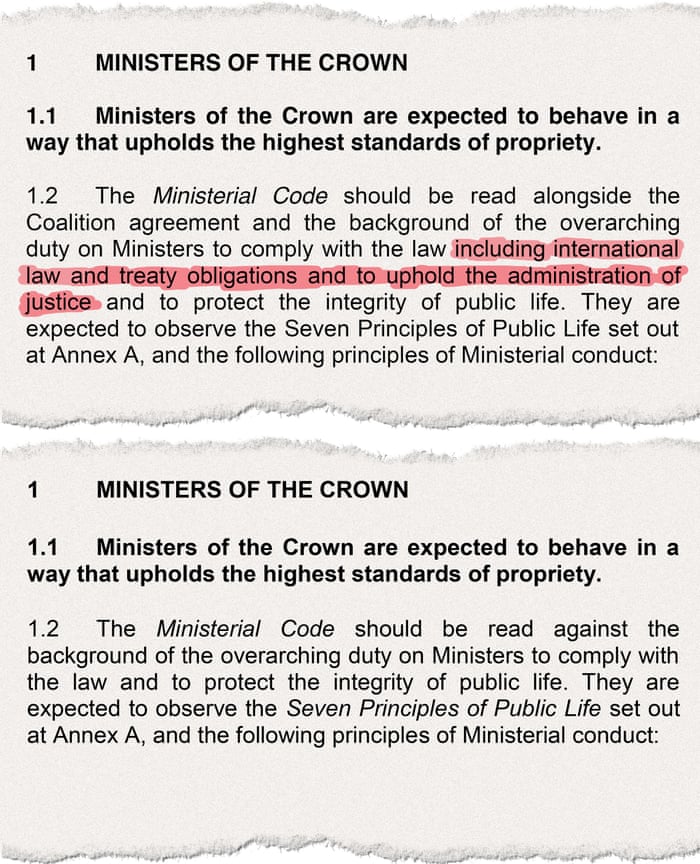
The rewritten ministerial code, which was updated on October 15  without any announcement, sets out the standard of conduct expected of ministers. It has been quietly edited. The latest version of the code is missing a key element regarding the UK’s complicity with international law. 

The previous code, issued in 2010, said there was an “overarching duty on ministers to comply with the law including international law and treaty obligations and to uphold the administration of justice and to protect the integrity of public life”.

The new version of the code has been edited to say only that there is an “overarching duty on ministers to comply with the law and to protect the integrity of public life”.

Legal experts say key issues affected by the change could include decisions about “whether to go to war or use military force, such as the use of drones in Syria, any decision made by an international court about the UK and any laws not incorporated into English law, such as human rights legislation and the Geneva conventions.

Ministerial code changes between 2010 and 2015.
Photograph: Government handout – courtesy of the Guardian

This comes as the UK government is facing another United Nations inquiry regarding widespread allegations that the Conservative welfare reforms breach the Human Rights of disabled people. It also comes following the government announcement this week that there are plans to scrap the Human Rights Act by next summer, to replace it with a controversial “British Bill of Rights.”

Raquel Rolnik, the UN’s special rapporteur for housing, found the bedroom tax to contravene human rights and in 2013, she called for the Tory “spare room subsidy” to be suspended immediately. In a wide-ranging report she also calls for the extension of grants to provide more social housing, the release of public land, build-or-lose measures to target landbanks and increased private rented sector regulation. None of these are recommendations which the Conservatives have been remotely willing to entertain, instead they have directed hostility towards the United Nations.

The Conservatives have already taken away access to legal aid from the poorest and most vulnerable citizens, in a move branded contrary to the very principle of equality under the law. Last year, Grayling, then the Justice Secretary, was accused of turning legal aid into an instrument of discrimination by a court, because of his attempt to introduce a residency test to legal aid access, a move which exceeded his statutory powers when he devised it.

He has also tried to dismantle a vital legal protection available to the citizen – judicial review – which has been used to stop him abusing his powers again and again. Judicial review is the mechanism by which citizens can hold the government to its own laws. With the Criminal Justice and Courts Bill, the justice secretary tried to put it out of reach.

Grayling, suffered a defeat in the House of Lords vote on his plans to curtail access to judicial review, which would have made it much harder to challenge government decisions in court.

Peers voted by 247 to 181, a majority of 66, to ensure that the judges keep their discretion over whether they can hear judicial review applications after a warning from a former lord chief justice, Lord Woolf, that the alternative amounted to an “elective dictatorship”.

He has tried to restrict legal aid for domestic abuse victims, welfare claimants seeking redress for wrongful state decisions, victims of medical negligence, for example.

It’s very worrying that this is a government that wants to leave Europe behind and sever the connection with the European Convention on Human Rights.  It’s a government that wants to do as it pleases, free from international scrutiny and what it clearly sees as the constraints of international law and the judgments of international courts.

The Conservatives have demonstrated an eagerness to take away citizens’ rights to take their case to the European court, with many of their actions clearly based on an intent on tearing up British legal protections for citizens and massively bolstering the powers of the state.

The Guardian reports that a legal challenge against the change will be lodged on Friday by Rights Watch, an organisation which works to hold the government to account. Yasmine Ahmed, its director, said:

“This amendment to the ministerial code is deeply concerning. It shows a marked shift in the attitude and commitment of the UK government towards its international legal obligations.”

In his preamble to the new ministerial code, David Cameron says: “People want their politicians to uphold the highest standards of propriety. That means being transparent in all we do.”

However, I reported last year that in terms of international standards of conduct, the Conservatives are not doing well. Transparency International flagged up many areas of concern in their report: A mid-term assessment of the UK Coalition Government’s record on tackling corruption

The Cabinet Office has of course denied there was any intention to weaken international law and the administration of justice by omitting the phrases from the new code.

A spokesman said:

“The code is very clear on the duty that it places on ministers to comply with the law. ‘Comply with the law’ includes international law.

The wording was amended to bring the code more in line with the civil service code. The obligations remain unchanged by the simplified wording. The ministerial code is the prime minister’s guidance to his ministers on how they should conduct themselves in public office.”

However, a Conservative party policy document promises that the ministerial code will be rewritten in the context of the UK withdrawing from the European convention on human rights. In order to help achieve these aims the document says:

“We will amend the ministerial code to remove any ambiguity in the current rules about the duty of ministers to follow the will of Parliament in the UK.”

Lord Falconer, Labour’s shadow lord chancellor, said:

“If this is what ministers are planning to do it is shocking. We are a country that prides itself on operating in accordance with the rule of law. That has always meant both domestic and international law.

This is a message we have sent out both internally and externally. If we are now regarding compliance with international law for ministers as optional that is staggering. If ministers breach international law it will no longer be misconduct.”

The Guardian cites Ken Macdonald QC, the former director of public prosecutions, who said:

“It is difficult to believe that this change is inadvertent. If it’s deliberate, it appears to advocate a conscious loosening of ministerial respect for the rule of law and the UK’s international treaty obligations, including weakening responsibility for the quality of justice here at home.

In a dangerous world, the government should be strengthening its support for the rule of law, not airbrushing it out of the ministerial code. On every level, this sends out a terrible signal.”

Ironically, on the same day that the new code was quietly released, the attorney general, Jeremy Wright, gave a keynote address about the importance of international law to an audience of government lawyers at the Government Legal Service International Law Conference.

Wright said:

“The constitutional principle to respect the rule of law and comply with our international obligations is reflected in the ministerial code – which applies to me as much as to any other minister. The code states that there is an overarching duty on ministers to comply with the law, including international law and treaty obligations and to uphold the administration of justice and to protect the integrity of public life.”

It is not clear whether or not the attorney general was informed about the changes to the ministerial code at the time of his speech. Both the Cabinet Office and the attorney general’s office have declined to answer this question.

Tory ministers are a major source of national embarrassment when they denounce the European Court of Human Rights whilst instructing the rest of the world, including other European states, to respect our collective international human rights obligations and “the rule of law.” Human Rights legislation exists throughout the free world. Free speech, the right to a fair trial, respect for private life and the prohibition on torture are values which distinguish democratic societies from despotic states.

There is no justification for editing obligations to upholding international laws, human rights or for repealing the Human Rights Act: that would make Britain the first European country to regress in the level and degree of our human rights protection. It is through times of recession and times of affluence alike that our rights ought to be the foundation of our society, upon which the Magna Carta, the Equality Act and the Human Rights Act were built – protecting the vulnerable from the powerful and ensuring those who govern are accountable to the rule of law.

Update: Former head of government’s legal service says obligation that ministers must comply with international law – dropped from revised ministerial code – had irritated PM: No 10 ‘showing contempt for international law’


I don’t make any money from my work and I am not funded. I am disabled because of illness and struggle to get by. But you can help me continue to research and write informative, insightful and independent articles, and to provide support to others, by making a donation. The smallest amount is much appreciated – thank you.

DonatenowButton

Prime minister dismisses UN inquiry into government’s discriminatory treatment of disabled people

disability_2218977b

Labour leader Jeremy Corbyn has asked David Cameron at Prime Minister’s Questions today to publish the details of the Government’s response to the United Nations inquiry into the allegations that Conservative policies are breaching the rights of disabled people in the UK. He also asked if the government intended to co-operate with the inquiry.

Such UN investigations are conducted confidentially by the UN and officials will not confirm or deny whether the UK is currently being put under scrutiny.

However, the ongoing inquiry been widely reported by disability rights groups and campaigners. The Department for Work and Pensions has previously declined to comment on the possibility of an investigation.

Mr Corbyn used his final question to ask about the United Nations inquiry into alleged “grave or systemic violations” of the rights of disabled people in the UK. The PM gave a dismissive response, saying the inquiry may not be “all it’s cracked up to be” and said that disabled people in other countries do not have the rights and support that “they” [disabled people] in the UK are offered. Cameron also implied that Labour’s “strong” equality legislation was a Conservative policy. However, the Equality Act was drafted under the guidance of Harriet Harman.

Jeremy Corbyn asks about David Cameron about his response to the UN inquiry at Prime Minister’s Questions

The United Nations team of investigators are expecting to meet with the Equality and Human Rights Commission, members of parliament, individual campaigners and disabled people’s organisations, representatives from local authorities and academics.

The team will be gathering direct evidence from individuals about the impact of government austerity measures, with a focus on benefit cuts and sanctions; cuts to social care; cuts to legal aid; the closure of the Independent Living Fund (ILF); the adverse impact of the Work Capability Assessment (WCA); the shortage of accessible and affordable housing; the impact of the bedroom tax on disabled people, and also the rise in disability hate crime.

Mr Corbyn said:

“This is deeply embarrassing to all of us in this house and indeed to the country as a whole. It’s very sad news.”

The Government’s approach to people with disabilities had been extremely controversial and been met with criticism from campaign groups. Disabled people have borne the brunt of austerity cuts, losing more income and support than any other social group, and this is despite the fact that Cameron promised in 2010 to protect the poorest, sick and disabled people and the most vulnerable.

In 2013, Dr Simon Duffy at the Centre for Welfare Reform published a briefing outlining how the austerity cuts are targeted. The report says:

The cuts are not fair.

They target the very groups that a decent society would protect:

  • People in poverty (1 in 5 of us) bear 39% of all the cuts
  • Disabled people (1 in 13 of us) bear 29% of all the cuts
  • People with severe disabilities (1 in 50 of us) bear 15% of all the cuts

The report outlines further discrimination in how the austerity cuts have been targeted. The report says:

The unfairness of this policy is seen even more clearly when we look at the difference between the burden of cuts that falls on most citizens and the burdens that fall on minority groups. By 2015 the annual average loss in income or services will be:

  • People who are not in poverty or have no disability will lose £467 per year
  • People who are in poverty will lose £2,195 per year
  • Disabled people will lose £4,410 per year
  • Disabled people needing social care will lose £8,832 per year

Work and Pensions Secretary Iain Duncan Smith said at the  Conservative party conference speech in Manchester that disabled people “should work their way out of poverty.”

The Work and Pensions Secretary has been widely criticised for removing support for disabled people who want to work: by closing Remploy factories, scrapping the Independent Living Fund, cuts to payments for a disability Access To Work scheme and cuts to Employment and Support Allowance.

The reformed Work Capability Assessment has been very controversial, with critics labeling them unfair, arbitrary, and heavily bureaucratic, weighted towards unfairly removing people’s sickness and disability benefit and forcing them to look for work.

The bedroom tax also hits disabled people disproportionately, with around two thirds of those affected by the under-occupancy penalty being disabled.

The United Nations have already deemed that the bedroom tax constitutes a violation of the human right to adequate housing in several ways. If, for example, the extra payments force tenants to cut down on their spending on food or heating their home. There are already a number of legal challenges to the bedroom tax under way in British courts. In principle the judiciary here takes into account the international human rights legislation because the UK has signed and ratified the International Covenant on Economic, Social and Cultural Rights.

The right to adequate housing is recognised in a number of international human rights instruments that the UK has signed up to.

UN rapporteur Raquel Rolnik called for the UK government last year to scrap its controversial bedroom tax policy. Rolnik’s report was dismissed as a “misleading Marxist diatribe” by Tory ministers, and she had been subject to a “blizzard of misinformation” and xenophobic tabloid reports.

The DWP’s sanctions regime has also been widely discredited, and there has been controvery over death statistics, eventually released by the Department after a long-running refusal to release the information under freedom of information law.

The Daily Mail has already preempted the visit from the special rapporteur, Catalina Devandas Aguilar, who is spearheading the ongoing inquiry into many claims that Britain is guilty of grave or systematic violations of the rights of sick and disabled people, by using racist stereotypes, and claiming that the UN are “meddling”. The Mail blatantly attempted to discredit this important UN intervention and the UN rapporteur before the visit.

Meanwhile, Cameron seems very keen to play the investigation down, and dismiss the impact of his government’s “reforms” on the lives of sick and disabled people.

We are a very wealthy, so-called first-world liberal democracy, the fact that such an inquiry has been deemed necessary at all ought to be a source of great shame for this government.


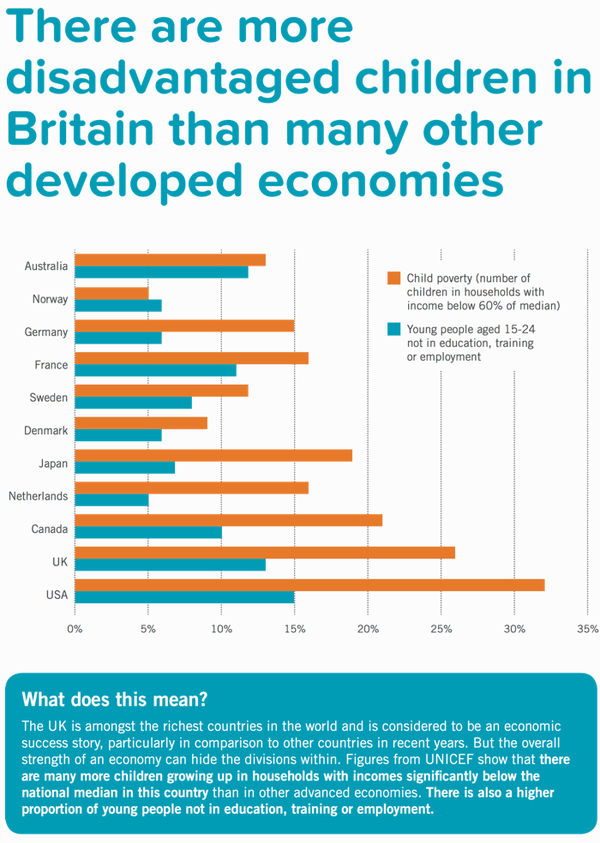
The impact of a Conservative government on Child Poverty – analysis of report by UNICEF

crdb2_0xiaacsaz
Graphic from Inequality Briefing

If ever you needed convincing evidence that austerity – which is central to neoliberalism and social conservatism – doesn’t benefit the majority, and that the UK has a system that extends inequality and increases poverty, this is it.

Furthermore, austerity was not imposed as an economic necessary, and there were other choices available to the UK government that were less damaging to the poorest citizens and to the economy.

UNICEF have published a report about the impact of the global economic crisis and its aftermath on children. It runs fron 2007 to 2013, so worryingly, the more recent UK government welfare cuts and the consequences are not yet included in this international analysis.

In the executive summary, the report says:

“For each country, the extent and character of the crisis’s impact on children has been shaped by the depth of the recession, pre-existing economic conditions, the strength of the social safety net and, most importantly, policy responses

Remarkably, amid this unprecedented social crisis, many countries have managed to limit – or even reduce – child poverty. It was by no means inevitable, then, that children would be the most enduring victims of the recession.”

The report goes on to say that those Governments that supported existing public institutions and programmes helped to buffer countless children from the crisis – a strategy that others may consider adopting.

The UK was quite clearly not one such country, and more recently, Iain Duncan Smith has conveniently announced changes to how we measure child poverty, shifting the economic responsibility and moral focus by blaming individuals for circumstances created by socioeconomic constraints and political decisions.

The report says:

“Many countries with higher levels of child vulnerability would have been wise to strengthen their safety nets during the pre-recession period of dynamic economic growth, which was marked by rising disparity and a growing concentration of  wealth.”

In the UK, inequality has grown since the recession because of austerity measures that have been targeted at the poorest households. In fact, the UK is now the most unequal country in the EU, and has even higher levels of inequality than the US.

“The magnitude of change since the recession is worth noting. The absolute number of children living in severe material deprivation in the 30 European countries analysed was 11.1 million in 2012 – 1.6 million more than in 2008

This trend is the result of a net effect that includes substantial decreases (more than 300,000 fewer deprived children in Germany and Poland) and unprecedented increases in four countries (Greece, Italy, Spain and the United Kingdom).”

Almost half of the severely materially deprived children (44 percent) in 2012 lived in three countries: Italy (16 percent), Romania (14 per cent) and the United Kingdom (14 per cent).

The report goes on to say:

“At the start of the recession, not surprisingly, child poverty was lower where public spending on families and children was higher. During the recession, welfare states were expected to increase their public protection spending, and many did. 

In such countries, the health and well-being of citizens, especially those in financial or social need, are safeguarded by grants, unemployment assistance programmes, pensions and other benefits. 

In a recession, these benefits act as counter-cyclical economic stabilizers.”

One of the most striking contrasts in the report was that whilst many other countries increased spending on welfare and essential public services to shelter the most vulnerable citizens from the impact of the global recession, in the UK, the government chose to target those social provisions for all of the austerity cuts.

The report says:

“Since 2010, the United Kingdom has implemented a series of cuts that have reduced the real value and coverage of child benefits and tax credits for families withchildren. In 2013, a cap was imposed on the total benefits a household can receive, mainly affecting a small number of large families with high housing costs, while housing benefits were cut (the so-called ‘bedroom tax’), affecting large numbers of social tenants.”

It’s clear that the impacts and aftershocks of the global recession were not shared equally in our society, and the austerity measures have only made things worse for those most affected – the poorest. One emerging certainty from this report is that economic indicators alone do not reveal the complexity of social reality.

The report recommends that governments increase investment in social protection policies and programmes that can reduce poverty, enhance social resilience in children and support economic development in an efficient, costeffective way.

Such measures include guaranteeing basic incomes for families, and a child rights impact assessment as strategy for political decision-making in the best interests of children.

Last year, I wrote that the government’s Children’s Commissioner for England published a report criticising the Coalition’s austerity policies, which have reduced the incomes of the poorest families by up to 10 percent since 2010.

The Children’s Commissioner said that the increasing inequality which has resulted from the cuts, and in particular, the welfare reforms, means that Britain is now in breach of the United Nations Convention on the Rights of the Child, which protects children from the adverse effects of government economic measures.

It therefore comes as no surprise that the current government is planning to repeal our Human Rights Act and replace it with an alternative Bill of Rights. That will mean that  human rights will no longer be absolute – they will be subject to stipulations and caveats. The government will establish a threshold below which Convention rights will not be engaged, allowing UK courts to strike out what are deemed “trivial cases”.

During their last term, the Conservatives contravened the Human Rights of disabled people, women and children. It’s clear that we have a government that regards the rights and wellbeing of most of the population as an inconvenience to be brushed aside.

You can read the UNICEF report in full here.

(Non -discrimination): The Convention applies to all children, whatever their race, religion or abilities; whatever they think or say, whatever type of family they come from. It doesn’t matter where children live, what language they speak, what their parents do, whether they are boys or girls, what their culture is, whether they have a disability or whether they are rich or poor. No child should be treated unfairly on any basis.

Article 3

(Best interests of the child): The best interests of children must be the primary concern in making decisions that may affect them. All adults should do what is best for children. When adults make decisions, they should think about how their decisions will affect children. This particularly applies to budget, policy and law makers.

Article 26

(Social security): Children – either through their guardians or directly – have the right to help from the government if they are poor or in need.

Article 27

(Adequate standard of living): Children have the right to a standard of living that is good enough to meet their physical and mental needs. Governments should help families and guardians who can not afford to provide this, particularly with regard to food, clothing and housing.

1957929_293215800829475_303676825_o

Tories to scrap Human Rights Act by next summer

564882_438358886199493_1982719183_n

The Government are planning to fast-track a British Bill of Rights, aiming to get the extremely controversial legislation made law by next summer. 

A Bill of Rights was a Conservative manifesto pledge, but is strongly opposed by civil liberties groups that say it will restrict freedoms that are guaranteed under the European Convention on Human Rights (ECHR). 

The Independent reports that a 12-week public consultation on the Conservative Bill of Rights will start in November or December this year. It will be worded to clarify that the UK will not pull out of the European Convention of Human Rights, as some critics have feared, (and actually, as David Cameron has pledged previously). It will even mirror much of the ECHR language in an effort to “calm opposition.”

The Conservative Bill of Rights will go straight to the House of Commons without a Green or White Paper, which are usually introduced before legislative scrutiny.

It is understood that Michael Gove will visit Scotland before the consultation is published, when he will try to convince the Scottish government to back the Bill of Rights. He will also need the support of Wales and Northern Ireland. The Bill will need to be carried over to the next Queen’s Speech, expected in May, if it is to become law before MPs leave for summer recess in July.

A cabinet minister told The Independent on Sunday that the summer timescale was “aspirational”, because the Bill could be “really clogged up in the House of Lords” and predicted it was more likely to be law by the end of next year. The upper chamber has some seasoned lawyers, many of whom fear the consequences of scrapping the HRA, and the Tories do not command a majority in the Lords. 

The rights protected by the Human Rights Act are quite simple. They include the right to life, liberty and the right to a fair trial; protection from torture and ill-treatment; freedom of speech, thought, religion, conscience and assembly; the right to free elections; the right to fair access to the country’s education system; the right to marry and an overarching right not to be discriminated against. Cameron has argued that it should be repealed just 10 years after its implementation (the Human Rights Act (HRA) came into force in October 2000) … so that he can pass another Act.

No other country has proposed de-incorporating a human rights treaty from its law so that it can introduce a Bill of Rights. The truly disturbing aspect of Cameron’s Bill of Rights pledge is that rather than manifestly building on the HRA, it’s predicated on its denigration and repeal. One has to wonder what his discomfort with the Human Rights Act is. The Act, after all, goes towards protecting the vulnerable from neglect of duty and abuse of power.

The HRA incorporated the ECHR in British law, it is a straightforward statute, that works by allowing individuals in the UK to enforce their rights in their local courts.  The Act makes available a remedy for breach of a Convention right without the need to go to the European Court of Human Rights in Strasbourg.

It was designed to supplement the ECHR. It also requires public authorities to respect the rights of those they serve. As a part of Labour’s 1997 commitment to a new constitutional settlement, it represented a new way of thinking about law, politics and the relationship between public authorities and individuals.

The rights protected by the HRA are drawn from the 1950 European convention on human rights, which was a way of ensuring that we never again witness the full horrors of the second world war, and overwhelmingly, one of the greatest stains on the conscience of humanity – the Holocaust. Winston Churchill was one of the main drivers of the Convention, it was largely drafted by UK lawyers and the UK was one of the first countries to ratify it in 1951.

This was the establishing of a simple set of minimum standards of decency for humankind to hold onto for the future. The European Convention on Human Rights and Fundamental Freedoms (ECHR) was drafted as a lasting legacy of the struggle against fascism and totalitarianism.

Yet the HRA is quite often portrayed by the Right as a party political measure. However, whilst the Human Rights Act is ultimately recognised as one of the greatest legacies of Labour in government, Cameron seems oblivious to the fact that Human Rights are not objects to be bartered away. They arose from struggles that were begun long ago by past generations who gave their lives for these rights to be enshrined in our laws.

The case for the HRA is a strong one. It is a moral case based not only on learning from the history of some of the worst violations of human rights before and during the second world war, but also from recent history – the here and now. If a new settlement based on social inclusion and greater equality is to be reached, the HRA should not be viewed suspiciously, as a burden, but promoted as an instrument of equality, social cohesion and public purpose. It is expected of a democratic government to improve the understanding and application of the Act. That is an international expectation, also.

There is no justification for editing or repealing the Act itself, that would make Britain the first European country to regress in the level and degree of our human rights protection. It is through times of recession and times of affluence alike that our rights ought to be the foundation of our society, upon which the Magna Carta, the Equality Act and the Human Rights Act were built – protecting the vulnerable from the powerful and ensuring those who govern are accountable to the rule of law.

Observation of human rights distinguishes democratic leaders from dictators and despots. Human Rights are the bedrock of our democracy, they are universal, and are a reflection of a society’s and a governments’ recognition of the equal worth of every citizens’ life.

One sentence from the misleadingly titled document that outlines how the Tories plan to scrap the Human Rights Act – Protecting Human Rights in the UK, (found on page 6 ) – is particularly chilling: “There will be a threshold below which Convention rights will not be engaged.”

Basically this means that human rights will no longer be absolute – they will be subject to stipulations and caveats. The government will establish a threshold below which Convention rights will not be engaged, allowing UK courts to strike out what are deemed trivial cases.

The Tories’ motivation for changing our human rights is to allow reinterpretations to work around the new legislation when they deem it necessary. The internationally agreed rights that the Tories have always seen as being open to interpretation will become much more parochial and open to subjective challenge.

Any precedent that allows a government room for manoeuvre around  basic and fundamental human rights is incredibly dangerous.

During their last term, the Conservatives contravened the Human Rights of disabled people, women and children. It’s clear that we have a government that regards the rights of most of the population as an inconvenience to be brushed aside.


United Nation’s investigation in the UK concerning the human rights of disabled people- submission deadline

536738_306169162785952_999031084_n

I reported last year that the UK is to be investigated formally by the United Nations because of allegations of “systematic and grave” violations of disabled people’s human rights.

In August I wrote that officials from the United Nation’s Committee on the Rights of Persons with Disabilities (UNCRPD) are to visit Britain. The inquiry is confidential, and those giving evidence have been asked to sign a confidentiality agreement.

A United Nations team have arrived in the UK and it’s understood they will visit Manchester, London, Bristol, as well as parts of Scotland, Wales and Northern Ireland.

The United Nations team are also expecting to meet with the Equality and Human Rights Commission, members of parliament, individual campaigners and disabled people’s organisations, representatives from local authorities and academics.

The team will be gathering direct evidence from individuals about the impact of government austerity measures, with a focus on benefit cuts and sanctions; cuts to social care; cuts to legal aid; the closure of the Independent Living Fund (ILF); the adverse impact of the Work Capability Assessment (WCA); the shortage of accessible and affordable housing; the impact of the bedroom tax on disabled people, and also, the rise in disability hate crime.

In 2013, Amnesty International condemned the erosion of human rights of disabled people in UK, and the Joint Parliamentary Committee on Human Rights conducted an inquiry into the UK Government’s implementation of Article 19 of the United Nations Convention on the Rights of Persons with Disabilities – the right to live independently and to be included in the community. The inquiry, which began in 2011, has received evidence from over 300 witnesses.

The inquiry highlighted just how little awareness, understanding and employment of the Convention there is by the (then) Tory-led Government. Very few of the witnesses made specific reference to the Convention in their presented evidence, despite the inquiry being conducted by the Parliamentary Human Rights Committee, with the terms of reference clearly framing the inquiry as being about Article 19 of the UN’s committee on the rights of persons with disabilities. (UNCRPD.)

“This finding is of international importance”, said Oliver Lewis, MDAC Executive Director, “Our experience is that some Governments are of the view that the CRPD is nothing more than a policy nicety, rather than a treaty which sets out legal obligations which governments must fulfil.”

The report was particularly critical of the Minister for Disabled People (Maria Miller, at the time) who told the Committee that the CRPD was “soft law”. The Committee criticised this as “indicative of an approach to the treaty which regards the rights it protects as being of less normative force than those contained in other human rights instruments.” (See the full report.) The Committee’s view is that the CRPD is hard law, not soft law. 

In August, I wrote about how the inquiry was triggered by campaigners and groups using the convention’s optional protocol, (which the last Labour government signed us up to, in addition to the convention.) The protocol allows individuals (and groups) who are affected by violations to submit formal complaint to the UNCRPD.

The deadline for evidence submissions to the UNCRPD is thought to be 31 October.

Contact details are here.

An inclusive well done to all who worked to bring about the UN Inquiry into the systematic and grave violations of disabled people’s human rights

377683_445086432227557_1770724824_n (1)

I reported last August that the United Nations is to carry out an unprecedented inquiry into “systematic and grave violations” of disabled people’s human rights by the UK government. The UK is the first developed country to face such an inquiry, a fact which should be a source of shame for the Conservatives.

Many campaigners have been concerned for a long time by the disproportionate impact of the Tory-led cuts on disabled people. Many of those campaigners have themselves been adversely affected by the Tory’s draconian welfare cuts, myself included.

My own experiences of the Government’s Work Capability Assessment process led to a deterioration in my health in 2011. (I have lupus, a chronic and life-threatening autoimmune illness). I was wrongly assessed as fit for work, after being forced to give up my job as a mental health social worker because I was deemed too ill to work by my doctor, and my benefit was withdrawn – my only source of income. I appealed and after waiting nine months for the tribunal, I won.

Since then I have worked to support others going through this often harrowing and extremely punitive process. I co-run a group on Facebook called ESA/DLA, which offers support and free legal advice to sick and disabled people facing adverse circumstances because of the draconian Tory policies. The other administrators are Tracey Flynn, who is a qualified human rights specialist, Robert Livingstone, a friend and fellow campaigner, and Sonia Wilson, who originally set the group up. We are all ill and affected by disabilty. We welcome the United Nations inquiry, and both Tracey and I have made our own detailed submissions to the UN.

I reported in 2013 that the Joint Parliamentary Committee on Human Rights conducted an inquiry into the UK Government’s implementation of Article 19 of the United Nations Convention on the Rights of Persons with Disabilities (UNCRPD) – the right to live independently and to be included in the community. The inquiry which began in 2011 has received evidence from over 300 witnesses.

As I reported last month, the UN inquiry has taken place under the Convention’s Optional Protocol on the Rights of Persons with Disabilities, which is a side-agreement to the Convention on the Rights of Persons with Disabilities. It was adopted on 13 December 2006, and entered into force at the same time as its parent Convention on 3 May 2008. As of July 2015, it has 92 signatories and 87 state parties.

The Optional Protocol establishes an individual complaints mechanism for the Convention similar to that of other Conventions. But this Protocol also accepts individual economic, social and cultural rights. Parties agree to recognise the competence of the Committee on the Rights of Persons with Disabilities to consider complaints from individuals or groups who claim their rights under the Convention have been violated. The Committee can request information from and make recommendations to a party.

In addition, parties may permit the Committee to investigate, report on and make recommendations on “grave or systematic violations” of the Convention. The mechanism has allowed many disabled campaigners to submit reports and evidence to the United Nations, including myself.

The inquiry has arisen because of the hard work of many campaigners, since 2012. As well as collective contributions from prominent disability rights groups such as Disabled People Against the Cuts (DPAC), many other groups and independent campaigners have also worked very hard to make this inquiry happen, and have submitted evidence to the UN. That needs to be acknowledged, we need to be inclusive and celebrate the achievement of everyone who has collaborated and contributed to this.

I would like to say a special and personal thank you to Samuel Miller, a Canadian disability rights specialist who has supported many campaigners here in the UK, and who also recognised the retrogressive and draconian nature of Tory policies. Samuel has worked hard to submit reports and evidence to the UN over the last few years, he has included and incorporated the work of other campaigners, such as myself, as well as supporting other campaigners with their own independent submissions.

The WOW campaign also deserve a massive thank you for their work in raising awareness of the need for a cumulative impact assessment of the welfare “reforms”. Another thank you goes to Jane Young, for her work and leading authorship of the Dignity and Opportunity for All: Securing the rights of disabled people in the austerity era report for the Just Fair consortium.

A massive thank you to everyone who has contributed to awareness raising and campaigning for the rights of disabled people, many have worked so hard, independently, unsupported and with quiet determination and strength.

Every single contribution is precious and every effort is valued and deserves recognition, inclusion and thanks.

Another personal thanks goes to Dr Simon Duffy, director of think tank The Centre for Welfare Reform for his research and hard work. He demonstrated through independent research carried out since 2010 that the UK Government has targeted cuts on people in poverty and people with disabilities.

Many of us have consistently and repeatedly pointed to the disproportionate, negative impact of the bedroom tax on sick and disabled people; the closure of the Independent Living Fund (ILF); the political stigmatisation of sick and disabled people and the role played by the media in inflaming disability hate crime; the extent of cuts to local authority care funding; the government’s persistent unwillingness to carry out cumulative impact assessment of its “reforms” on sick and disabled people; the impact of benefit sanctions on disabled people; delays in benefit assessments; and the government’s reluctance to monitor disabled people found fit for work and who have lost their lifeline benefits – their only means of support.

Dr Duffy said:

“In fact the people with the most severe disabilities have faced cuts several times greater than those faced by cuts to the average citizen. This policy has been made even worse by processes of assessment and sanctions that are experienced as stigmatising and bullying.

The government has utterly failed to find jobs for the people they target – people who are often very sick, who have disabilities or who have mental health problems.

Instead we are seeing worrying signs that they are increasing rates of illness, suicide and poverty.”

In December 2014, the UN Human Rights Council created the role of UN Special Rapporteur on the rights of persons with disabilities. Part of the Special Rapporteur’s broad mandate is to report annually to the Human Rights Council and General Assembly with recommendations on how to better promote and protect the rights of persons with disabilities.

The Special Rapporteur, Catalina Devandas Aguilar, will be coming to the UK in the next couple of months to gather further evidence of the grave and systematic  violations of disabled people’s human rights.

United Nations (UN) investigations are conducted confidentially, I’ve already submitted evidence. Anyone wishing to make a submission may contact the UN here:

Catalina Devandas Aguilar
Special rapporteur on the rights of persons with disabilities
Address: OHCHR-UNOG; CH-1211 Geneva 10, Switzerland
Email: sr.disability@ohchr.org

Witnesses will be asked to sign an agreement to prevent them from speaking about the meeting with the UN rapporteurs, or identifying who gave evidence. The UN said that confidentiality is necessary to secure the co-operation of the host country and importantly, to protect witnesses.

Evidence submitted to the inquiry, its subsequent report to the UK government and the government’s response will not be published until the CRPD meets to discuss the inquiry in Geneva in 2017.


536738_306169162785952_999031084_n
Images courtesy of Robert Livingstone

Full Fact’s ‘fit for work’ coverage is unfit for use as toilet paper – Vox Political

http://i0.wp.com/voxpoliticalonline.com/wp-content/uploads/2015/08/falsefacts.png

I had my own issues with Full Fact last year, when the site supported Tom Chivers of the Telegraph in denying that sick and disabled people had died after their lifeline benefits had been stopped by the Department of Work and Pensions, despite the fact that the Hansard Parliamentary record and the media have recorded many examples of this being the case. The row I had with Tom Chivers last year about the mortality statistics can be seen here – Black Propaganda.

This article is from Mike Sivier at Vox Political:

Here’s a slimy little article for you: Sam Ashworth-Hayes’ piece on the benefit deaths at Full Fact.

The fact-checking website set him to respond to reporting of the DWP’s statistical release on incapacity benefit-related deaths, and he’s done a proper little cover-up job.

“It was widely reported that thousands of people died within weeks of being found ‘fit for work’ and losing their benefits,” he scribbled.

“This is wrong.

“Within weeks of ending a claim, not within weeks of an assessment.”

Not true – unless Sam is saying the DWP has failed to answer my Freedom of Information request properly.

If Sam had bothered to check the FoI request to which the DWP was responding, he would have seen that it demanded the number of ESA claimants who had died since November 2011, broken down into categories including those who had been found fit for work and those who had had an appeal completed after a ‘fit for work’ decision.

The date the claim ended is irrelevant; the fact that they were found fit for work and then died is the important part.

If the DWP finds someone fit for work, then it ends the claim anyway, you see. Obviously.

But Sam continues: “If someone is found fit for work, they can appeal the decision, and continue to receive ESA during the appeal process. There is no way of telling how long after the start of the appeal process those claims ended.”

Not true.

The statistical release covers those who had had such an appeal completed and then died – 1,360 of them. The release does not state that they should be considered separately from those who had a fit for work decision, meaning that this is one of several areas in which the release is not clear. In order to err on the side of caution, This Writer has chosen not to add them to the 2,650 total of those found fit for work. Any who were still deemed to be fit for work after their appeal ended, I have deemed to be among the 2,650.

The release most emphatically does not mention those who had appealed against a fit for work decision, but the appeal was continuing when they died, as Sam implies. The DWP asked me to alter my request to exclude them, and I agreed to do so. Therefore Sam’s claim is false. Nobody included in these figures died mid-appeal. Some died after being found fit for work again. Some died after winning their appeal and while they were continuing to receive their benefit – but they do not skew the figures because they aren’t added onto the number we already had (we don’t know how many of them succeeded because the DWP has chosen to follow the letter of the FoI request and has not provided that information). The outcome of the appeal is, therefore, irrelevant.

The point is, the decision that they were fit for work was wrong, because they died.

Let’s move on. Under a section entitled Mortality rates matter, Sam burbles:

“If 2,380 people were found fit for work from late 2011 to early 2014, and all 2,380 subsequently died in the process of challenging that decision, that would indicate that something was almost certainly going wrong in the assessment process.”

2,380? He means 2,650! For a person supposedly checking the facts, this was an elemental mistake to make.

“But if 2 million people were found to be fit for work, there would be less concern that the assessment process was going wrong; one in 1,000 dying could just be the result of the ‘normal’ level of accident, misfortune and sudden illness.

“If we want to know if people found fit for work are more likely to die than the general population, then age-standardised mortality rates would let us make that comparison while adjusting for differences in age and gender.

“Unfortunately, the DWP has not published an age-standardised mortality rate for those found ‘fit for work’.”

Fortunately, This Writer has been directed to a site whose author has attempted just that. This person states that the problem is that we don’t know how many people were found fit for work in total – only that there were 742,000 such decisions during the period in question. This would suggest that the number of people dying within the two-week period used by the DWP is 0.35 per cent of the total. We know that there were 74,600 deaths among the general working-age population in 2013 – a population totalling around 39 million – meaning the chance of dying within any two-week period was 0.007 per cent. So, using these crude figures, the probability of an incapacity benefits claimant dying after being found fit for work is no less than 50 times higher than for the working-age population as a whole, and probably much higher.

So sure, if Sam thinks mortality rates matter, let him look at that.

His article isn’t fit to be toilet paper, though.

Read the original article at the Vox Political Facebook page.

A critical analysis of the DWP’s Mortality Statistics release


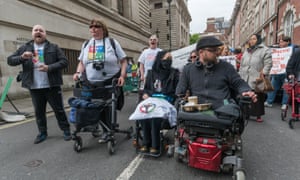
Disability rights activists protest in London, November 2016

The government’s release of mortality statistics related to sickness and disability benefits has caused fierce debate about what the figures actually mean. It has to be said that the way the figures were presented – in a flat descriptive way – makes drawing causal links and inferences very difficult and making useful comparisons impossible. This of course was intentional.

There’s a simple difference between descriptive and inferential statistics – descriptive statistics simply summarise a current dataset, it’s just raw data. Subsequently, analysis is limited to the data and does not provide a scope that permits the extrapolation of any conclusions about a group or population. Inferential statistics are usually used to test an hypothesis, and aim to draw conclusions about an additional population outside of the dataset. Inferential statistics allow researchers to make well-reasoned inferences about the populations in question, and may be tested for validity and reliability, using various appropriate formulae.

To complicate matters further, the Department for Work and Pensions (DWP) claim that they don’t keep detailed information regarding whether a person died before or after their benefit claim was ended. So when the data is about people who died within six weeks of their claim ending, it could mean that the claim ended before they died, or after, because the person had died.

Of course the question we need to ask is why the DWP don’t keep a more accurate record of that data. And furthermore, why are the government so supremely unconcerned about even basic monitoring of the consequences of their welfare “reforms” on sick and disabled people?

I had a lengthy debate with Tom Chivers from the Telegraph last year about this very issue. He said that it was most reasonable to assume that the overwhelming majority of deaths happened before the claim ended, rather than the converse being true. He criticised campaigners for claiming that people were dying as a consequence of the “reforms”.

However, we know from media coverage of some of those tragic deaths that people have died as a consequence of having their employment and support allowance (ESA) benefit claim ended. We also know from the debates in parliament that have been tabled by the opposition on this topic, and the inquiries instigated by the work and pensions committee, that many people have been adversely affected by having their claims ended because they were assessed as “fit for work”, some of the cases presented had also died – details of which can be found on the Hansard record.

So it isn’t a reasonable assumption that most people died and then had their claim closed, on the part of Tom Chivers (and others) at all. But there’s more.

I made a statistical cross comparison of deaths, using the same Department for Work and Pensions statistics as Tom Chivers, though my analysis was undertaken the year before his. I found that the data showed people having their claim for Employment Support Allowance (ESA) stopped, between October 2010 and November 2011, with a recorded date of death within six weeks of that claim ceasing, who were until recently claiming Incapacity Benefit (IB) – and who were migrated onto ESA – totalled 310.

Between January and November 2011, those having their ESA claim ended, with a recorded date of death within six weeks of that claim ending totalled 10,600.

This is a very substantial, significant statistical variation over a comparatively similar time scale (although the 10,600 deaths actually happened over a shorter time scale – by 3 months) that appears to be correlated with the type of benefit and, therefore, the differing eligibility criteria – the assessment process – as both population samples of claimants on ESA and IB contain little variation regarding the distribution in the cohorts in terms of severity of illness or disability. Bearing in mind that those who were successfully migrated to ESA from IB were assessed and deemed unfit for work, (under a different assessment process, originally) one would expect that the death rates would be similar to those who have only ever claimed ESA.

This is very clearly not the case.

Further evidence that very ill and disabled people have been excluded from an award of ESA may be found in the statistical outcomes of tribunals – there is a consistently very high success rate amongst those who have appealed Atos/DWP decisions, over that time period. Those on IB were not required to have continuous assessments, whereas those on ESA are constantly required to undergo the Work Capability Assessment.

Dr Steven Bick indicated that there are targets to reduce the number of people who “qualify” for ESA payments, the WCA is unfairly and irrationally weighted towards finding people fit for work, often when it’s clearly not the case, so each assessment is simply an opportunity for the DWP to end claims. Many claimants have described a “revolving door” process of endless assessment, ceased ESA claim, (based on an outcome of almost invariably being wrongly “assessed” as fit for work), appeal, successful appeal outcome, benefit reinstated, only to find just three months later that another assessment is required.

The uncertainty and loss of even basic security that this process creates, leading to constant fear and anxiety, is having a damaging, negative impact on the health and well-being of so many. A significant proportion of those required to have endless assessments have very obviously serious illnesses such as cancer, kidney failure, lung disease, heart disease, severe and life-threatening chronic conditions such as multiple sclerosis, lupus, myalgic encephalomyelitis, rheumatoid arthritis, brain tumours, severe heart conditions, and severe mental health illness, for example. To qualify for ESA, the claimant must provide a note from a doctor stating that the person is unfit for work.

There can be no justification for subjecting people who are so ill to further endless assessments, and to treating us as if we have done something wrong. Negative labelling, marginalising and stigmatising sick and disabled people via propaganda in the media, using despiteful and malicious terms such as “fraudster”, “workshy” and “feckless” is a major part of the government’s malevolent attempt at justification for removing the lifeline of support from sick and disabled citizens.

In addition to very justified anxieties regarding the marked increase in disability hate crime that the Tory-led propaganda campaign has resulted in, many sick and disabled people have also stated that they feel harassed and bullied by the Department for Work and Pensions and Atos. All of this is taking place in a setting of government generosity to very wealthy people, with Osborne implementing austerity cuts, which disproportionately target the poorest citizens, at the same time as he awarded millionaires £107, 000 each per year in the form of a tax cut.

Many sick and disabled people talk of the dread they feel when they see the brown Atos envelope containing the ESA50 form arrive through the letter box. The strain of constantly fighting for ESA entitlement – a lifeline support calculated to meet basic needs –  and perpetually having to prove that we are a ‘deserving’ and ‘genuine’ sick and disabled person is clearly taking a toll on so many people’s health and well being. I know from personal experience that this level of stress and anxiety exacerbates chronic illness. 

Many families of those who have died have said that the constant strain, anxiety and stress of this revolving door process has contributed significantly to their loved ones’ decline in health and subsequent death. The figures from the DWP, and the marked contrast between the ESA and IB death statistics certainly substantiate these claims. At a meeting in June 2012, British Medical Association doctors voted that the Work Capability Assessment (WCA) should be ended “with immediate effect and be replaced with a rigorous and safe system that does not cause unavoidable harm to some of the weakest and vulnerable in society”.

On 22 May 2013, a landmark decision by the courts in a judicial review brought by two individuals with mental health problems ruled that the WCA is not fit for purpose, and that Atos assessments substantially disadvantage people with mental health conditions. Despite the ruling’s authoritative importance, the decision had a similar lack of real-world effect as it did not halt or slow down the WCA process: Atos and the DWP have ignored the judgement and its implications.

Many of us have reasonably demanded a cumulative impact assessment of government welfare policies, AND an inquiry into the statistically significant increase in mortality rates correlated with the government’s welfare “reforms” aimed at sick and disabled people, only to be told that the cases we present as evidence of the need for investigation are merely “anecdotal”.

Yet when the government talk of “scroungers”, the “workshy”, “generations of ‘worklessness'”, a “culture of entitlement”, a “something for nothing culture”, we are expected to accept that at face value as ’empirical evidence”. With no offer of evidence or reasoned discussion to support these ideological claims.

There is an argument to be had (which I’ve presented previously) about the need for more methodological pluralism in social and political research, with a leaning towards qualitative data. The government should not be attempting to invalidate people’s accounts of their own everyday experiences and attempting to re-write them to suit themselves. I’ve a strongly qualitative preference when it comes to methodology, because of issues relating to validity, reliability and because of the meaningful, authentic, rich details that can be gathered this way. Using quantitative methods only tends to exclude the voices of those groups that are being studied. Qualitative methodologies also tend to be more conducive to understanding issues being researched, rather than simply describing them numerically. Statistics tend to dehumanise because they exclude the narratives of citizens’ lived experiences, and of how they make sense of their circumstances.

As it is, we have ministers shamefully rebuked by the Office for National Statistics (ONS) for lying to justify extremely punitive welfare cuts, more than once, yet with even more cuts to come, and an ongoing United Nations’ inquiry into this government’s human rights abuses, it’s very worrying that there is a silence and lack of concern from the wider public about any of these issues.

The point blank refusal to enter into an open debate and open an inquiry into the deaths that are correlated with Tory policy reflects a callous, irrational and undemocratic government that draws on an underpinning toxic social Darwinist ideology and presents a distinctly anti-enlightenment, impervious epistemological fascism from which to formulate justification narratives for their draconian policies, in order to avoid democratic accountability and to deflect well-reasoned and justified criticism.

That ought to be a cause for considerable concern for the wider public of the UK – a very wealthy, former first-world liberal democracy.


Campaigners from Disabled People against Cuts (DPAC) protest in central London against welfare reform


Endnote

A few people have asked me what epistemology means. It’s a branch of philosophy, very relevant to science and the social sciences, that is the study and investigation of the origin, nature, methods, and limits of human knowledge. It’s about what and how we understand. It’s related to ontology, which is the study of the nature of reality and existence, and both branches of philosophy are important to social sciences such as politics, sociology and psychology, influencing methodology – informing how we conduct research.

I’m always happy to explain any terms or phrases I use. I sometimes use sociology or psychology terminology and conceptual frameworks, because these are often very useful for presenting clearly defined and very specific meanings, and for framing debates meaningfully to raise our understanding of social issues. But I don’t assume everyone has done a degree in the social sciences, so please don’t hesitate to ask for meanings.

I always do when I don’t understand something.


I don’t make any money from my work. But you can help by making a donation to help me continue to research and write informative, insightful and independent articles, and to provide support to others. The smallest amount is much appreciated – thank you.

DonatenowButton