Month: October 2018

Paypal claim I am a ‘politically exposed person’ and have restricted my account

I logged into my paypal account and had the following message, completely out of the blue:

paypal limitation

I clicked on the PEP questions and got this:

politically exposed

I answered no because I don’t hold a position of political office, or ‘public trust’ and I’m not ‘associated’ with or related to someone in the public trust or polical office.  

I am, however, a member of a political party, like many other citizens. I have also been known to meet with MPs to raise and discuss issues with them. That does not make me a ‘politically exposed person.’

I briefly researched what a ‘politically exposed person’ is: “In financial regulation, “politically exposed person” (PEP) is a term describing someone who has been entrusted with a prominent public function. A PEP generally presents a higher risk for potential involvement in bribery and corruption by virtue of their position and the influence that they may hold.”

And: “While there is no global definition of a PEP, most countries have based their definition on the 2003 Financial Action Task Force on Money Laundering (FATF) standard, as for example the Swiss financial market regulator in 2011, which quoted it as “the international standard.” 

The FATF’s latest definition of politically exposed persons (PEP), revised from 2003, is as follows

  • Foreign PEPs: individuals who are or have been entrusted with prominent public functions by a foreign country, for example Heads of state or Heads of government, senior politicians, senior government, judicial or military officials, senior executives of state owned corporations, important political party officials.
  • Domestic PEPs: individuals who are or have been entrusted domestically with prominent public functions, for example Heads of State or of government, senior politicians, senior government, judicial or military officials, senior executives of state owned corporations, important political party officials. (Not all countries subscribe to the concept of domestic PEPs with respect to regulatory requirements/application of due diligence. For example, US law, specifically Section 312 of the USA Patriot Act and its implementing regulations provide for enhanced due diligence for SFPFs (Senior Foreign Political Figure) only, defined as: “a current or former senior official in the executive, legislative, administrative, military, or judicial branches of a ‘foreign’ government…a senior official of a major ‘foreign’ political party; and a senior executive of a ‘foreign’ government-owned commercial enterprise.)
  • Persons who are or have been entrusted with a prominent function by a state owned enterprise or an international organisation refers to members of senior management, i.e. directors, deputy directors and members of the board or equivalent functions.

Requirements for a PEP apply to family members or close associates, any individual publicly known, or known by the financial institution to be a close personal or professional associate.

None of these criteria apply to me.

As of January 2015 the UK’s PEP definition is identical to the 2003 FATF definition, i.e. without the 2012 update to include domestic PEPs; It is found in the Money Laundering Regulations 2007 Section 14(5)[9] A politically exposed person is considered any individual who fits any of the criteria listed below:

  • A foreign person who has held any time in the preceding year a prominent public function outside the United Kingdom, in a state or international institution
  • Members of courts of auditors or of the boards of central banks
  • Ambassadors, chargés d’affaires and high-ranking officers in the armed forces
  • Members of the administrative, management or supervisory bodies of state-owned enterprises
  • Heads of state, heads of government, ministers and deputy or assistant ministers
  • Members of parliaments
  • Members of supreme courts, constitutional courts or of other high-level judicial bodies

The definition explicitly excludes middle-ranking or more junior officials.

Apparently there are business screening tools available to “Screen your prospective clients against extensive global PEP lists.”  

There are a number of companies advertising for regulatory, financial and reputational risk screening.

‘Due diligence to uncover PEPs can be time consuming and requires the checking of names, dates of birth, national identification numbers and photos of clients against a reputable database of known PEPs, which usually contains over one million profiles.’

I should add at this point that I have this week had sudden inexplicable finance related problems. One is with a catalogue I have credit with (I needed a new cooker at the time, and other household items, which I have bought on credit) who have suddenly doubled the annual interest rate on my account, and justified this by claiming a ‘risk’ had come to light. They wouldn’t tell me what the ‘new risk’ was. I don’t have any other credit accounts, luckily, and have used the catalogue only when I have needed to replace essential household items for my family.

It’s probably unrelated, but I’m also suddenly battling with the council regarding an underpayment. They did reimburse me the amount last month thatthey had been deducting by mistake from my housing benefit over the last year. But now the council have this week retrospectively claimed that some of that money was Discretionary Housing Payment (DHP), and want more than half of the money they reimbursed me back.

The DHP, which I didn’t actually claim from the dates they say, was only awarded on the date I received the notification for the decision to reimbuse me the amount I was underpaid, and mysteriously backdated over a year. They are now claiming they paid that money at the time my rent was reduced for the reason the council claimed was behind the mistaken deductions. The deductions happened because the council decided without telling me that my son no longer lived at home. He was at university, but returned home out of term times. Legally that means he still lives at home. As it happens, he had eft university anyway and returned home permanently, for much of the period concerned.

The Council are now claiming – a month after this was sorted out and I was paid for the period of underpayment concerned that they had awarded DHP at the time, because they understood my son had left home. The period they claim they paid me for was last year. A notification for that didn’t arrive until I got a letter telling me the council had made a mistake and were going to reimburse me. The DHP notification letter was among the documents of how my benefit had been worked out. The letter thanked me for making a claim – that I never made for that period –  which I thought was odd at the time.

It’s bureaucratic bullshit that reminds me of the Thatcher era, when the DHSS kept ‘losing’ my ‘file’ and not paying me my unemployment benefit at a time when I was a lone parent with a baby, fleeing domestic violence, staying in a women’s aid refuge  – and a political activist. At that time, I had some major and inexplicable problems accessing any support that other people take for granted.

I do have to wonder how I could possibly even remotely be considered to be a ‘politically exposed person,’  given the definition. I have very little money. I don’t get a huge amount of donations on my site. The current balance on my Paypal site is £3.46.

This week I have had a few more donations than average because of an appeal for support to replace my laptop, which is broken, but that could not reasonably be considered a trigger for the current restriction on my account or of any suspicion of ‘corruption’.

The most I have ever had on my paypal balance is £100, minus the money that Paypal deduct. I often don’t check my balance for a week at a time or longer, because on average, I generally do not have very much on my balance.

I don’t get paid for the work I do. I would love to make a living from research and writing, but have been unable to so far. That won’t stop me from continuing doing what I do, though, providing I can stay connected to the internet, of course. 

People donate sometimes. Those donations of course are entirely voluntary, and they support me in researching and writing independent articles, as well as providing help for people who desperately need support. I support people with their PIP and ESA assessments, reviews and appeals. I also support people who contact me because they are profoundly distressed by of the consequences of government austerity policies. 

If simply being a person who cares very much about injustice, human rights, inequality and increasing poverty, and about how our society is organised makes me a ‘politically exposed person’, well, so be it.


Update

I contacted Paypal today and went through some security checks with them. I asked why I had been suspected of being a ‘politically exposed person’ and they replied that the company is obliged to carry out monitoring and checks. I asked them why they had decided they needed to carry out monitoring and checks on me, specifically, and they said they ‘could not say why’.

My account restrictions have now been lifted.


My work is unfunded and I don’t make any money from it. This is a pay as you like site. If you wish you can support me by making a one-off donation or a monthly contribution. This will help me continue to research and write independent, insightful and informative articles, and to continue to support others.

Until the issues on my account with Paypal have been resolved, I won’t be using their donation button. But you can contact me directly if you want to make a donation.


The budget will not alleviate inequality, poverty and hardship that government policies have created

Watch Jeremy Corbyn’s excellent response to the budget, while facing the braying, sneering, smirking government. 

Hammond is economical with copies of the Budget 

The Labour party have accused the chancellor Philip Hammond of breaking the ministerial code after opposition parties were not given a copy of the budget in advance. The code states that when a minister makes a statement to MPs in the Commons “a copy of the text of an oral statement should usually be shown to the opposition shortly before it is made”. The rules are that 15 copies and associated documents should be sent to the chief whip’s office at least 45 minutes before a statement. The government have frequently flouted these rules, prefering to follow the rampant authoritarianism protocol of avoiding scrutiny, transparency and above all, democratic accountability

However, a Treasury source claims that there was ‘no official rule’ that other parties should get an early look at budget measures. “We did not do anything differently from what we have been doing for the past 20 years,” the source said. I half expected him to add that the Ministerial Code isn’t really a code, but more a kind of ‘loose guideline’. 

The opposition is said to be considering a formal complaint. 

Austerity has not ended

Jeremy Corbyn accused the government of a U-turn on Theresa May’s party conference pledge that austerity was over. Hammond told MPs that austerity was “coming to an end”. The Labour leader replied: “The prime minister pledged austerity is over. This is a broken promises budget. What we’ve heard today are half measures and quick fixes while austerity grinds on.”

The Labour party also criticised income tax cuts, which it said would favour the better off and said there were no guarantees that government departments would not face further cuts. The Resolution Foundation have also concluded the same. 

Government rattles the Office for Budget Responsibility

The Office for Budget Responsibility (OBR), whose role, unsuprisingly, is to scrutinise the budget are also disgruntled because the government only handed over the final Budget policy measures on 25 October, a day late. This means the OBR hasn’t been able to check that the government’s sums actually add up.

The precise changes to universal credit came too late for the OBR to assess them properly, too. The budget red book says that the roll-out of universal credit is now scheduled to end in December 2023. It says:

In response to feedback on universal credit, the implementation schedule has been updated: it will begin in July 2019, as planned, but will end in December 2023.

But until recently, as this House of Commons library briefing (pdf) reveals, the roll-out was due to end in March 2023.

Officially the government says that, if the UK had to leave the EU with no deal, it could manage. But the OBR doesn’t share this view:

A disorderly one [Brexit] could have severe short-term implications for the economy, the exchange rate, asset prices and the public finances. The scale would be very hard to predict, given the lack of precedent.

The Press Association (PA) reports that the Labour leader said eight years of austerity has “damaged our economy” and delayed the recovery, adding the government has not abandoned the policy despite the chancellor’s latest spending pledges. The PA says:

Leading the response to the budget, Corbyn also said the proposals announced will “not undo the damage done” by the squeeze on spending.

He told the Commons: “The prime minister pledged austerity was over – this is a broken promise budget.

“What we’ve heard today are half measures and quick fixes while austerity grinds on.

“And far from people’s hard work and sacrifices having paid off, as the chancellor claims, this government has frittered it away in ideological tax cuts to the richest in our society.”

Corbyn added: “The government claims austerity has worked so now they can end it.

“That is absolutely the opposite of the truth – austerity needs to end because it has failed.”

Corbyn later said the “precious” NHS is a “thermometer of the wellbeing of our society”, adding: “But the illness is austerity – cuts to social care, failure to invest in housing and slashing of real social security.

“It has one inevitable consequence – people’s health has got worse and demands on the National Health Service have increased.”

Corbyn also condemned the “horrific and vile antisemitic and racist attack” in Pittsburgh, noting: “We stand together with those under threat from the far-right, wherever it may be, anywhere on this planet.”

The Labour leader criticised pay levels for public sector workers, adding: “Every public sector worker deserves a decent pay rise, but 60% of teachers are not getting it – neither are the police nor the Government’s own civil service workers.”

The economy is also being damaged by a “shambolic Brexit”, Corbyn added.”

Elements of the budget have revealed a Conservative party in ideological retreat. One of Jeremy Corbyn’s greatest achievements as leader of the opposition is the undermining of the neoliberal hegemony and his presentation of an alternative narrative and economic strategy. Personally I am glad that neocon neoliberal Francis Fukuyama didn’t get the last word after all. 

Over the last couple of years, the government have imported policy ideas and adopted rhetoric from the Labour party to use as strategic window dressing. Hammond announced an end to the government signing off on much-loathed private finance initiative contracts – something Corbyn had already promised. As a former Treasury advisor noted:

Originally introduced by John Major, and continued under New Labour, PFIs are essentially a way for the state to finance and then look after new infrastructure. The traditional way for the government to build a new piece of infrastructure, such as a hospital, a school, or a new road bypass, was to raise the money in taxes, or borrow it from the bond markets, and then pay builders to deliver the project. After that, the public sector would own the asset. 

The theoretical justification for Private Finance Initiatives (PFI) is that the private sector is more efficient at delivering and managing infrastructure projects than civil servants. PFI also supposedly transfers the financial risk of a construction project over-running from the public to the private sector. However earlier this year, the National Audit Office (NAO), released a new report which highlighted a lack of evidence that PFIs offer value for money for taxpayers.

The report followed the collapse of the construction and services firm Carillion which has shone a bright spotlight on the flawed process of  state contracting and outsourcing.

According to the Treasury data there are 716  PFI projects (of which 686 are operational) with a capital value of just under £60bn. Of this total the Department of Health was responsible for £13bn, the Ministry of Defence £9.5bn and the Department of Education £8.6bn.

Hammond pledged a tax crackdown with a UK “digital services tax”, aimed only at multimillion companies rather than startup businesses. On universal credit, the government attempted to neutralise the toxic issues with an extra £1bn to ‘ease issues with its rollout.’

But Hammond’s generous tax cuts to the very wealthiest households indicate that this is still very much a government for the few, not the many. 

Alison Garnham, chief executive of the Child Poverty Action Group, commented:

The work allowance increase is unequivocally good news for families receiving universal credit but a bigger salvage operation is still needed for the benefit. And bringing forward higher tax allowances – which will cost much more than the universal credit change – will mainly benefit the richest half of the population. We look forward to hearing more detail on how the secretary of state will use the extra £1bn to ease the migration of people on existing benefits to universal credit.

This is crunch time for universal credit. We hope the chancellor’s positive announcements on work allowances will be followed by a pause in the roll-out to allow for a fundamental review of its design and, crucially, for a commitment to restoring all the money that’s been taken out of universal credit.

Final comment:


My work is unfunded and I don’t make any money from it. This is a pay as you like site. If you wish you can support me by making a one-off donation or a monthly contribution. This will help me continue to research and write independent, insightful and informative articles, and to continue to support others.

DonatenowButton

Wealthiest tenth of households are ‘overwhelmingly’ the biggest beneficiaries of Hammond’s budget tax cuts

Image result for Philip hammond rewards for the wealthy

The Resolution Foundation is a non-partisan think tank that works to improve the living standards of those in Britain on low to middle incomes.

The foundation’s initial comments on Hammond’s budget: 

The big print giveth and the small print taketh away.

Torsten Bell, director of the Resolution Foundation, says about the budget:

“In today’s budget, the chancellor has significantly eased – but not ended – austerity for public services. However, tough times are far from over.

The chancellor has set out plans to spend almost all of a very significant fiscal windfall on extra spending for the NHS, bringing to a close the era of falling overall public service spending. But unprotected departments are still on course for spending cuts into the 2020s – averaging 3% between 2019 and 2023.

The chancellor has also delivered a welcome boost to [‘hard working’] families on universal credit worth £630 a year.” 

Tomorrow the Resolution Foundation and the Institute for Fiscal Studies will both be publishing detailed assessments of the budget. I will be scrutinising these and commenting on them.

Jeremy Corbyn’s verdict:


My work is unfunded and I don’t make any money from it. This is a pay as you like site. If you wish you can support me by making a one-off donation or a monthly contribution. This will help me continue to research and write independent, insightful and informative articles, and to continue to support others.

DonatenowButton

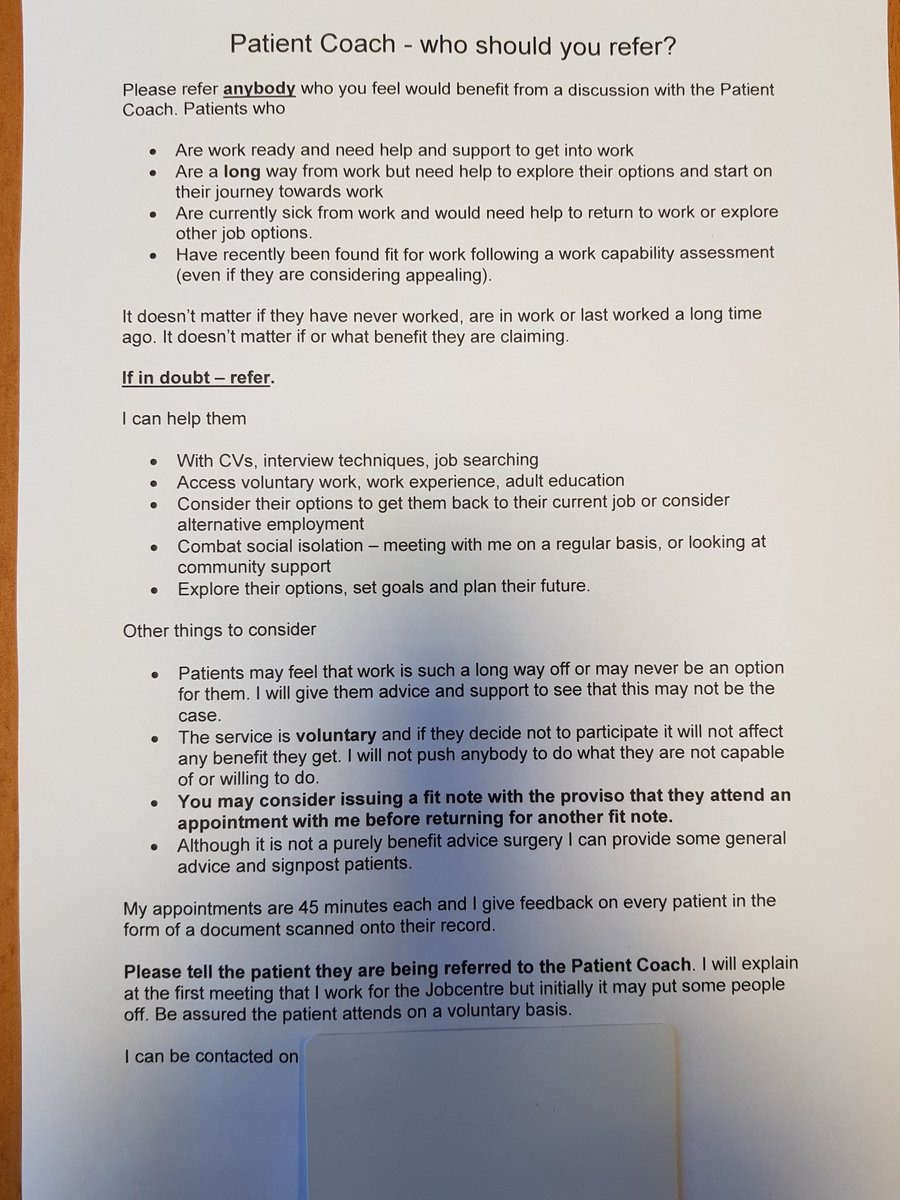
GPs told to consider making fit notes conditional on patients having appointment with work coach

Thanks to  for the copy of a patient work coach letter to GPs.

One of the most worrying comments on the above letter is that despite claiming the work coach service is voluntary, and that if a patient refuses to engage “it won’t affect any benefit they get”, the letter then goes on to suggest that doctors may consider the issuing of subsequent fit notes conditional (“with the proviso that”) on their patient attending a meeting with the work coach. That one sentence simply makes a mockery of the claim that patient engagement with work coaches is voluntary. 

Illnesses don’t respond to provisos or caveats. People don’t suddenly recover when the Department for Work and Pensions decides that they are fit for work. When job centre staff tell GPs to stop issuing sick notes to patients it can have catastrophic consequences, from which the government never seem to learn. In fact they don’t even acknowledge the terrible costs that their deeply flawed policies are inflicting on citizens. 

Julia Savage is a manager at Birkenhead Benefit Centre in Liverpool. In 2016, she wrote a letter (an ESA65B notification form) addressed to a GP regarding a seriously ill patient. It said:

We have decided your patient is capable of work from and including January 10, 2016.

“This means you do not have to give your patient more medical certificates for employment and support allowance purposes unless they appeal against this decision.

“You may need to again if their condition worsens significantly, or they have a new medical condition.” 

The GP subsequently repeatedly refused to provide him with new fit notes, even as his health deteriorated, and he died months later.

James Harrison – the patient – had been declared “fit for work” and the letter stated that he should not get further medical certificates. The Department for Work and Pensions contacted his doctor without telling him, and ordered him to cease providing sick certification, James died, aged 55.

He was very clearly not fit for work.

It is very worrying that the ESA65B form is a standardised response to GPs from the Department for Work and Pensions following an assessment where someone has been found fit for work.  

The government as boardroom doctors: political jobsworths

The Department for Work and Pensions issued a new guidance to GPs in 2013, regarding when they should issue a Fit Note. This was updated in December 2016. 

In the dogma document, doctors are warned of the dangers of “worklessness” and told they must consider “the vital role that work can play in your patient’s health”. According to the department, “the evidence is clear that patients benefit from being in some kind of regular work”

As a matter of fact, it isn’t clear at all.

The idea that people remain ill deliberately to avoid returning to work  – what Iain Duncan Smith and David Cameron termed “the sickness benefit culture” – is not only absurd, it’s very offensive. This is a government that not only disregards the professional judgements of doctors, it also disregards the judgements of ill and disabled people. However, we have learned over the last decade that political “management” of people’s medical conditions does not make people healthier or suddenly able to work.

Government policies, designed to ‘change behaviours’ of ill and disabled people have resulted in harmdistress and sometimes, in premature deaths.

Call me contrary, but whenever I am ill with my medical and not political illness, I generally trust my qualified GP or consultant to support me. I would never think of making an appointment to see the irrational likes of Esther McVey or Iain Duncan Smith for advice on lupus, or to address my health needs and treatment. 

The political de-professionalisation of medicine, medical science and specialisms (consider, for example, the ghastly implications of permitting job coaches to update patient medical files), the merging of health and employment services and the recent absurd declaration that work is a clinical “health” outcome, are all carefully calculated strategies that serve as an ideological prop and add to the justification rhetoric regarding the intentional political process of dismantling publicly funded state provision, and the subsequent stealthy privatisation of Social Security and the National Health Service. 

De-medicalising illness is also a part of that increasingly behaviourist-neoliberal process:  “Behavioural approaches try to extinguish observed illness behaviour by withdrawal of negative reinforcements such as medication, sympathetic attention, rest, and release from duties, and to encourage healthy behaviour by positive reinforcement: ‘operant-conditioning’ using strong feedback on progress.” Gordon Waddell and Kim Burton in Concepts of rehabilitation for the management of common health problems. The Corporate Medical Group, Department for Work and Pensions, UK. 

Waddell and Burton are cited frequently by the Department for Work and Pensions (DWP) as providing ‘scientific evidence’ that their policies are “verified” and “evidence based.” Yet the DWP have selectively funded their research, which unfortunately frames and constrains the theoretical starting point, research processes and the outcomes with a heavy ideological bias. 

This behaviourist framing simply shifts the focus from the medical conditions that cause illness and disability to the ‘incentives’, behaviours and perceptions of patients and ultimately, to neoliberal notions of personal responsibility and self-sufficient citizenship in the dehumanising context of a night watchman, non-welfare state, absent of any notion of human rights. 

Medication, rest, release from duties, sympathetic understanding – the remedies to illness – are being appallingly redefined as ‘perverse incentives’ for ill health, yet the symptoms necessarily precede the prescription of medication, the Orwellian renamed (and political rather than medical) “fit note” and exemption from work duties. Notions of ‘rehabilitation’ and medicine are being redefined as behaviour modification: here it is proposed that operant conditioning in the form of negative reinforcement –  punishment – will cure’ ill health. 

It’s a completely slapstick rationale, hammered into shape by a blunt instrument – political ideology. People cannot simply be ‘incentivised’ (coercion is a more appropriate term) into not being ill. Punishing people for being poor by removing their support does not ‘help’ them to stop being poor, either, despite the  doublespeak and mental gymnastic pseudoscientific rubbish the government spouts.

Turning health care into a government work programme 

The government dogmatically assert “The idea behind the fit note is that individuals do not always need to be fully recovered to go back to work, and in fact it can often help recovery to return to work.” 

It was 2015 when I wrote a breaking article about the government’s Work and Health programme, raising concerns that the Nudge Unit team were working with the Department for Work and Pensions and the Department of Health to trial social experiments aimed at finding ways of: “preventing people from falling out of the jobs market and going onto Employment and Support Allowance (ESA).” 

“These include GPs prescribing a work coach, and a health and work passport to collate employment and health information. These emerged from research with people on ESA, and are now being tested with local teams of Jobcentres, GPs and employers.”

Of course the government hadn’t announced these ‘interventions’ in the lives of ill and disabled people. I found out about it quite by chance because I happened to read Matthew Hancock’s  conference speech: The Future of Public Services.

I researched a little further and found an article in Pulse – a publication for for medical professionals – which confirmed Hancock’s comment: GP practices to provide advice on job seeking in new pilot schemeI posted my own article on the Pulse site in October 2015, raising some of my concerns.

Many of us have warned that the programme jeopardises doctor-patient confidentiality, risks alienating patients from their doctors and perverts the primary role and ethical mission of the healthcare system, which is to help people to recover from illnesses. Placing job coaches in GP surgeries makes them much less inaccessible, because it turns appointments potentially into areas of pressure and coercion. That is the very last thing someone needs when they become ill.

One worry was that the government may use the ‘intervention’ as a further opportunity for sanctioning ill and disabled people for ‘non-compliance’. People who are ill often can’t undertake work related tasks precisely because they are ill. Until recent years, this was accepted as common sense, and any expectation of sick people having to conform with such rigid welfare conditionality was quite properly regarded as both unfair and unrealistic.

I expressed concern that the introduction of  job coaches in health care settings, peddling the myth that ‘work is a health outcome’ would potentially conflict with the ethics and role of a doctor. I also stated my concern about the potential that this (then) pilot had for damaging the trust between doctors and their patients. 

In another article in 2016, titled Let’s keep the job centre out of GP surgeries and the DWP out of our confidential medical records, I outlined how GPs had raised their own concerns about sharing patient data with the Department for Work and Pensions – and quite properly so. 

Pulse reported that the Department for Work and Pensions (DWP) plans to extract information from GP records, including the number of Med3s or so-called ‘fit notes’  issued by each practice and the number of patients recorded as ‘unfit’ or ‘maybe fit’ for work, in an intrusive move described by GP leaders as amounting to “state snooping.”

Part of the reason for this renewed government attack on ill and disabled people is that the Government’s flagship fit note scheme, which replaced sick notes five years ago in the hope it would see GPs sending thousands more employees back to work to reduce sickness-related absence, despite GPs having expressed doubts since before its launch, has predicably failed.

The key reason for the failure is that employers did not take responsibility for working with employees and GPs seriously, and more than half (59%) of employers said they felt unable to support employees by making all of the legally required workplace adjustments for those who had fit notes signed as “may be fit for work.” Rather than address this issue with employers, the government has decided instead to simply coerce patients back into work without essential support.

Another reason for the failure of this scheme is that most people who need time off from work are ill and genuinely cannot return to work until they have recovered. Regardless of the government’s concern for the business and state costs of sick leave, people cannot be simply ushered out of illness and into work by the state to “contribute to the economy.”

When a GP says a person is ‘unfit for work’, they generally ARE unfit for work, regardless of whether the ‘business friendly’ government likes that or not. And regardless of the politically prescribed Orwellian renaming of sick notes, which show ‘paternalist’ linguistic behaviourism in action.

In 2017, the General Medical Council (GMC) – independent regulator for doctors in the UK – wrote a response to the government’s green paper: Improving Lives: The Work, Health and Disability Green Paper consultation. The authors of the document begin by saying ” Our purpose is to protect, promote and maintain the health and safety of the public by ensuring proper standards in the practice of medicine.”

The response continues: “Where doctors are expected to play a role in initiatives such as those set out in the Green paper, our concern is to ensure that any responsibilities that might be placed on doctors would be consistent with their professional obligations and would not risk damaging patients’ trust in their doctors. While we believe that many of the Green paper proposals are promising, we are concerned that key elements appear to present a conflict with the ethical responsibilities we place on doctors. The comments below are seeking clarification in these areas.”

And: “We understand from this Green paper, and from the Department of Work and Pensions’ published FOI response, dated 22 December 2016, that the work coaches who will conduct the mandatory health and work conversation with claimants will not be health professionals. There is a risk that claimants will not get the right support in setting health and work-related goals during this mandatory conversation if the work coach does not have clinical expertise.

“It would be helpful to know whether work coaches will be expected to have access to the claimant’s healthcare team and/or health records to inform these conversations. If so, we would appreciate reassurance that there will be a process for obtaining consent from the claimant, and providing assurance to the relevant health professionals that the individual has provided consent. Given that work coaches do not require medical expertise, we have some concerns about these conversations leading claimants to agree to health-related actions in a Health and Work ‘claimant commitment’. It seems possible that agreed actions might not be clinically appropriate for that individual or not the best course of action given their health condition. 

If a claimant commitment were reviewed by the claimant’s doctor (or other healthcare professional), and the doctor concluded that there was a health risk; then would the claimant be free to withdraw from the commitment without facing a benefits penalty? If not, then this would put the doctor and patient in a very difficult position, if it appeared that the patient had been poorly advised by the work coach and was not making an informed, voluntary decision in requesting a particular treatment or care regime from their doctor. 

We note the intention is for any agreement made in the Health and Work Conversation to be seen as voluntary. However, it seems to us that since the Conversation itself is mandatory and a Claimant commitment may influence subsequent handling of an individual’s Work Capability assessment, then in practice claimants may see these agreements as mandatory.

“As a result they may feel pressured to accept advice and make commitments which may not be appropriate in their case. This would place theirdoctors in a difficult ethical position, and we are concerned to ensure that this is not the case.

The authors add: “… we make it clear in our guidance that doctors must consider the validity of a patient’s consent to treatment if it is linked with access to benefits. Doctors should be aware that patients may be put under pressure by employers, insurers, or others to accept a particular investigation or treatment (paragraph 41, Consent: patients and doctors making decisions together).

“Difficulty could arise if a doctor does not believe that a patient is freely consenting to treatment and is instead only giving consent due to financial pressure. Doctors must be satisfied that they have valid consent before providing  treatment, which means they could be left with a difficult decision as to whether to refuse treatment in the knowledge that this could affect the patients benefit entitlements.” 

The GMC also raise concerns about how sensitive health data is collected and shared for purposes other for patients’ direct care, without patients being informed or giving consent. The government have simply proposed to access health care data to support “any assessment for financial support” and told GPs to assume consent has been given.

Promoting the myth that work is a ‘clinical outcome’ 

A Department for Work and Pensions research document published back in 2011 – Routes onto Employment and Support Allowance – said that if people believed that work was good for them, they were less likely to claim or stay on disability benefits. 

Of course it may be the case that people in better health work because they can, and have less need for healthcare services simply because they are relatively well, rather than because they work. 

From the document“The belief that work improves health also positively influenced work entry rates; as such, encouraging people in this belief may also play a role in promoting return to work.”

The aim of the research was to “examine the characteristics of ESA claimants and to explore their employment trajectories over a period of approximately 18 months in order to provide information about the flow of claimants onto and off ESA.” 

A political decision was made that people should be “encouraged” to believe that work was “good” for their health. There is no empirical basis for the belief, and the purpose of encouraging it is simply to cut the numbers of disabled people claiming Employment and Support Allowance (ESA) by “helping” them into work.

Another government document from 2014 – Psychological Wellbeing and Work – says: We know that being in work is good for wellbeing and that mental health problems are an increasing issue for the nation and so the Minister for Welfare Reform and the Minister for Care and Support jointly sought to expand the evidence base on common mental health problems.  

“A number of Government programmes assess and support those with mental health difficulties to work, but it is internationally recognised that the evidence base for successful interventions is limited. 

“The Contestable Policy Fund gives ministers alternative avenues to explore new thinking and strategies that offer cross-Government benefits. This report was commissioned through this route.” 

And: “Within the time and resources available for this study the research team did not undertake extensive assessment of the quality of the evidence base (eg assessing the research design and methodology of previous studies)”

The government have gone on to declare with authoritarian flourish that they now want to reinforce their proposal that “work is a health outcome.” Last year, a report by the Mental Health Task Force and chaired by Mind’s Paul Farmer, recommended that employment should be recognised as a ‘health outcome’.  I’m just wondering how people with, say, personality disorders, or psychosis are suddenly going to overcome the nature of their condition and all of a sudden successfully hold down a job for a minimum of six months.

Mind those large logical gaps… 

This has raised immediate concerns regarding the extent to which people will be pushed into work they are not able or ready to do, or into bad quality, low paid and inappropriate work that is harmful to them, under the misguided notion that any work will be good for them in the long run.

It has become very evident over recent years that the labour market is not delivering an adequate income for many citizens and despite “record levels of employment”, the problem seems to be getting bigger. The government’s answer to the problem has been to extend punishment those on low pay, rather than tackle employers who pay exploitative, low wages.

The idea of the state persuading doctors and other professionals to “sing from the same [political] hymn sheet”, by promoting work outcomes in social and health care settings is more than a little Orwellian. Co-opting professionals to police the welfare system is very dangerous. 

In linking receipt of welfare with health services and “state therapy,” with the single intended outcome explicitly expressed as employment, the government is purposefully conflating citizen’s widely varied needs with economic outcomes and diktats, isolating people from traditionally non-partisan networks of relatively unconditional support, such as the health service, social services, community services and mental health services.

Public services “speaking with one voice” as the government are urging, will invariably make accessing support conditional, and further isolate already marginalised social groups. Citizens’ safe spaces for genuine and objective support is shrinking as the state encroaches with strategies to micromanage those using public services. This encroachment will damage trust between people needing support and professionals who are meant to deliver essential public services, rather than simply extending government dogma, prejudices and discrimination.

State micromanagement of tenants

The GMC say in their response to the government’s proposals: “We are unclear about the evidence that might support a move to the position that ‘being in employment’ should be regarded as a ‘clinical outcome’ that healthcare professionals are expected to work towards with people of employment age seeking health-related advice and treatment. This is a highly contentious issue and indeed Dame Carol Black’s report certainly makes clear that there is limited support for this within the profession.” 

I’m not unclear. There is no evidence. In an era of small state neoliberalism and ideologically driven austerity, it is an act of sheer political expediency to claim that ‘worklessness’ is the reason for the poor health outcomes that are in fact correlated with increasing inequality, poverty and lower standards of living – higher mortality;  poorer general health, long-standing illness, limiting longstanding illness; poorer mental health, psychological distress, psychological/psychiatric morbidity; higher medical consultation, medication consumption and hospital admission rates.

Both social security and the National Health Service have been intentionally underfunded and run down by the Conservatives, who have planned and partially implemented a piecemeal privatisation process by stealth, to avoid a public backlash.

Unemployment (not ‘worklessness’ –  that’s part of the privileged discourse of neoliberalism, which serves to marginalise the structural aspects of persistent unemployment and poverty, by transforming these into individual pathologies of benefit ‘dependency ‘and ‘worklessness’) is undoubtedly associated with poverty, because welfare provision no longer meets the most basic living costs.

However to make an inferential leap and claim that work is therefore ‘good’ for health’ is incoherent, irrational and part of an elaborate political gaslighting campaign of an authoritarian government, who simply don’t want to address growing poverty and inequality caused by their own neoliberal policies.

The direction that government policy continues to be pushed in represents a serious threat to the health, welfare, wellbeing, basic human rights, democratic inclusionand lives of patients and the political independence of health professionals.


Related

The new Work and Health Programme: government plan social experiments to “nudge” sick and disabled people into work 

Illustration by Jack Hudson


My work is unfunded and I don’t make any money from it. This is a pay as you like site. If you wish you can support me by making a one-off donation or a monthly contribution. This will help me continue to research and write independent, insightful and informative articles, and to continue to support others.

DonatenowButton

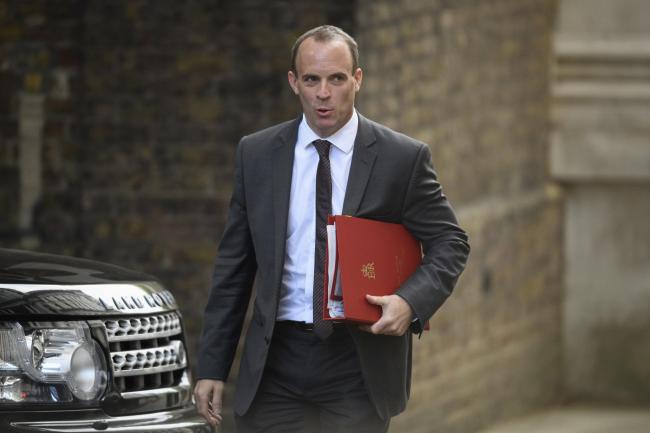
Authoritarian Brexit secretary refuses to give evidence to Parliament

Image result for Dominic Raab refuses to

The Lords European Union Committee has written to Dominic Raab MP, Secretary of State for Exiting the European Union, urging him to engage with Committees in order to facilitate scrutiny of the Withdrawal Agreement and political statement on the future UK-EU relationship.

See:

Lord Boswell, Chair of the Committee, reacted with anger to Raab’s refusal to engage and to behave in a democratically accountable manner. In a letter, he told the Brexit secretary his behaviour was ‘unacceptable.’ 

The former Conservative MP said: “Select committees have a job to do. Lack of engagement from the government, keeping us in the dark, means we can’t do that job.

He also said “Brexit was supposed to be about enhancing the role of parliament, not diminishing it – but that message doesn’t seem to have got through to ministers.”

Background

The Committee wrote the Secretary of State for Exiting the EU on 5 September 2018 inviting him to appear before the Committee as soon as possible after the October European Council, after the Secretary of State gave a Commitment in a letter of the 17 July “to give evidence on a regular basis”.

The Committee was told on Tuesday 23 October that the Secretary of State for Exiting the EU will be unable to attend or give evidence to the Committee until after a deal with the EU has been finalised. The Committee describes this as “unacceptable… [it] inhibits the Committee in fulfilling its obligations in scrutinising the progress of Brexit negotiations”.

The Committee’s letter also called on the Government to ensure that enough time is allowed between an agreement being reached and any ‘Meaningful Vote,’ so that committees can make recommendations to the two Houses. Recent reports suggest that the time allowed for committees to report on the agreement and the ‘political declaration’ on future UK-EU relations could be a little as ten days.

The letter goes on to say “…  it is imperative that both Houses—and the wider public—are able to have an informed debate. This means, among other things, that the Committees of both Houses with responsibility for scrutinising the Brexit negotiations must have an opportunity to report on the text of any agreement ahead of the ‘Meaningful Vote’—in the same way as the AFCO Committee of the European Parliament will have an opportunity to report ahead of any vote in that Parliament.

“We therefore seek your assurance that the Government will allow time for effective
Committee scrutiny of any agreement, ahead of the ‘Meaningful Vote’; and we ask you to setout your plans for engaging with Committees in order to facilitate this scrutiny.”

The Committee requested that Raab make an appearance before the end of November, saying his refusal “flies in the face of the commitment in your letter of 17 July, ‘to give evidence on a regular basis’.”

The Brexit department have been contacted for a comment. 

A little about Dominic Raab

Raab lies on the swivel eyed end of the right wing continuum. In 2017, he was branded “offensive” by then Liberal Democrat leader Tim Farron after saying “the typical user of a food bank is not someone that’s languishing in poverty, it’s someone who has a cash flow problem”. The Office For National Statistics also took issue with Raab’s claims that immigration has caused house prices to rise, demanding that he present data to back up such assertions. A document published by the Ministry of Housing, Communities and Local Government shows that the finding was based on an out-of-date model that had never been intended for this kind of analysis. 

Theresa May herself has previously spoken out against Rabb’s controversial remarks, scorning his categorization of feminists as ‘obnoxious bigots’. In an article in January 2011 on the Politics Homewebsite, Raab argued in favour of transferable paternity leave and against “the equality bandwagon” “pitting men and women against each other”. He argued in favour of a ‘consistent approach’ to sexism against men and women commenting that some feminists were “now amongst the most obnoxious bigots” and it was sexist to blame men for the recession.

He believes that the welfare state should be further reduced and his opposition to human rights and equalities is unremittingly and dangerously authoritarian. 

Raab’s opinions reflect contempt for international human rights frameworks in particular. The EU Charter of rights has not been included in the Withdrawal Bill.

Writing in the Daily Mail on prisoners votes back in 2013, Raab said: “The problem today is that the Strasbourg Court is packed with academics and politically motivated lawyers desperate to foist their ‘progressive’ agenda on the rest of Europe. The Strasbourg judges have long since given up merely interpreting the European Convention – their proper job – and are jealously usurping the power of elected lawmakers in sovereign states to create new law, inventing novel rights along the way.”

And “The Human Rights Act [UK] is bad enough. But, at least it states plainly that our courts only have to ‘take into account’ Strasbourg case-law, rather than slavishly bow to it. Yesterday, the Supreme Court shifted the goal posts, ruling that British courts must comply with Strasbourg rulings unless it involves ‘some truly fundamental principle’, or an ‘egregious oversight or misunderstanding’ of UK law.”

He also said “The wretched Human Rights Act should be replaced with a British Bill of Rights, to insulate us from the judicial onslaught from Strasbourg. And when we renegotiate the UK’s relationship with the European Union, we must shield our democracy from their ambition to impose yet another layer of European human rights law on the long-suffering British public.”

He seems to have completely missed the point of human rights. And scarily, he fails to make the connection between civil rights and democracy. 


Related

An introduction to Dominic Raab, the new Brexit sectarian

Government refuse to publish Brexit impact assessment. We need to ask why

The Centre for Social Justice say Brexit is ‘an opportunity’ to introduce private insurance schemes to replace contribution-based social security

European fundamental rights charter to be excluded in the EU withdrawal Bill, including protection from eugenic policy

Brexit is a zero sum neoliberal strategy


My work is unfunded and I don’t make any money from it. This is a pay as you like site. If you wish you can support me by making a one-off donation or a monthly contribution. This will help me continue to research and write independent, insightful and informative articles, and to continue to support others.

DonatenowButton

George Osborne ignored civil servants’ warnings of increased child poverty due to 1% public sector cap

Image result for George osborne

Back in July 2015, George Osborne, then chancellor, announced that the 1% public sector pay cap would be extended for four years – a policy that had not been included in the Conservative manifesto. The cap remained in force until the 2018/19 pay round.

Documents released under the Freedom of Information Act show that Osborne had received advice from civil servants warning him that the policy would “make it more difficult for low-income families with children to access essential goods, and will therefore make it harder for the government to hit the Child Poverty Act targets.”

Authoritarian Osborne ignored civil servants’ warnings that extending the public sector pay cap would force children into poverty, the newly released documents reveal. Civil servants also warned that extending the cap “could increase financial pressure on families of public sector workers which may have a negative impact on family relationships”.

The previously undisclosed warnings are contained in a ministerial decision record obtained by GMB union. The papers reveal that ministers had also considered freezing public sector pay for two years. 

The Treasury released the paper to GMB after a prolonged delay and following being instructed to respond to the GMB by the information commissioner. Rehana Azam, GMB’s national secretary, said the pay freeze had a devastating impact on the union’s members for many years.

Osborne’s policy has directly affected over a million families with children. There are an estimated 2.4 million dependent children in households in which there is at least one public sector worker in the UK.

Azam went on to say : “This document is a mark of shame on ministers who imposed years of real-terms pay cuts in the full knowledge that it would condemn families and children to poverty.

“If Theresa May is serious about ending ‘burning injustices’, she must use this budget to reverse the fall in living standards that this government has imposed on ordinary working people.”

It emerged earlier this month that the cap on benefits, also imposed by Osborne in 2015, will mean that low-income families will miss out on an extra £210 a year from April. Analysis by the Resolution Foundation highlighted that more than 10m households will face a real-terms loss of income from the government’s austerity measures, introduced when Osborne was chancellor. It was also reported this week that Philip Hammond, Osborne’s successor, is considering imposing regional public sector pay rates. However, similar proposals were defeated in the 2010 to 2015 parliament.

A Whitehall source confirmed that the Treasury is considering overhauling the system to allow greater regional variation in pay rises. The chief secretary to the Treasury, Liz Truss, reportedly told the cabinet that pay rises should be ‘determined by retention, performance and productivity.’

The reasoning means that those working in London and the south-east could receive greater increases because pay in other regions is already more “competitive” with private sector levels, the source confirmed.

Meanwhile, Hammond is under increasing pressure to loosen curbs on spending after May used her conference speech in Birmingham to tell voters that next year’s spending review would mark the end of almost a decade of austerity.

George Osborne was contacted for comment and has not responsed at the time of writing.

Image result for George osborne


My work is unfunded and I don’t make any money from it. This is a pay as you like site. If you wish you can support me by making a one-off donation or a monthly contribution. This will help me continue to research and write independent, insightful and informative articles, and to continue to support others.

DonatenowButton

Public and Commercial Services Union wins £3 million compensation from the Department for Work and Pensions

Image result for PCS union

The Public and Commercial Services Union (PCS) has won a major victory over the government. The High Court has ruled that ministers acted illegally by withdrawing check-off, the decades-old practice of collecting members’ union subscriptions directly from their pay packet.

The union has won £3 million from the government because of the illegal moves the Department for Work and Pensions (DWP) used to try to ‘crush’ the PCS.

In 2015 the union was at the heart of opposition to the government, fighting against the government’s cuts and closures andchallenging when the Conservatives were robbing members of their redundancy rights. The union were steadfast in opposing austerity.

As a result the then Conservative Cabinet Office minister, Francis Maude, took a particularly vicious and authoritarian decision to attack members’ terms and conditions, also launching an offensive on union reps and attempting to bankrupt the PCS. Maude announced overnight that he would not allow members to pay their union subscriptions directly from their pay packets. However, this was a system that had been in operation for many decades. A union spokesperson said he did that because he knew that 90% of the union’s  income came from that method.

Magnificent campaign

PCS say: “In a magnificent campaign we signed up over 160,000 members to pay their subs by direct debit in a matter of weeks and months to stop us from going bankrupt and to ensure we could continue to represent members at work. We also took legal action in the High Court to show that the government had acted illegally, and to get compensation. Today that case has been settled and in a humiliating defeat for the government, in its attempt to smash PCS and other unions in the public sector, it has to pay £3 million compensation and all of our legal costs.

“In the DWP, reps and members worked hard together to ensure that PCS didn’t suffer as a result of check-off ending. Fran Heathcote, DWP President said ‘Our members recognised this attack for what it was, and it is pleasing to learn that the courts have recognised that too’.

“We now plan to take legal action against every major government department because of the illegal way they’ve treated us.”

PCS General Secretary Mark Serwotka said: “Today’s announcement tells us we have settled one departmental case on union busting, we have many more to come. That’s good news for all of us, and now we’ll ensure we use that money to benefit our members.

“This goes to show that this union can win. We can win in the courts and we can win through campaigning. We’ve defeated the government on the Civil Service Compensation Scheme and we’re waiting for the outcome of a judicial review on the way the government handled pay this year because we believe they did not consult us lawfully. But we’ve got more campaigns to fight. We’ve still got to challenge the government on pay, and ensure that next year we can win above inflation pay rises.

“We will continue to take them to court when we can, but the key to winning is to be a stronger union in every workplace. If you know a colleague who hasn’t joined PCS, please urge them to join. If you’re a member consider becoming a rep. The more of us who are in the union, the more of us who are active means we won’t just beat the government in court we will beat them in our campaigning, too.”

I say well done. A splendid, well fought victory.


Related

Why I strongly support Trade Unionism

The link between Trade Unionism and equality

The “Let Lynton Lobby Bill” – Grubby Partisan Politics and a Trojan Horse


My work is unfunded and I don’t make any money from it. This is a pay as you like site. If you wish you can support me by making a one-off donation or a monthly contribution. This will help me continue to research and write independent, insightful and informative articles, and to continue to support others.

DonatenowButton

Conservative MSP faces calls to resign over eugenic comments about benefits claimants

Michelle Ballantyne

 Michelle Ballantyne MSP

A Conservative Member, of the Scottish Parliament (MSP) has said welfare claimants ‘cannot have as many children as they like’ during her defence of the government’s welfare reforms.

The Conservative spokesperson on social security made the claim that poor people should not have more than two children, during a debate on poverty and inequality at Holyrood. The Scottish Government’s Cabinet Secretary for Communities and Local Government, Aileen Campbell MSP, intervened to ask whether the spokesperson was “proud of the two child limit and proud of the rape clause”.  

MSP Michelle Ballantyne said, “It is fair that people on benefit cannot have as many children as they like, while people who work and pay their way and don’t claim benefits don’t have to make decisions about the number of children they have”.

Ballantyne seems to have overlooked the fact that many people may have their children while in work. Over the last eight years, employment has become precarious, with many people moving in and out of work frequently. Furthermore, as wages have stagnated and been devalued, many people in work also rely on welfare to ensure they can meet their basic needs. Yet she implies that those claiming social security are a distinct class of  people who don’t work.  

Scottish National Party MSP, Tom Arthur, furiously criticised Ballantyne’s offensive eugenic suggestion, stating: “In my two and half years in this parliament, the contribution from Michelle Ballantyne was one of the most disgraceful speeches I have ever heard.

“Six minutes of pompous Victorian moralising, that would have been better suited to the pages of a Dickens novel.

“And to suggest that poverty should be a barrier to a family, that people who are poor are not entitled to any more than two children – what an absolutely disgraceful position.

“And she should be utterly, utterly ashamed of herself.”

Ballantyne previously called for a debate on “whether we feel there should be no restriction on the number of children you can have”.  She was widely condemned for her appalling defence of the two-child cap on benefits.

Ballantyne has argued previously that welfare recipients should have limits imposed on their right to a family life. In an interview in May this year, she said: “That’s a debate we’re going to have to have in Scotland in terms of whether we feel there should be no restriction on the number of children you can have.”

She added: “If you are looking for it in terms of what is nice, and what feels good then it’s easy to say we shouldn’t impose limits.”

In the same interview, Ballantyne made the ludicrous claim that, while foodbank demand was rising, “what we haven’t got is hard evidence about what the real causes are… I haven’t yet seen the concrete evidence of where that’s coming from.”

Foodbank providers have repeatedly provided evidence linking demand with Conservative welfare policy, including sanctions and the roll-out of Universal Credit.


SNP MSP Tom Arthur said: “The mask has well and truly slipped. Michelle Ballantyne’s horrific comments were not a slip of the tongue, but instead reflected her long-standing views.

“And now that these previous, utterly unacceptable comments about imposing a ‘restriction’ on the number of children people should have has come to light, she should withdraw the remark and apologise for it.

“The two child cap will put 150,000 Scottish children at greater risk of poverty by 2021 – but to Michelle Ballantyne, that’s a price worth paying so she can lecture those in low paid work or who’ve fallen on hard times.

“The Tories truly are the nasty party.”

Arthur has since called on Ballantyne to resign. He said: “Michelle Ballantyne’s comments were vile and ignorant – and should have no place in Scottish political life”, he said.

“Given her comments, and what we now know about her hypocrisy and her form on the issue, Michelle Ballantyne’s position as Tory welfare spokesperson is completely untenable.

“That Ruth Davidson thought someone with Ms Ballantyne’s views would be acceptable in this role is all we need to know about the Scottish Tories.

“If Ms Davidson and her Deputy won’t remove Ms Ballantyne she should resign as Tory welfare spokesperson – otherwise it will be clear that the Tories are prepared to drag the debate into the gutter as their welfare cuts drive more and more children into poverty.”

The two-child policy was passed into law via universal credit. The original idea for treating children as a commodity and moralising about what items poor people should spend their money on came from Iain Duncan Smith – the Tory consensus is definitely no flat screen TVs, (has anyone tried to buy one that isn’t flat-screened now?) or iphones, and certainly not more children than the government deems appropriate for poorer families.

The Conservatives really do think like this. It’s not just a ‘slip’ by one nasty MSP. It’s now a fundamental part of the wretched and punitive welfare policy framework. 

And the punch line:

Related

The government’s eugenic policy is forcing some women to abort wanted pregnancies

The government’s eugenic turn violates human rights, costing families at least £2,800 each so far, according to DWP statistics

UN to question the Conservatives about the two-child restriction on tax credits

A brief history of social security and the reintroduction of eugenics by stealth

Eugenics is hiding behind Hitler, and informs Tory policies


My work is unfunded and I don’t make any money from it. This is a pay as you like site. If you wish you can support me by making a one-off donation or a monthly contribution. This will help me continue to research and write independent and informative articles, and to continue to support others.

DonatenowButton

Former Universal Credit staff reveal call targets and ‘deflection scripts’

Image result for universal credit logo

Joanne Huggins worked on the universal credit helpline in the Grimsby service centre for nearly two years before quitting in April. She had worked in social housing and understood the social security system but was still surprised by what she found. I did not expect it to be so fundamentally flawed,” she told Patrick Butler, in a Guardian interview back in July.

She had hoped she would be able to help resolve the problems reported by claimants, some of whom would call in upset after payments were late, or were unexpectedly reduced, but soon found the system resistant to offering quick or easy assistance.

“It felt like these were not people that you serve, not customers, not important, but people who get in the way of what you are are trying to do, which was to hit call targets,” she said.

She said it was “heartbreaking” having to block or deflect vulnerable claimants, telling them that they would not be paid, or would have to submit a new claim, or have a claim closed for missing a jobcentre appointment, or be sanctioned – a penalty fine for breaching benefit conditions – or go to the food bank.

She added that the system felt crude rather than intuitive, and her role often felt adversarial. Huggins said: “It was more about getting the person off the phone, not helping.”

Bayard Tarpley also worked in the Grimsby centre. He said the system was not only avoidably complex but failed to anticipate that claimants may find it difficult. Tarpley gives countless examples of how his experience showed that the system is designed irrationally, or clumsily, or in a way that confuses staff as well as claimants and leads directly to people not receiving the lifeline financial support they need and are entitled to.

Tarpley said:

“Universal credit is like one of those old Disney cartoons with a leaky boat. The holes spring up, and Bugs Bunny or whoever sticks a finger in, but then a new hole appears, and they end up sprawled across the boat trying to block all the leaks. The holes aren’t the problem, though, it’s the boat” 

Staff often get confused by the welter of system updates, guidance and memos.

“This results in a massive variation in understanding between agents, teams and especially service centres, meaning that claimants can call three times in a row and get three different answers to a query.”

He added:

“This piled excessive responsibilities on to call centre staff. When people call up with very specific questions about how their terminal illness affects their benefit, it’s me that answers that question. It’s me that has to judge whether it’s appropriate to ask a claimant if her third child is the result of sexual assault because it may affect her benefit entitlement.

“The decisions I make on a daily basis have an impact on how quickly someone is able to pay their landlord, turn the heating back on, get their children to school. I have made decisions that have resulted in people being evicted, and decisions I have made have led people to tell me that it is the reason they are self-harming.

“I would argue that I am scarcely qualified for any of those things, never mind all of them.”

Now, the former Universal Credit service centre advisor, Bayard Tarpley, has revealed details of a ‘deflection script’ that staff are given to get claimants off the phone. Speaking to Sky News, ahead of a major report on Universal Credit that is due to be released by the Public Accounts Committee (PAC) today, Tarpley echoed earlier concerns raised by Huggins. about call targets. 

He said:  I think certainly from a frontline position I wasn’t particularly confident that Universal Credit was meeting that goal of helping people work and making them better off based on their circumstances.”

He added:

“We were encouraged to end the call sooner so that we could quickly get through things.

“There didn’t seem to be a lot of changes that were specifically there to support claimants.

“So there was there is something called the deflection script. It was a piece of paper that explains what to do when someone calls in.

“Even if a problem could be solved then and there on the phone we were encouraged to do everything in our power to get them to hang up the phone and do that online.”

The Department for Work and Pensions (DWP) released a statement that denies the existence of such a deflection script but added that “staff may use aides to effectively deal with claimants.”

A spokesperson added: “We take the training of our call handling staff extremely seriously to ensure they are prepared to handle a range of enquiries, regardless of how long they might take – there is no policy to get callers off the phones.

“Since 2010, one million people have been lifted out of absolute poverty, with on average 1,000 more people going into work each and every day since 2010.”

Whistleblower Tarpley concludes:

The DWP’s ‘culture of denial’

With the chancellor under intense pressure to act in his budget next Monday to cushion the impact of the the universal credit system, the public accounts committee has warned that the government has ignored the concerns of those at the sharp end. The committee took evidence from charities and local authorities, which told MPs they had seen sharp increases in rent arrears and food bank usage among new recipients of universal credit, not least because of the five-week wait for the first payment.

The DWP’s own survey found that 40% of people were experiencing financial difficulties eight or nine months into their claim, and work and pensions secretary Esther McVey recently admitted the rollout would leave “some people worse off”.

The committee has said McVey’s department has repeatedly been unresponsive to on-the-ground evidence about the practical problems with universal credit, and what it called the “unacceptable hardship” faced by many.

“The department’s systemic culture of denial and defensiveness in the face of any adverse evidence presented by others is a significant risk to the programme,” the MPs said, citing the DWP’s response to an earlier critical report by the National Audit Office (NAO).

McVey was forced to apologise to parliament earlier this year, when the NAO’s head, Sir Amyas Morse, complained that she had misrepresented the report as positive, when it had called for a “pause” in the rollout of universal credit.

Several of the organisations that gave evidence told the committee they had a positive relationship with local jobcentres, but found it impossible to influence the DWP nationally.

Meg Hillier, the public accounts committee’s chair, said: “This report provides further damning evidence of a culture of indifference at DWP – a department disturbingly adrift from the real-world problems of the people it is there to support.”

The committee said the help available to people moving over to universal credit, known as “universal support”, which is funded by the DWP but commissioned by councils, is patchy, and “not fit for purpose” – because it does not include debt advice, for example

By June this year, 980,000 people were already in receipt of universal credit, with another 7.5 million due to move over to the new system. So far, only new claimants, or those whose circumstances have changed, have been moved on to universal credit.

The government recently delayed so-called “managed migration”, which will allow existing claimants to be moved across, from January 2019 to later in the year, apparently because it feared being defeated by backbench rebels in parliament if it tabled the necessary regulations.

The committee criticised the DWP’s claim that switching to universal credit will save taxpayers up to £8bn, by coaxing more people back into the workforce. They said that the department cannot say how it will measure whether the targets have been hit – or how many of those moving into work would have done so under the old system anyway.

A DWP spokesperson said: “We will carefully consider the findings in the report – a number of which we are already working on. For example, we have recently begun a new partnership with Citizens Advice to deliver better support to the most vulnerable, and are working with stakeholders to ensure the Managed Migration process for people moving onto Universal Credit works smoothly. 

“So far this year we have already announced several improvements to Universal Credit, such as plans to reinstate housing benefit for vulnerable 18-21 year olds, making direct payments to landlords, offering 100% advances and providing an additional 2 weeks of housing benefit for claimants.”

The so-called improvements are very clearly not enough. Legacy benefits were calculated to meet very basic living costs. Because universal credit leaves many people worse off, it means that they are facing unacceptable levels of extreme hardship and situations of absolute poverty – where people can’t meet their fundamental survival needs such as food, fuel and shelter. In this respect, Universal Credit is now not just failing our contemporary standards of addressing poverty but those of William Beveridge in the 1940s.

Until that issue is addressed, universal credit will continue fail the people it was allegedly designed to support. 


My work is unfunded and I don’t make any money from it. This is a pay as you like site. If you wish you can support me by making a one-off donation or a monthly contribution. This will help me continue to research and write independent, insightful and informative articles, and to continue to support others.
DonatenowButton

PMQs showcases a government that is spiteful and Conservative with the truth


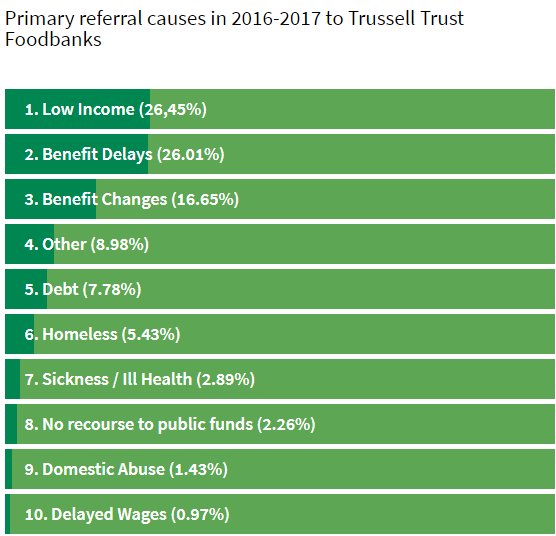
In a very wealthy so-called liberal democracy, from 2016 to last year, these are the reasons why people were referred to food banks. The highest number of referals are among the low earners, demonstrating the government’s slogan ‘making work pay’ is a myth. Work does not pay for many. However, the government chooses to gaslight the population about consequences of it’s policies.

Today in Prime Minister’s Questions: 

As my local Labour MP, Kevan Jones quipped: “the Conservatives will be celebrating re-opening workhouses next.”

The spite and malice on the Prime Minister’s face as she responds to the opposition, using blatant and snide playground gestures to intimidate never fails to anger me. It’s disgraceful that the government reduce serious political issues to immature ‘win or lose’ game playing and PR tactics.

The truth is that Universal Credit is not just failing our ‘relative’ contemporary standards of poverty but those of William Beveridge in the 1940s. Conservatives accuse Labour of ‘taking us back to the seventies’, but May’s government have taken us back to the 1940s, and to absolute poverty levels that existed before there was a welfare state. Absolute poverty is when people cannot meet their basic survival needs: food, fuel and shelter. The UK’s publicly funded social security system is no longer an adequate provision for people to meet the costs of their most fundamental and universal human needs. 

This is a government that has demanded the most from those citizens with the very least under the guise of austerity, while handing out public funds to the private banks accounts of the wealthiest.

Theresa May also selectively and maliciously quoted a section of a book – Economics For The Many  – which was edited by Shadow Chancellor John McDonnell, declaring Labour’s costed manifesto “doesn’t add up”. the Prime Minister went on it to claim the Labour party would “wreck the economy”, but as usual she was being Conservative with the facts.

She attempted to make it look like Professor Simon Wren-Lewis was criticising Labour’s economic strategy, but he wasn’t. The quote mining – a frequently used Conservative strategy to present lies and to mislead parliament and the public – referred to a book chapter May referred to by Wren Lewis , an economist and member of Labour’s Economic Advisory Committee.  Basically the chapter says that Labour will ensure: 

  • The Government is spending less than it takes in in tax within five years
  • Government debt is falling within five years
  • Labour will only borrow for investment and infrastructure, not for day-to-day spending.

Wren Lewis never said that Labour’s manifesto didn’t ‘add up’. He said that other people claimed it didn’t add up. And he said that it didn’t matter.

Wren Lewis notes in the chapter that the Institute for Fiscal Studies (IFS)claimed it ‘doesn’t add up’ – which is a very different thing. And actually, the IFS didn’t really say that either. It said that it was “hard to say” whether Labour’s pledge to reduce debt was compatible with their promises of a wave of nationalisations of water and energy.

The IFS said essentially that because the Labour party would transform the economy so radically, it would be impossible to say whether their manifesto costings would be accurate.

It’s a priceless cheek, as well as a malicious attack, especially considering that the Conservatives did not bother to cost their own manifesto at all.

The blatant lie also shows the prime minister’s utter contempt for democracy.

Finally, a word about the Conservative’s crowing regarding ‘their’ employment levels. 

The ‘high employment’ narrative does not benefit citizens, who face zero hour contracts, little employment security and more than half of those people needing to claim welfare support are in work. The Conservative’s definition of ‘employment’ includes people who work as little as one hour a week. It includes carers. It also includes people who have been sanctioned.

Now there is a perverse incentive to furnish a hostile environment of Department for Work and Pensions’ administrative practices in action.

When the Conservatives took office in 2010, on average citizens earned £467 a week. The latest figures from the Office for National Statistics (ONS) show that we now take home £460 a week. In other words, average wages have gone down in real terms during the eight years of Conservative-Lib Dem and Conservative governments, while the cost of living has risen substantially. It’s a misleading to make these claims at all when weekly earnings are actually 1.3 per cent lower now in real terms than they were when the Conservatives took office in 2010.

Furthermore, the ONS also produced household data suggesting that the true rate of unemployment is 4 times greater than the government’s preferred statistic.

The Conservative’s official definition of unemployment disguises the true rate, of course. In reality, about 21.5% of all working-age people (defined as ages 16 to 64) are without jobs, or 8.83 million people, according to the Office for National Statistics. I know whose statistics I believe, given the Conservative’s track record of abusing figures and telling lies.

Here is more data here on the effect of chronic underemployment of the unemployment rate, and the depressing Conservative reality of the ‘business friendly’ gig economy.

Conservatives being conservative with the truth as ever.

And spiteful.


I don’t make any money from my work. But you can help me by making a donation to help me continue to research and write informative, insightful and independent articles, and to provide support to others. The smallest amount is much appreciated – thank you. 

DonatenowButton