Category: Uncategorized

Government changes to Mental Capacity Act threatens human rights of vulnerable citizens

DoLs

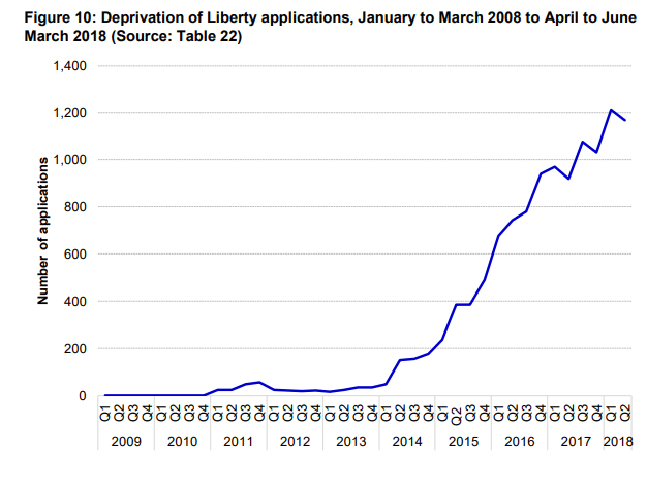
Under the Conservative government, applications for the Deprivation of Liberty of citizens have soared. (Source: Court of Protection hub.) 

In 2014, a Supreme Court judgment significantly widened the definition of deprivation of liberty, meaning more people were subsequently considered to have their liberty deprived. There was a ten-fold increase in the number of deprivation of liberty applications following the judgment. Services struggled to cope, deadlines were “routinely breached” and the Law Commission decided that the system should be replaced. 

Law Commissioner Nicolas Paines QC said the Deprivation of Liberty Safeguards were designed at a time when fewer people were considered deprived of their liberty and now it was “failing” people it was set up to protect.

“It’s not right that people with dementia and learning disabilities are being denied their freedoms unlawfully,” he said.

“There are unnecessary costs and backlogs at every turn, and all too often family members are left without the support they need.”

Over the last eighteen months, the Law Commission – a statutory independent body created by the Law Commissions Act 1965 to keep the law of England and Wales under review and to recommend reform where it is needed – has been reviewing the framework that is called Deprivation of Liberty Safeguards (DoLs) which is put in place when a person who lacks capacity is placed in a care home.

Deprivation of Liberty, which is defined in part of the Mental Capacity Act 2005, is there to ensure that there are checks and balances for the person placed in care, that decisions are made in their best interest and that an independent advocate can be appointed to speak on their behalf in these decision making processes.

The Commission made recommendations to change the law, following public consultation. The recommendations included:

  • Enhanced rights to advocacy and periodic checks on the care or treatment arrangements for those most in need.
  • Greater prominence given to issues of the person’s human rights, and of whether a deprivation of their liberty is necessary and proportionate, at the stage at which arrangements are being devised.
  • Extending protections to all care settings, such as supported living and domestic settings, therefore removing the need for costly and impractical applications to the Court of Protection.
  • Widening the scope to cover 16 and 17 year olds and planned moves between settings.
  • Cutting unnecessary duplication by taking into account previous assessments, enabling authorisations to cover more than one setting and allowing renewals for those with long-term conditions.
  • Extending who is responsible for giving authorisations from councils to the NHS if in a hospital or NHS healthcare setting.
  • A simplified version of the best interests assessment, which emphasises that, in all cases, arrangements must be necessary and proportionate before they can be authorised.

However, the Law Commission recognised that many people who need to be deprived of their liberty at home benefit from the loving support that close family can provide. These reforms, which aimed to widen protections to include care or treatment in the home, were designed to ensure that safeguards can be provided in a simple and unobtrusive manner, which minimises distress for family carers.

Importantly, the Commission also recommended a wider set of reforms which would improve decision making across the Mental Capacity Act. This is not just in relation to people deprived of liberty. All decision makers would be required to place greater weight on the person’s wishes and feelings when making decisions under the Act.

Professionals would also be expected to confirm in writing that they have complied with the requirements of the Mental Capacity Act when making important decisions – such as moving a person into a care home or providing (or withholding) serious medical treatment. 

The government responded and put forward proposals for changing the Mental Capacity Act. However, though this new legislation has been worded carefully, its effect will be to risk the removal of key human rights; it also ignores the entire concept of best interests and has put decision making power over people’s liberty and rights in the hands of organisations and their managers with a commercial interest in decisions and outcomes.  

Any statutory scheme which permits the state to deprive someone of their liberty for the purpose of providing care and treatment must be comprehensible, with robust safeguards to ensure that human rights are observed. 

In July 2018, the government published the Mental Capacity (Amendment) Bill, which if passed into law, will reform the Deprivation of Liberty Safeguards (DoLS), and replace them with a scheme known as the Liberty Protection Safeguards (although the term is not used in the Bill itself).

The Bill draws on the Law Commission’s proposals for reforming DoLS, but generally does not address some of the wider Mental Capacity Act reforms that the Law Commission suggested. Proposed reforms around supported decision making and best interests are not included, for example, and these omissions are very controversial.

In a statement accompanying the proposals the government claims that £200m per year will be saved by local authorities under the new scheme, though the increased role of the NHS and independent sector providers will lead to increased costs elsewhere.

The new responsibilities being imposed on care homes, Clinical Commissioning Groups (CCGs) and hospitals will need some thought, resources and training.

Members of the House of Lords have already warned that the Bill to reform the law on deprivation of liberty does not adequately secure the rights of people subject to restrictive care arrangements. In Parliament’s first debate on the Mental Capacity (Amendment) Bill on 16 May this year, peers questioned several elements of the legislation. 

The Liberty Protection Safeguards are designed to provide a much less bureaucratic system than DoLS for authorising health and social care arrangements that involve a deprivation of liberty to which a person cannot consent.

The proposed Bill has been widely criticised because it contains insufficient safeguards and is not fit for purpose in its current form. It requires serious reconsideration and extensive revision.
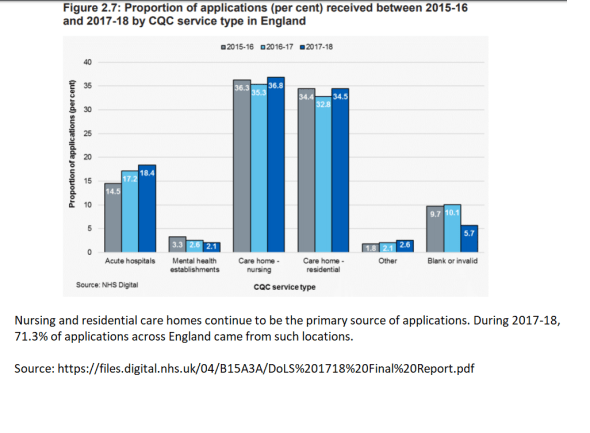
applications for DoLs

The vast majority of both home care and residential care in England is now provided by private companies. Both the quality of care in adult social care and the terms and conditions of the workforce have declined over the past two decades as a result of privatisation. 

The Department of Health’s review of Adult Social Care in 2015/16 discussed the introduction of red tape reduction options in non-statutory areas of DoLS applications, in the private sector, and concluded that these had been ‘exhausted’.

The review report (page 30) says: “As such, the Department has funded the Law Commission (as the experts in law reform) to perform a fundamental review of DoLS “with a view to minimising pressures on care providers.” 

That must not come at the expense of safeguarding adults from exploitation for private profit.

In October 2017, the Prime Minister also commissioned a review of the Mental Health Act 1983, seeking to address concerns about how the legislation is currently being used. 

The government called for an Act in step with a ‘modern mental health system’, giving special attention to rising rates of detention and the disproportionate number of people from black and minority ethnic backgrounds being detained under the Act. Terms of reference for the review are available to view online. The review was tasked to appraise existing practice and evidence, formulating recommendations to improve legislation and/or practice in the future. 

The chair of the review is Simon Wessely.  He said “The Mental Health Act goes to the core of the relationship between the individual and the state.

“It poses the question: ‘When is it legitimate to deprive someone of their liberty, even when they have done nothing wrong?’ It sets rules that require professionals to judge if a mentally ill person poses a risk to themselves or others, and hence needs to be detained in order to safely receive treatment. It tries to strike a fair bargain with the detained person, giving them safeguards like second opinions and tribunals to ensure due process.

Reviewing the Act isn’t just about changing the legislation. In some ways that might be the easy part. The bigger challenge is changing the way we deliver care so that people do not need to be detained in the first place. In my experience it is unusual for a detention to be unnecessary – by the time we get to that stage people are often very unwell, and there seems few other alternatives available.

“But that does not mean this was not preventable or avoidable. The solutions might lie with changes to the legislation, but could also come from changes in the way we organise and deliver services. It would also be naïve to deny that much wider factors, such as discrimination, poverty and prejudice, could be playing a role.”

Wessely said his final report will make recommendations that require ‘significant’ new investment in the sector. However the government is looking to save money.

Wessely has played a notorious key role in the demedicalisation of  myalgicencephalomyelitis / chronic fatigue syndrome (ME/CFS) research. Serving as an advisor to the hugely controversial PACE trial, Wessely has defended the study of these illnesses, and the proposed treatment regime of CBT and graded exercise, stating “this trial was a landmark in behavioral complex intervention studies.” Wessley’s purely psychological approach to these physiological illnesses has been widely criticised, he has been accused of “unsupported conclusions derived from faulty analyses.” 

In 1988 the public water supply in Camelford in England was accidentally contaminated with aluminium sulfate. Wessely published a paper in 1995 playing down the effects of the pollution and suggesting ‘significant psychological factors’ were involved. The government formally and unreservedly apologised in 2013, 25 years later, to those whose health was affected by the water supply contamination. 

Things Wessley has said about ME/CFS include “The worst thing to do is tell them to rest”, “exercise is good for these patients” and  “[Welfare] Benefits can often make patients worse”.  See Notes on the involvement of Wessely et al with the Insurance
Industry and how they deal with ME/CFS claims .

I’m not confident that either the stated aims or in the outcome of this ‘independent’ review. The government have already amended the Mental Capacity Act, removing Practice Direction 9, which provided safeguards for people with degenerative illnesses and brain injury in the event of the proposed withdrawal of nutrition and hydration by doctors (See British Medical Association proposals deemed passive ‘euthanasia by stealth’ for disabled people with degenerative illnesses).

See also: Independent review of the Mental Health Act: interim report

The Law Society’s condemnation of the government’s Mental Capacity (Amendment) Bill 2018

The Law Society has issued a rather damning briefing on the Mental Capacity (Amendment) Bill 2018 that moved to a Lords committee stage in early September.

The Society says that the Bill is not fit for purpose: “While agreeing that simplification is needed and acknowledging that there are resource constraints, these constraints are “insufficient justification for not implementing fully the safeguards recommended by the Law Commission.” 

The Briefing also sets out six recommendations for change, reflecting what the authors feel should be the principles underpinning the new framework and why they are concerned that the Bill does not meet those principles, as it includes:

  • an already overly complex scheme being further complicated by a replacement scheme which instead of placing the cared-for person at the centre of the process, significantly dilutes and even removes the existing protections for them
  • the risk of increased burdens on local authorities who will bear ultimate responsibility for mistakes and poor implementation rather than building on the learning from the problems with DoLS and retaining those elements that have been effective whilst removing those which are unnecessary and bureaucratic
  • the cared-for person will not be at the centre of the process but side-lined with decisions being made without proper or even basic protections
  • the removal of the invaluable role of Best Interests Assessors and Relevant Person’s Representatives would leave vulnerable people without protection from unnecessary detention.

You can read the Law Society’s full Briefing here: Parliamentary briefing: Mental Capacity (Amendment) Bill – House of Lords committee stage (PDF 196kb).

Junior health and social care minister Lord O’Shaughnessy opened the debate at the Bill’s second reading in the House of Lords by saying the Liberty Protection Safeguards (LPS) would be less burdensome than DoLS on people, carers and local authorities, saving the latter an estimated £160m a year.

He said it would do this by making consideration of restrictions on people’s liberties a part of their overall care planning and eliminating repeat assessments and authorizations. However, peers from across the House of Lords agreed that several aspects of the bill risked weakening safeguards for people deprived of their liberty.

Labour peer Lord Touhig, vice-president of the National Autistic Society (NAS), voiced concerns about the rights of autistic people under the bill’s proposals, insisting that many of the problems with the existing system had not been addressed.

He cited, as particularly problematic, the removal of the best interests assessment currently provided under DoLS, which ensures that arrangements to deprive a person of their liberty are in the individual’s best interests, necessary to protect them from harm and proportionate to the likelihood and seriousness of that harm.

Under the LPS, the equivalent requirement would be to establish that the arrangements are ‘necessary and proportionate’, one of three criteria that must be met for a LPS authorisation, the others being that the person lacks capacity to consent and is of ‘unsound mind’.

Touhig said: “The new criteria risk losing sight of what is best for the individual and what the individual wants.

“Let us be wary of enacting legislation that pays scant regard to the individual, in particular an individual who is perhaps the most vulnerable in society.”

Liberal Democrat peer Baroness Barker highlighted problems with the ability of bodies authorising LPS arrangements to rely on historic assessments of mental capacity, which may have been carried out for other purposes.

She said: “There is a danger that we might end up with decisions being made about a person’s capacity to make one decision which rests on information that was gathered for a wholly different purpose. That would not be right.”

Under the new title, ‘Liberty Protection Safeguards,’ the proposals mean that the Deprivation of Liberty Safeguard is removed from the Mental Capacity Act 2005, with a new administrative scheme for authorising arrangements when it comes to the deprivation of liberty.

In the Bill it says that the person responsible for decision making should ‘reasonably believe’, action to deprive someone of liberty is necessary to prevent ‘serious deterioration.’ One problem is that there is no guarantee in place that ensures a sharp focus on ensuring decisions are made in the best interest of  vulnerable individuals. It is also important to ensure the new legislation allows for deprivation of liberty to be a very last resort.

There is also nothing in the Bill that explores what training will be made available to  acting mental capacity professionals and where the costs of this will fall.

While the new system aims to remove the problems associated with getting authorisation when moving between a care home and hospital setting will be welcomed, whether this places new pressures on the sector will also need some consideration. It is therefore expected that the debate will consider the cost of new arrangements, with close attention being paid to the £200m a year the government project the system will save local authorities.

The government’s recent amendment is regressive and the changes, instead of looking after people’s best interests, appear to have become a cost-cutting exercise that can only lead to people’s human rights being removed.

In summary, key features of the Liberty Protection Safeguards (LPS) include:

  • Like DoLS (but contrary to the Law Commission’s suggestion) they start at 18. There is no statutory definition of a deprivation of liberty beyond that in the Cheshire West and Surrey Supreme Court judgement of March 2014 – the acid test.
  • Deprivations of liberty have to be authorised in advance by the ‘responsible body’
    • For hospitals, be they NHS or private, the responsible body will be the ‘hospital manager’.
    • For arrangements under Continuing Health Care outside a hospital, the responsible body will be the local CCG (or Health Board in Wales).
    • In all other cases – such as in care homes, supported living schemes (including for self-funders), the responsible body will be the local authority.
  • For the responsible body to authorise any deprivation of liberty, it needs to be clear that:
    • The person lacks the capacity to consent to the care arrangements
    • The person is of unsound mind
    • The arrangements are necessary and proportionate.
  • To determine this, the responsible body must consult with the person and others, to understand what the person’s wishes and feelings about the arrangements are.
  • An individual from the responsible body, but not someone directly involved in the care and support of the person subject to the care arrangements, must conclude if the arrangements meet the three criteria above (lack of capacity; unsound mind; necessity and proportionality).
  • Where it is clear, or reasonably suspected, that the person objects to the care arrangements, then a more thorough review of the case must be carried out by an Approved Mental Capacity Professional.
  • Where there is a potential deprivation of liberty in a care home, the Bill suggests the care home managers should lead on the assessments of capacity, and the judgment of necessity and proportionality, and pass their findings to the local authority as the responsible body. This aspect of the Bill has generated some negative comment, with people feeling that there is insufficient independent scrutiny of the proposed care arrangements.
  • Safeguards once a deprivation is authorised include regular reviews by the responsible body and the right to an appropriate person or an IMCA to represent a person and protect their interests.
  • As under DoLS, a deprivation can be for a maximum of one year initially. Under LPS, this can be renewed initially for one year, but subsequent to that for up to three years.
  • Again, as under DoLS, the Court of Protection will oversee any disputes or appeals.

The new Bill also broadens the scope to treat people, and deprive them of their liberty, in a medical emergency, without gaining prior authorisation.

A critical summary of changes from Law Commission proposals

Although the Bill is based on the proposals produced last year by Law Commission following a government-commissioned review of the law on deprivation of liberty in care, the government has not included several of the commission’s key proposals in the Bill.

Those in government working on the bill had “selectively picked” from the Law Commission’s proposals in place of accepting the “whole package of measures” that had been created to produce “a robust defence” for individuals.

Among Law Commission proposals that have been omitted are the application of the LPS scheme to 16- and 17-year-olds, reforming the best interests test under the Mental Capacity Act 2005 to place a greater weight on people’s wishes and feelings and reforming section 5 of the Mental Capacity Act to restrict the availability of the defence from liability for care staff acting in relation to a person whom they reasonably believe lacks capacity to consent to the actions concerned. 

Some amendments have already been tabled to the Bill by Labour shadow health minister Baroness Thornton. These would apply the reforms to people 16- and 17-year-olds and specify that the provisions must be read in a way which is compatible with Article 5 of the European Convention of Human Rights, which secures the right to liberty.

With several questions regarding the Bill and the government’s decision to stray from the Law Commission’s proposals, it is expected that there will be more challenges.

The changes include:

  • The Commission’s original reference to necessity/proportionality is no longer tied specifically to risk of harm/risk to self, but simply, now, necessity and proportionality; 
  • The Law Commission’s proposed tort of unlawful deprivation of liberty (actionable against a private care provider) has gone; 
  • The LPS ‘line’ of excluding the LPS from the mental health arrangements has been changed, and the current status quo (i.e. objection) as regards the dividing line between the MCA/MHA in DOLS is maintained.

Lord O’Shaughnessy appeared to address this fact in his final comments during the second reading, saying the government would “reflect on” whether changes could be made.

“It has been clear from this debate that there is still much work to be done to provide the right kind of reforms that we all want to see,” O’Shaughnessy said.

Some amendments have already been tabled to the bill by Labour shadow health minister Baroness Thornton. These would apply the reforms to people 16- and 17-year-olds and specify that the provisions must be read in a way which is compatible with Article 5 of the European Convention of Human Rights, which secures the right to liberty.

The first day of the Lords Committee stage of the Mental Capacity (Amendment) Bill took place on 5 September. The Hansard transcript can be found here and here.

‘A backward step’

Sarah Lambert, head of policy and public affairs at the National Autistic Society (NAS), reiterated the arguments of those inside the House of Lords, saying: “NAS has substantial concerns that the bill, as drafted, does not put autistic or other individuals, who lack capacity, at the centre of decisions about their care.”

“Firstly, the bill moves away from the current position, where decisions should be made in someone’s ‘best interests’ and so risks losing sight of what is best for the individual, or what that individual wants.”

“Even though someone may lack capacity to make a decision about their living arrangements, their preferences or wishes should be a central factor in any decision about their lives. This makes it a backward step in protecting the rights people who lack capacity to consent to their care.”

“We will be working with members of the House of Lords and MPs as the bill passes through Parliament to make sure substantial amendments are made to secure the rights of autistic people and others.”

The Bill is so contentious as it does, in places, significantly depart from the recommendations of the Law Commission. Furthermore, the Joint Committee on Human Rights (JCHR) provided a report on the Law Commission’s proposals in July, and this report raised other issues that will need to be considered by Parliament.

One issue highlighted is the importance of establishing a clear definition of “deprivation of liberty” so that Article 5 (of the Human Rights Act) safeguards are applied to those who truly need them. The JCHR recognised that deprivation of liberty is an evolving Convention concept rooted in Article 5; the arising difficulty is how this is interpreted and applied in the context of mental incapacity. 

The report says: “Parliament should provide a statutory definition of what constitutes a deprivation of liberty in the case of those who lack mental capacity in order to clarify the application of the Supreme Court’s acid test and to bring clarity for families and frontline professionals. Without such clarity there is a risk that the Law Commission’s proposals will become unworkable in the domestic sphere.”

Another problem raised is that at present, the Legal Aid Agency can refuse non-means tested certificates for challenges to DoLS where there is no existing authorisation. The current system has produced arbitrary limitations on the right of access to a court. Legal aid must be available for all eligible persons challenging their deprivation of liberty, regardless of whether an authorisation is in place, particularly given the vast number of people unlawfully deprived due to systemic delays and failures, according to the JCHR.

There is also concern raised over the term “of unsound mind”, little understood and arguably more stigmatising. The JCHR has recommended that “further thought be given to replacing ‘unsound mind’ with a medically and legally appropriate term.”

The report concludes: “DoLS apply to those with a mental disorder. LPS will apply to persons of ‘unsound mind’ to reflect the wording of Article 5. We recommend that further thought be given to replacing “unsound mind” with a medically and legally appropriate term and that a clear definition is set out in the Code of Practice.

“The interface between the Mental Capacity Act (MCA) and the Mental Health Act (MHA) causes particular difficulties. Deciding which regime should apply is complex, and causes the courts and practitioners difficulties. The Law Commission proposes to maintain the two legal regimes: the MHA would apply to arrangements for mental disordersthe LPS would apply to arrangements for physical disorders. Inevitably, problems will continue to arise at the interface between these two regimes. We are particularly concerned by two issues.

“Firstly, this proposal requires assessors to determine the primary purpose of the assessment or treatment of a mental or physical disorder–this is difficult where persons have multiple disorders. Secondly, we are concerned that there would be essentially different laws and different rights for people lacking capacity depending upon whether their disorder is mental or physical. We consider that the rights of persons lacking capacity should be the same irrespective of whether they have mental or physical disorders.”

The Law Commission’s Recommendations made an attempt to include protection for a person’s Article 8 rights (of the European Convention on Human Rights: right to a family and private life) within the proposed amendments to the Mental Capacity Act by specifying a list of applicable decisions that require a written record of decision making (including any decision regarding covert medication and contact restrictions).

The Bill makes no reference to this however (despite the government accepting this part of the proposal in their response), focusing only on Article 5 rights. This is likely to be of great concern to many campaigners and stakeholders and therefore may become a pertinent issue in Parliament. In the meantime, the current law on Article 8 authorisations and covert medication remains in place.

The current DOLS framework requires a best interest assessor to determine whether a deprivation of liberty is in a person’s best interests. The Amendment Bill, however, requires no consideration of best interests, only requiring that the arrangements are ‘necessary and proportionate.’

Although this is partly is line with the Law Commission’s proposals that the LPS should remove the focus on best interests to move away from substituted decision making (in line with the Convention on the Rights of Persons with Disabilities), the Bill contains no explanation of what is meant by ‘necessary and proportionate’ or how these should be assessed. It is expected that concern will be raised in Parliament regarding the removal of best interests from the LPS and the lack of guidance surrounding necessity and proportionality.

The Bill will affect the fundamental human rights of hundreds of thousands of people with conditions such as dementia, learning disability and brain injury.

Commenting on the Bill Sue Bott CBE, Deputy CEO Disability Rights UK said:

I am concerned with the contents of this Bill which takes the rights of disabled people backwards. 

“There is nothing more serious for an individual than a decision to deprive them of their liberty yet, as it stands, this Bill will make challenging such decisions difficult and costly with little independent oversight and no commitment to taking the views of the individual into account. 

“I hope members of the House of Lords will, through amendments, be able to radically improve the Bill.”

Among the concerns highlighted by Disability Rights UK are:

  • The very least people, who are detained, need is information about why that decision has been made and what their rights are – there is no provision for this in the Bill
  • The Bill makes access to justice worse than the current system in not providing for non-means tested legal aid
  • There is no provision for the ‘cared for’ person to participate in court proceedings regarding their own liberty
  • Contains offensive and out-of-date language such as ‘unsoundness of mind’
  • Too much power is being given to care home managers to decide about people being deprived of their liberty
  • The Bill moves UK law even further away from the UN Convention on the Rights of People with Disabilities by not providing for supported decision making and for the wishes and feeling of the person to be taken into account.
  • The Bill in its current form is not supported by professionals in this area. 

The right to life and state compliance with Article 2 (ECHR)

The past five years have been challenging in terms of health outcomes in the UK, they add. For example, spending on health and social care year on year has increased at a much slower rate than in previous years, while outcomes in a large number of indicators have deteriorated, including a very rapid recent increase in the numbers of deaths among mental health patients in care in England and Wales. The government has a duty and a role to provide specific care for people experiencing mental health conditions at a time of vulnerability. That role must comply with Article 2, which:

  1. Imposes an obligation on the State to protect the right to life.
  2. Prohibits the State from intentionally killing.
  3. Requires an effective and proper investigation into all deaths caused by the State.
  4. Requires the State to take appropriate steps to prevent accidental deaths by having a legal and administrative framework in place to provide effective deterrence against threats to the right to life. 

The Policing and Crime Act 2017 came into effect to amend the Coroners and Justice Act 2009 and relieved coroners of the duty to hold an inquest into every death where the deceased was subject to a Deprivation of Liberty Safeguards authorisation or was deprived of their liberty through provisions in the Mental Capacity Act 2005. Coroners’ inquests into unnatural deaths involving health and social care organisations are on the increase. 

Where a DOL is in force, the State has effectively curtailed the liberty of the patient; as such when the patient dies then the death is equivalent to a detention in custody. Article 14 of the Convention prohibits discrimination in the enjoyment of the Convention rights. This means that the State must ensure that the right to life of people with mental health conditions is given equal protection to that of other people.  

There have been a number of  other legal developments that change the way decisions about life-prolonging treatments are made, in addition to the recent court judgments and the government’s radical withdrawal of the Court of Protection’s Practice Direction 9E which addresses protections concerning serious medical treatment.

The direction was effectively abolished by the Ministry of Justice  and the changes came into effect last December. The Court of Protection in English law is a superior court of record created under the Mental Capacity Act 2005. It has jurisdiction over the property, financial affairs and personal welfare of people who lack mental capacity to make decisions for themselves. 

One consequence of this is the British Medical Association’s recent proposals in response to legal test cases in which judges ruled that qualified NHS staff and officials no longer required a court’s permission to withdraw artificial nutrition and hydration from those patients who are incapacitated and unable to communicate or feed themselves.

The Supreme Court justices’ decision in July supported the right of doctors to withdraw life-sustaining nutrition on their own authority, provided they had the explicit permission of the patient’s family or, where no family existed, medical proxy. If there is a disagreement and the decision is finely balanced, an application should still be made to the Court Of Protection. 

Changes to protections were introduced via secondary legislation – a negative resolution statutory instrument – there was very little parliamentary scrutiny. Furthermore, as the instrument is subject to negative resolution procedure no statement regarding implications in relation to the European Convention on Human Rights was required from government ministers, nor was public consultation deemed necessary. An Impact Assessment has not been prepared for this instrument. 

The fact that the UK government had already made amendments to safeguarding laws to accommodate these proposals, which took effect last December, and now plan to make it easier to remove people’s liberty under the Mental Health Act without public consultation, has caused deep unease. In the latest proposed changes to the Mental Health Act, the government seems to think it is appropriate to consider restrictions of people’s liberties as part of their overall ‘care package,’ and approach which is not compatible with human rights.

Changing legislation isn’t going to improve the lives of people with mental illness.  Improving mental health services depends on funding, the right number of well-trained staff and the right resources to meet the needs of patients, their families and carers.

More information on concerns about the Bill can be found here

You can read the most recent debate about the Mental Capacity Amendment Bill in the House of Lords on 05 September 2018 here.

Image result for deprivation of freedom


I don’t make any money from my work. If you want to, you can help by making a donation to help me continue to research and write informative, insightful and independent articles, and to provide support to others.


DonatenowButton

British Medical Association proposals deemed passive ‘euthanasia by stealth’ for disabled people with degenerative illnesses

Image result for euthanasia 

The British Medical Association have put forward proposals in response to legal test cases in which judges ruled that qualified NHS staff and officials no longer required a court’s permission to withdraw artificial nutrition and hydration from those patients who are incapacitated and unable to communicate or feed themselves.

The Supreme Court justices’ decision in July supported the right of doctors to withdraw life-sustaining nutrition on their own authority, provided they had the explicit permission of the patient’s family or, where no family existed, medical proxy. If there is a disagreement and the decision is finely balanced, an application should still be made to the Court Of Protection. 

The Court of Protection is the specialist court for all issues relating to people who lack capacity to make specific decisions. The court can make decisions and appoint deputies to make decisions about someone’s property and financial affairs or their healthcare and personal welfare.

Under the Mental Capacity Act 2005 (which is also currently being re-written by the government), the court has the power to:

• make decisions about the personal welfare or property and financial affairs of people who lack the capacity to make such decisions themselves;
• make declarations about a person’s capacity to make a decision;
• make decisions in relation to serious medical treatment cases, which relate to providing, withdrawing or withholding treatment to a person who lacks capacity;
• authorise deprivation of liberty in relation to a person’s care and residence arrangements;
• appoint a deputy to make ongoing decisions on behalf of a person who lacks capacity, in relation to either the person’s personal welfare or property and financial affairs; and
• make decisions about a Lasting Power of Attorney or Enduring Power of Attorney, including whether the power is valid, objections to registration, the scope of the  attorney’s powers and the removal of attorney’s powers

According to the draft proposals currently being circulated by the British Medical Association (BMA), doctors should be granted the authority to end the lives not only of those patients who are near death or in vegetative or minimally conscious states but also “the much larger group of patients who have multiple co-morbidities, frailty or degenerative neurological conditions.”  

This also includes stroke patients and those with “rapidly progressing brain injury.”   

However, on the NHS site, it says: “In most cases, a minimally conscious state isn’t usually considered to be permanent until it’s lasted several years. 

“It’s impossible to predict the chances of someone in a state of impaired consciousness improving.” 

“Supportive treatment is used to give the best chance of natural improvement. 

“This can involve:

  • providing nutrition through a feeding tube 
  • making sure the person is moved regularly so they don’t develop pressure ulcers
  • gently exercising their joints to prevent them becoming tight
  • keeping their skin clean
  • managing their bowel and bladder (for example, using a tube known as a catheter to drain the bladder)
  • keeping their teeth and mouth clean
  • offering opportunities for periods of meaningful activity – such as listening to music or watching television, being shown pictures or hearing family members talking.” 

And importantly: “It’s impossible to predict the chances of someone in a state of impaired consciousness improving.”

The authors of the BMA document say: “Due to the degenerative nature of their condition, these patients are on an expected downward trajectory and will inevitably die, usually as a result of their underlying condition, although perhaps not imminently and could, potentially, go on living for many years.”

In the Executive Summary of the BMA document, it says that no second opinion need be obtained unless there is ‘reasonable doubt about the diagnosis or prognosis, or where the healthcare team has limited experience of the condition in question’ [ …] ‘it is not necessary to wait until (investigations) have been completed’ if there is not ‘sufficient evidence’ that they will ‘affect the outcome of the best interests assessment’ 

Nutrition and hydration delivered by tubes is currently legally defined as ‘medical treatment’ and not ‘basic ‘care’.  

There have been a number of legal developments that change the way such decisions about life-prolonging treatments are made, in addition to the recent court judgments and the government’s radical withdrawal of the Court of Protection’s Practice Direction 9E which addresses protections concerning serious medical treatment.

The direction was effectively abolished by the Ministry of Justice  and the changes came into effect last December. The Court of Protection in English law is a superior court of record created under the Mental Capacity Act 2005. It has jurisdiction over the property, financial affairs and personal welfare of people who lack mental capacity to make decisions for themselves. 

As the changes to protections were introduced via secondary legislation – a negative resolution statutory instrument – there was very little parliamentary scrutiny. Furthermore, as the instrument is subject to negative resolution procedure no statement regarding implications in relation to the European Convention on Human Rights was required from government ministers, nor was public consultation deemed necessary. An Impact Assessment has not been prepared for this instrument. 

The fact that the UK government had already made amendments to safeguarding laws to accommodate these proposals, which took effect last December, and now plan to make it easier to remove people’s liberty under the Mental Health Act without public consultation, has caused deep unease. In the latest proposed changes to the Mental Health Act, the government seems to think it is appropriate to consider restrictions of people’s liberties as part of their overall ‘care package.’

Picture

The Law Society has issued a rather damning briefing on the Mental Capacity (Amendment) Bill 2018 that moved to a Lords committee stage, early last month.

In their briefing, the society say: “While agreeing that simplification is needed and acknowledging that there are resource constraints, these constraints are “insufficient justification for not implementing fully the safeguards recommended by the Law Commission.” 

It is in light of the most recent change in legislation that the British Medical Association (BMA) put forward  proposals that mean doctors may be permitted to end the lives of patients who may otherwise have survived for years, by the withdrawal of nutrition and hydration, without the need to go to court. While this reduces substantial cost to the NHS in terms of legal fees and in the prolonged treatment for some patients, not everyone is comfortable with these developments.

Writing critically about the legislation changes last year, Mohamed Y Rady and Joseph L. Verheijde say:

“(1) starvation and dehydration is certain to cause death without the presence of concurrent life-limiting disease or life-threatening illness and (2) the dying process by starvation and dehydration can last two to three weeks and can be distressful to both patients and their families. We disagree with the legal and clinical stipulation (post-Bland [a legal case]) that assisted nutrition and hydration (ANH) is medical treatment. Instead, as adopted in many other jurisdictions, we hold that ANH constitutes ‘a basic compassionate care service rendered to disabled persons’. 

“We think that court oversight is of practical importance for the safety of the general public and the protection of vulnerable disabled persons in society.

“We outline our rationale for advocating that court oversight should not be limited to Vegative State/Minimal Conscious State but should include any person.”

The authors added:  “The clinical guidelines have distinguished only three levels of disorders of consciousness (DOC) (coma, Vegative State (VG), and Minimal Conscious State (MCS) based on clinical assessment for the presence or absence of awareness and wakefulness. However, the diagnostic accuracy of the guidelines’ criteria and definitions of the three levels of DOC has not been validated scientifically. Cohort studies suggest that the rate of clinical misdiagnosis in VS is at least 41% and this error rate has not declined over the past 15 years.

“Incorrect diagnosis can result in a fatal outcome because of premature withdrawal of medical care and ANH. The clinical guidelines have not yet acknowledged the relevance of contemporary neuroscience advances to increase the diagnostic accuracy and expand on the available therapeutic options in DOC. Incorrect diagnosis and/or withholding of therapy in DOC violates the trust of families in the transparency and truthfulness of clinicians who are making life and death decisions on behalf of their loved ones.

“The clinical guidelines have recommended that a neurological diagnosis and prognosis should be made at least within four weeks after the onset of prolonged DOC to determine futility of continued medical care and ANH (Royal College of Physicians of London. Under these circumstances, we propose that court oversight can provide an additional safeguard by including independent neuroscience experts to confirm the clinical diagnosis and prognosis of DOC and to ensure that the decision-making processes are well-informed and as rigorous as possible. Life and death decisions in DOC should be supported by contemporary neuroscience, among other considerations, and not be based on outdated clinical guidelines.”

In summary, the authors propose that until such time as we have greater clarity and understanding about the disorders of consciousness, and about the legal and ethical principles to be applied, there remains a need for independent oversight and that applications to the court should continue to be obligatory in all cases where the withdrawal of ANH is proposed, at least for the time being.

Their paper can be read in full here.

The BMA proposals to withdraw nutrition and hydration tubes have also been condemned as ‘euthanasia by stealth’.

Dr Peter Saunders, from the group Care Not Killing, said: “This is a recipe for euthanasia by stealth, but all in the name of autonomy and best interests – the very worst kind of doctor paternalism justified on the grounds that the patient would have wanted it.

“There are conceivably tens of thousands of patients in England and Wales who are vulnerable to the use and abuse of this guidance.

“It will be almost impossible to work out what has happened in a given case and there are no legal mechanisms in place for bringing abusers to justice.”

The landmark Bland ruling set down that artificial nutrition and hydration by tube are not normal feeding but ‘medical treatment’. It also said that it might not be in a patient’s best interests to be treated, and if medical treatment is not in the best interests of a patient who cannot speak for themselves, it can be stopped. Tony Bland, a Liverpool football supporter was just twenty-two when he suffered severe brain damage in the crush at Hillsborough football stadium in April 1989. The court ruled that he should be allowed to die.

The BMA document was circulated, however, in June. This follows after a court ruling in 2017, which concluded that there was no requirement for court approval before removing patients’ nutrition and hydration tubes.

More recently in July, the country’s highest appeal court, the Supreme Court, ruled in the test case of a patient known only as ‘Y’ that doctors can decide a patient should die without reference to a court.

A spokesman for the BMA said that decisions surrounding the withdrawal of clinically assisted nutrition and hydration (CANH) presented “clinical, ethical and legal challenges.” 

He added: “Following a number of legal developments, the BMA has been working with the Royal College of Physicians and the General Medical Council to produce guidance on best practice for health professionals when facing decisions about CANH.

“CANH is a form of medical treatment. The aim of medical treatment is not simply to prolong life at all costs, and the courts have been clear that in some circumstances it will not be in the best interests of the individual patients to receive it.

“Those making these decisions must do so in full dialogue with families to determine what is right for the individual patient, and of course, when there is any disagreement the court still has an important role to play.”

These proposals come at a time when health care has been subjected to increasing rationing. 

The BMA document says that the decisions on removing nutrition and hydration tubes should be taken by consultants for hospital patients, or GPs for those in nursing or residential homes or living in their own homes. It was suggested that families or friends should be consulted, usually through ‘best interests meetings’ set up to decide whether it would be better for a patient to live or die. However, the BMA suggested that family and friends should not have the final say on the matter.

In the Executive Summary, the BMA say that no second opinion need be obtained unless there is ‘reasonable doubt about the diagnosis or prognosis, or where the healthcare team has limited experience of the condition in question’ [ …] ‘it is not necessary to wait until (investigations) have been completed’ if there is not ‘sufficient evidence’ that they will ‘affect the outcome of the best interests assessment’ 

Shockingly, the BMA also propose that when patients die after the withdrawal of nutrition and hydration tubes, this should not be mentioned on death certificates. Instead only the underlying original condition should be given.

Professor Patrick Pullicino, from East Kent Hospitals University NHS Trust, said that this directs doctors to falsify death certificates. It tells doctors to put down the pre-existing condition and not that they died of dehydration. It will totally conceal the statistics of patients who are being dehydrated to death.”

Understandably, doctors and campaigners who are opposed to euthanasia and the deliberate termination of life by medical staff have condemned the proposals.

Pullicino, who is the consultant that helped expose the controversial hospital deaths under the discredited Liverpool Care Pathway, said the BMA plan was ‘terrible’. 

He added: “It codifies current practices of withdrawing food and fluid at the end of life and thereby encourages it.

“It facilitates the extension of end-of-life pathways to people with neurological diseases who are not dying, which is a very negative thing because there are a lot of disabled neurological patients.

“It perpetuates the myth of ‘best interests’, which has been shown to be erroneous and reflective of members’ views and not of the real best interests of the patients.”

I agree. My inital thoughts are that we need to guarantee people with disabilities have access to high quality palliative care. We need to have a process which reviews every incidence of proposed euthanasia, and that panel needs to include people with disabilities. We need to ensure that family members and service providers or anyone else who will benefit financially cannot abuse any application for end of life withdrawal of clinically assisted nutrition and hydration.

We also need to ensure the absolute transparency and accountability of decision-makers, which must include an accurate and honest record of cause of death on death certificates. Coroners have a duty to prevent future deaths, where medical mistakes have been made.

There is no clear definition of ‘degenerative diseases’ in the BMA document. Some illnesses, such as multiple sclerosis, lupus and other autoimmune mediated diseases, for example, may be progressive. Several of these illnesses may affect the neurological system. Most of the treatments for this group of disorders are experimental. People can improve over time, with or without some treatments, following periods of being critical ill. Many of the treatments are only prescribed as a last resort, as they are prohibitively expensive (biologics in particular) especially at a time of heavy NHS funding cuts. The outcomes of these diseases are widely variable from one person to the next. People may have indefinite remissions after years of being seriously ill. 

Even if these types of disease are not currently included in the BMA guidelines, complications or co-morbidities and frailty arising over the course of an illness may be.  

What guarantee do we have that the categories won’t expand over time?

The legislative changes have been couched in terms of ‘saving money’. The purpose of the NHS is to save lives. Everyone has the basic right to life, that must not be contingent on the ideological preferences of a ‘small state’ neoliberal government. ‘Best interests’ are not an political category, nor are they open to ideological interpretation. 

The UK government’s brand of ideological paternalism towards poor people claiming welfare support, for example, involves the removal of the means of meeting basic survival needs as a punishment in the form of sanctions, also considered to be in people’s ‘best interests’.

Unemployment itself has been redefined as a psychological or character disorder over the last few years, and the welfare state has become a political environment for administering discipline, which has shifted it away from the original purpose of providing basic support and alleviating poverty. Behavioural economics has contributed to bolstering this perspective by pathologising people who need support from publicly funded public services via claims of ‘cognitive deficits’ of poor people, rather than acknowledging the structural explanations of poverty.  Perish the thought that a socioeconomic system founded on competition would foster inequality. 

In healthcare there has been a shift towards ‘behavioural medicine’ too, apparent in the controversial PACE trial and a general emphasis on people’s ‘lifestyle choices,’ and personal responsibility. However these are extremely overly simplistic ideolological narratives that have not emerged because of robust empirical evidence. Public services were not originally designed to punish poor people who need them. Yet the withdrawal of the means of citizens meeting their basic survival needs seems to have become normalised. Pathologising and punishing people who need the support of public services has somehow become acceptable. 

The increasing rationing of treatments within the NHS and the neoliberal logic underpinning this is also a cause for concern. People who need support from any public service are subjected to increasing conditionality and rationing in an era of neoliberal austerity.

A spokesman for the BMA said that decisions surrounding the withdrawal of clinically assisted nutrition and hydration (CANH) presented “clinical, ethical and legal challenges.” 

He added: “Following a number of legal developments, the BMA has been working with the Royal College of Physicians and the General Medical Council to produce guidance on best practice for health professionals when facing decisions about CANH.

“CANH is a form of medical treatment. The aim of medical treatment is not simply to prolong life at all costs, and the courts have been clear that in some circumstances it will not be in the best interests of the individual patients to receive it.

Those making these decisions must do so in full dialogue with families to determine what is right for the individual patient, and of course, when there is any disagreement the court still has an important role to play.

“We shared the draft guidance in confidence with legal and health professionals and organisations and patient support groups to seek their views. The final version will reflect last month’s Supreme Court judgment when it is published this year.” 

The guidance says it is based on the current legal position which it defines as follows:

  • Clinically assisted nutrition and hydration (CANH) – essentially food and fluids by a fine tube through the nose or through the skin into the stomach – is a form of medical treatment
  • Treatment should only be provided when it is in a patient’s ‘best interests’
  • Decision makers should start from the presumption that it is in a patient’s best interests to receive life-sustaining treatment but that presumption may be overturned in individual cases
  • All decisions should be made in accordance with the Mental Capacity Act 2005 (which the government is proposing to amend).

The 77-page ‘confidential’ document, which is currently out for ‘consultation’ (although only to a few selected individuals), has been prepared by the BMA in conjunction with the Royal College of Physicians (RCP) and the doctors’ regulatory authority, the General Medical Council (GMC). It will not be open for public consultation at any point before publication later in the autumn.

The draft guidance, which builds on case and statute law and on previous practice guidelines, has huge implications for the care of some of the most vulnerable people in England and Wales.

However, it does not permit assisted dying – which is when a patient wants to end their life. British parliaments have consistently refused to legalise active euthanasia or assisted suicide for people with a quality of life they would not find ‘acceptable’ or would not ‘have wanted’. The BMA is proposing that doctors, not patients should make the choice to end a life, and that to end lives by starvation and dehydration, rather than with a lethal injection, is somehow perfectly acceptable.

So acceptable in fact that the BMA propose starvation and dehydration or withdrawal of care (or treatment if you wish) should be left off the death certificate, suggesting instead that the ‘underlying medical condition’ should be recorded as the cause of death. This suggestion does not inspire confidence in transparency and accountability concerning such fundamentally irreversible medical decisions, since the record of death hides errors in judgment and diagnoses, prevents scrutiny and prevents coroners from fulfilling the mandatory obligation to ‘prevent future deaths’ in the case of medical incompetence, negligence, abuse, deceit and error.


I don’t make any money from my work. I am disabled because of an illness called lupus. If you want to, you can help by making a donation to help me continue to research and write informative, insightful and independent articles, and to provide support to others.

I’m currently working on a very old, borrowed, temperamental and slow laptop as mine has broken. I am trying to raise money to buy a reconditioned one so I can keep working. The smallest amount is much appreciated – thank you.

DonatenowButton

Research finds ‘inaccuracies and distortions’ in media coverage of antisemitism and the Labour Party

Noam Chomsky, Yanis Varoufakis, Ken Loach, Brian Eno, Des Freedman, Justin Schlosberg and 21 others write about a recent report by the Media Reform Coalition.

Source: Guardian Letters 

We have long had serious concerns about the lack of due impartiality and accuracy in the reporting of allegations of antisemitism against Jeremy Corbyn and the Labour party. The recent report by the Media Reform Coalition examining coverage of Labour’s revised code of conduct on antisemitism shows that we are right to be concerned. 

The research examined over 250 articles and broadcast news segments and found over 90 examples of misleading or inaccurate reporting. In relation to the IHRA definition of antisemitism that was at the heart of the dispute, the research found evidence of “overwhelming source imbalance” in which critics of Labour’s code of conduct dominated coverage, with nearly 50% of Guardian reports, for example, failing to include any quotes from those defending the code or critiquing the IHRA definition. Moreover, key contextual facts about the IHRA definition – for example that it has only been formally adopted by eight countries (and only six of the IHRA member states) – were consistently excluded. 

The researchers conclude these were not occasional lapses in judgment but “systematic reporting failures” that served to weaken the Labour leadership and to bolster its opponents within and outside of the party. 

It is of course entirely appropriate and necessary for our major news outlets to report on the horrors of antisemitism, but wrong to present it as an issue specific to the Labour party. 

In covering the allegations that Labour is now “institutionally antisemitic”, there have been inaccuracies, clear distortions and revealing omissions across our most popular media platforms. We believe that significant parts of the UK media have failed their audiences by producing flawed reports that have contributed to an undeserved witch-hunt against the Labour leader and misdirected public attention away from antisemitism elsewhere, including on the far right, which is ascendant in much of Europe.

Prof Noam Chomsky
Brian Eno
Francesca Martinez
Yanis Varoufakis
Ken Loach
Raoul Martinez
Justin Schlosberg Birkbeck, University of London
Prof Des Freedman Goldsmiths, University of London
Prof Imogen Tyler Lancaster University
Prof Aeron Davis Goldsmiths, University of London
Prof Annabelle Sreberny Soas, University of London
Prof Greg Philo University of Glasgow
Prof Natalie Fenton Goldsmiths, University of London
Prof David Miller Bristol University
Prof David Hesmondhalgh University of Leeds
Prof James Curran Goldsmiths, University of London
Prof Julian Petley Brunel University
Stephen Cushion Cardiff University
Jason Hickel Goldsmiths, University of London
Einar Thorsen Bournemouth University
Mike Berry Cardiff University
Tom Mills Aston University
Jenny Manson Jewish Voice for Labour
Leah Levane Jewish Voice for Labour
Lindsey German Stop the War Coalition
Mike Cushman Free Speech on Israel
Glyn Secker Jewish Voice for Labour

Image result for media bias uk

Britain has one of the most concentrated media environments in the world, with 3 companies in control of 71% of national newspaper circulation and 5 companies in command of 81% of local newspaper titles.

The Media Reform Coalition has conducted in-depth research on the controversy surrounding antisemitism in the Labour Party, focusing on media coverage of the crisis during the summer of 2018.

The coalition say: “Following extensive case study research, we identified myriad inaccuracies and distortions in online and television news including marked skews in sourcing, omission of essential context or right of reply, misquotation, and false assertions made either by journalists themselves or sources whose contentious claims were neither challenged nor countered. Overall, our findings were consistent with a disinformation paradigm. 

We use the concept of disinformation to denote systematic reporting failures that broadly privileged a particular political agenda and ideological narrative. This does not mean that these failures were intentional or that journalists and news institutions were inherently biased. We recognize, for instance, that resource pressures combined with acute and complex controversies can foster particular source dependencies or blind spots. 

Nor does our research speak in any way to allegations of smear tactics. To interrogate the root causes of disinformation would necessitate a far more wide-ranging study than was undertaken here. We start from the well-founded assumption that concerns about antisemitic hate speech within the Labour Party are genuine and not necessarily or entirely misplaced. There have been unambiguous examples of racist discourse invoking holocaust denial, generalized references to Jews in stereotyped contexts, and critiques of Zionists or Zionism that explicitly use the terms as proxies for Jews. Some of these cases have involved holders of official positions within the party, including local councilors. 

Alongside such cases, there is a contested category of discourse that may be considered offensive or insensitive but not necessarily racist. Indeed, determining what counts as antisemitism lies at the heart of the wider controversy that has been played out in reams of column inches and air time since 2015, and with particular intensity during the spring and summer of 2018. We reserve judgement on this central point of contention but acknowledge legitimate views on both sides, as well as a spectrum in which relatively extreme and moderate positions are easily identifiable. 

We recognize that this controversy – on the surface at least – involves prominent voices in a minority community accusing a major political party of harbouring racism directed towards them. What’s more, these voices have been vocally supported by many high profile Labour MPs. In such circumstances we expect journalists to take these concerns seriously, view them as inherently newsworthy, and not necessarily afford equal time and attention to contesting views. It is also important to stress that journalists must be allowed – on occasion – to get the story wrong: the public interest is never served by an overly cautious press. 

But we do expect professional journalists to strive for accuracy, to establish essential contextual facts in any given story, and to actively seek out dissenting or contesting opinion including, in this case, within the minority group in question, within other affected minorities, and amongst relevant experts (both legal and academic). Nor do the particular complexities and sensitivities absolve journalists of their responsibility to offer a due right of reply to the accused or to interrogate contentious claims made by sources on all sides. 

Overall, we found 95 clear cut examples of misleading or inaccurate reporting on mainstream television and online news platforms, with a quarter of the total sample containing at least one such example. The problem was especially pronounced on television – which reaches far wider audiences by comparison – where two thirds of the news segments on television contained at least one reporting error or substantive distortion.

You can read the rest of the Media Reform Coalition’s report here


Related

Marginalisation of left leaning Jewish groups demonstrates political exploitation of the antisemitism controversy by the right wing

Antisemitism and the Labour party – a deeper look (cont) – Jewish Voice for  Labour

Journalism in the UK is under threat from a repressive, authoritarian government


I don’t make any money from my work. I am disabled because of an illness called lupus. If you want to, you can help by making a donation to help me continue to research and write informative, insightful and independent articles, and to provide support to others.

I’m currently working on a very old, borrowed, temperamental and slow laptop as mine has broken. I am trying to raise money to buy a reconditioned one so I can keep working. The smallest amount is much appreciated – thank you.

DonatenowButton


John McDonnell attacks Tory disability cuts and vows to address suicides linked to welfare reforms

Comradely? Labour leadership says nothing untoward about local parties expressing concern about sitting MPs

On Wednesday I am travelling down to Westminster. I have been invited to attend a meeting chaired by Labour’s shadow chancellor, John McDonnell. Welfare experts, researchers and campaigners are to contribute to a new drive to expose the mental health impacts and other harms linked with the government’s controversial reforms, such as the Work Capability (WCA) and Personal Independence Payment (PIP) assessments.

We will also explore and identify the wider impacts of the government’s Employment and Support Allowance (ESA) policies on the economy and society. 

The Labour party is committed to scrapping the fundamnetally flawed assessments, and have placed equalities at the centre of Labour party economic research through cross-departmental and multi-disciplinary collaboration. A Labour government will also undertake a specific stock-take of welfare policy and benefit sanctions to address the rising number of suicides, which have soared in recent years. The Labour party have said that they will place equalities at the centre of Labour’s economic research through cross-departmental and multi-disciplinary collaboration.

Speaking to the Huffington Post, the shadow chancellor says that he became furious during a Parliamentary debate when he demanded a comprehensive assessment of the cumulative impact of welfare reforms on disabled people and the government refused. He praised the website Calum’s List, which details the cases of at least 60 deaths linked to welfare cuts.

He added: We said to the Government we know now from Calum’s List, listing people from reports in the press and elsewhere of people committing suicide as a result of Government cuts.

We knew the Government were monitoring some coroners’ reports and we wanted them published, [then DWP minister Esther] McVey wouldn’t and I got really angry.”

“Next week, what we are doing is getting a group of campaigning organisations and a group of experts together to talk about the way in which Work Capability Assessments are still having an impact, to try to get to the bottom in terms of mental health and suicide.”

McDonnell added that Labour’s first Queen’s Speech include legislation “making sure we have a welfare and benefit system that lifts people out of poverty”.

He said that his Hayes and Harlington constituency casework now operates an open-door system four days a week due to demand from people hit by government cuts. 

He added: “Helen who runs my office said the casework now is on a scale and a depth of suffering that we’ve never seen before. And this in a constituency with the [Heathrow] airport, high levels of employment but wages not matching the housing costs and the pressure on people working all hours just to keep a roof over their heads.

“If anything goes wrong they fall out of the system. Last month we were dealing with two families living in cars. We also have the ‘beds in sheds’ phenomenon, families living in a shed or garage rented out to them, it’s staggering really.

“Before this last eight years, those sort of horrendous situations would be infrequent but you wouldn’t have someone so heavily sanctioned. The sanctions often impact on people with mental health conditions hardest.”

The Labour party’s track record of inclusion and democratic consultation with disabled citizens and their communities contrasts starkly with the Conservative’s exclusionary ‘we know better than you’ approach to disability policies. The government have imposed cuts on disabled people, acting upon them as if they are objects of policy rather than being citizens within a democracy.  

Government policies are expressed political intentions regarding how our society is organised and governed. They have calculated social and economic aims and consequences. In democratic societies, citizens’ accounts of the impacts of policies ought to matter.

However, in the UK, the way that welfare policies are justified is being increasingly detached from their aims and consequences, partly because democratic processes and basic human rights are being disassembled or side-stepped, and partly because the government employs the widespread use of linguistic strategies and techniques of persuasion to intentionally divert us from their aims and the consequences of their ideologically (rather than rationally) driven policies. Furthermore, policies have more generally become increasingly detached from public interests and needs.

McDonnell was involved in the setting up of Disabled People Against the Cuts (DPAC). Furthermore, after a nationwide round of consultations with disabled people about policies which enshrine the Equality and Human Rights acts, led by Debbie Abrahams, the Labour party wrote a manifesto, outlining policies for disabled people, called Nothing about you without you .

DSCN3314.JPG

Alex Cunningham, me, Debbie Abrahams and Gail Ward after the Disability Equality Roadshow in December, 2016.

The government have persistently refused to acknowledge that there is a ‘causal link’ between their punitive welfare policy programme – which has seen vulnerable citizens, including many disabled people, lose their lifeline support – and has been correlated with the rise in distress, suicides, harm and premature mortality among ill and disabled people in particular.

The correlation has consistently been recognised by disabled citizens, and evidenced by researchers, charities and disabled peoples’ organisations over the last few years. Although correlation is not the same thing as ‘causation’, it quite often implies a causal relationship. The problem is that the government have simply refused to investigate the established association further, choosing to simply deny the established link exists instead. That is completely unacceptable. 

Without further investigation of the many concerns raised, the government have no evidence whatsoever to verify their own claims of there being ‘no causal link’ precisely because they consistently refuse to conduct an inquiry regarding the established correlation between policies and harm, or to undertake a cumulative impact assessment of those policies. 

The UN Convention on the Rights of Disabled Persons (CRPD) says (in article four) that governments must, in implementing the convention, “closely consult with and actively involve persons with disabilities… through their representative organizations”. It also says (article 33) that “civil society, in particular persons with disabilities and their representative organizations, shall be involved and participate fully” in monitoring the implementation of the convention in each country. In July, Sarah Newton, the minister for disabled people, refused to meet a coalition of disabled people’s organisations, in an apparent breach of the UN disability convention.

At the very least, Newton shows no inclination whatsoever to listen to the accounts of the lived experiences of disabled people, nor does she value a democratic dialogue with us. That is profoundly worrying.

In July, the Shadow Disabilities Minister, Marsha De Cordova, also once again raised in parliament the fact that the United Nations (UN) had found “grave and systematic violations of disabled people’s rights” in the UK.

The Labour MP added: “This government’s policies have created a hostile environment causing grave violations on disabled people.”

Newton responded by claiming “it’s ‘not true’ that disabled people face a hostile environment.” She also asked the opposition not to say “things” that they “know are not true”. 

The United Nations (UN) and the Equalities and Human Rights Commission have already verified the truth of the statements, presented many times by Labour shadow ministers, disability charities and disabled people to an indifferent government. 

However, the Conservatives have a track record of denying empirical findings that don’t match their predetermined and ideological expectations. They simply deny and dismiss any criticism of their  discriminatory policies. Damian Green, the Work and Pensions Secretary at the time of the UN inquiry report, famously claimed that cuts to support for disabled people did “not necessarily mean worse outcomes.” That is a bit of a climb down to previous claims from the government that cuts to lifeline support for disabled people ‘help’ them into work by removing the ‘perverse incentives’ of provision. 

In July, in a rather frightening and repressive, authoritarian outburst, Newton went on to claim that the opposition’s comments were “dangerous” and “deter” people who need support from claiming it. However, it is government policies that are dangerous, and that have created a series of ordeals and barriers in the assessment process, designed to weight the assessments towards permitting the Department for Work and Pensions (DWP) to refuse people support.

Much of Newton’s response to legitimate criticism entails rationalisation techniques that are designed to undermine the credibility of the accounts of others and especially that of the narrator by editing the narrative, and presenting an alternative order of events. More broadly, the right wing media took up this role on behalf of the government, in scapegoating and stigmatising disabled people and others who need social security support, in advance of the welfare reform act. By portraying disabled people as ‘fakes’, ‘scroungers’ and as an ‘economic burden’, this rhetoric was designed to create folk devils, and to justify punitive cuts to ‘undeserving’ disabled people. 

Image result for negative media portrayals of disabled people

Image result for negative media portrayals of disabled people

Many of us have been through the ordeals that claiming ESA entails and then faced further ordeals confronting mandatory reconsideration and appeal.Many of us have been deterred from claiming PIP. That was my own experience too. Despite needing PIP from 2011, I couldn’t face claiming PIP until I really had to. I put it off for seven years because my experience of the ESA assessments was so horrible and distressing, it made me seriously ill, because the stress exacerbated my symptoms. (I have lupus).  My local authority supported me with the claim when they provided aids and adaptations to help my mobility in my home.

Conservative ministers conveniently overlook the fact that many disabled people have worked and contributed to the UK’s  social security provision via tax and through the national insurance system. I worked for many years until I became too ill to do so in 2010. 

Newton went on to say: “We have very strong protections for people with disabilities in our country.”

Newton even had the cheek to cite Labour’s Equality Act as a ‘protection’ for disabled people, as if it was the Conservatives who designed this policy. This is same Act that the government has violated over and over because of their welfare ‘reforms’ and austerity programme. This protection was brought about by the last Labour government, which also included the Human Rights Act, and signing the UK up to the Convention on the Rights of Persons with Disabilities (UNCRPD) – an international human rights treaty intended to protect the rights and dignity of persons with disabilities.

The UK’s established human rights and equality frameworks have been methodically ignored by this government, who decided to target disabled people with a significantly disproportionate burden of their ideological austerity programme. The UN found that the Conservatives’ treatment of disabled people gravely and systematically violates our human rights. The evidence gathered by the UN came from disabled people’s accounts (including mine) and those of disability organisations, academic researchers and charities.

This is a government that has systematically marginalised disabled people economically  socially and politically, sidestepping human rights and equality legal frameworks. Apparently the government doesn’t regard democratic accountability to disabled people as particularly important. Instead, ministers simply lie and deny other people’s experiences and accounts. 

Newton also shamefully suggested people losing their motability cars, scooters and wheelchairs should complain to the Motability charity – not the government. It’s not the charity that are creating a hostile environment for disabled people, carrying out assessments that are absolutely unfit for purpose. It is not the charity’s fault that assessments are inaccurate and designed to ensure as few people as possible are given a full PIP award.

This is a repressive, opaque, unaccountable and profoundly undemocratic government that simply refuse to accept any responsibility for the consequences of their own actions.

If the government genuinely believed that there is no causal link whatsoever between their cuts, extremely punitive policies and the distress, harm, increased suicide rate and deaths of disabled people, surely the way to provide evidence of their claim is to permit an independent investigation, and to undertake a thorough cumulative assessment of their policies.

Instead, it seems blunt denials and techniques of neutralisation are the government’s prefered response to legitimate criticism and serious concerns regarding the welfare and wellbeing of disabled people in the UK. 

Techniques of neutralisation: 

These are strategies often used to switch off the conscience when someone plans or has done something to cause harm to others. They most often entail rationalisations of denial.

The idea of techniques of neutralisation was first proposed by criminologists David Matza and Gresham Sykes during their work on Edwin Sutherland’s Differential Association in the 1950s. Matza and Sykes were working on juvenile delinquency, they theorised that the same techniques could be found throughout society and published their ideas in Delinquency and Drift, 1964.

They identified the following psychological techniques by which, they believed, delinquents justified ‘illegitimate’ or morally unacceptable actions, and Alexander Alverez further identified these methods used at a socio-political and psychological level in Nazi Germany to attempt to “justify” the Holocaust:

1. Denial of responsibility. The offender(s) will propose that they were victims of circumstance or were forced into situations beyond their control.

2. Denial of harm and injury. The offender insists that their actions did not cause any harm or damage.

3. Denial of the victim. The offender believes that the victim deserved whatever action the offender committed. Or they may claim that there isn’t a victim.

4. Condemnation of the condemners. The offenders maintain that those who condemn their offence are doing so purely out of spite, ‘scaremongering’ or they are shifting the blame from themselves unfairly. 

5. Appeal to higher loyalties. The offender suggests that his or her offence was for the ‘greater good’, with long-term consequences that would justify their actions, such as protection of a social group/nation, or benefits to the economy/ social group/nation.

6. Disengagement and Denial of Humanity is a category that Alverez added to the techniques formulated by Sykes and Matza because of its special relevance to the Holocaust. Nazi propaganda portrayed Jews and other non-Aryans as subhuman. A process of social division, scapegoating and dehumanisation was explicitly orchestrated by the government.

This also very clearly parallels Gordon Allport’s work on explaining how prejudice arises, how it escalates, often advancing by almost inscrutable degrees, pushing at normative and moral boundaries until the unthinkable becomes tenable. This stage on the scale of social prejudice may ultimately result in genocide.

Any one of these six techniques may serve to encourage violence by neutralising the norms against prejudice and aggression to the extent that when they are all implemented together, as they apparently were under the Nazi regime, a society can seemingly forget its normative rules, moral values and laws in order to engage in wholesale prejudice, discrimination, exclusion of citizens, hatred and ultimately, in genocide. 

I’m not comparing what is happening to disabled people in the UK with the Holocaust, though it is worth noting that disabled people were among the first group that were murdered by the Nazis. What I am saying is the techniques used to exclude, and to normalise the political oppression of a group, are the same. They are also used as a form of ‘norm default setting’ to desenisitise the public to the circumstances and experiences of groups being politically targeted with discriminatory and oppressive treatment. 

In accusing citizens and the opposition of ‘scaremongering’, the Conservatives are denying responsibility for the consequences of their policies, denying harm, denying  distress; denying the victims and condemning the condemners.

A spokesperson for the Department for Work and Pensions said: “Suicide is a complex issue and our sympathies are always with those left behind, but it’s misleading to link it to welfare reforms.

“We continually review and make improvements where needed, for example strengthening the Work Capability Assessment service by stopping reassessments for those with the most severe and lifelong conditions, and introducing video recording in PiP assessments.

 “We are committed to ensuring people get the support they need, and to improving lives. Decisions for PiP and ESA are made following consideration of all the evidence, including from someone’s doctor or medical specialist. Meanwhile sanctions are only applied in a small minority of cases when someone fails to meet their agreed requirements.”

Earlier this week the government stressed that it was committed to ensuring that disabled people get the support they need. 

We don’t agree.

For many of us, the government’s approach to social security has become random, controlling and an unremitting Orwellian trial. 


I don’t make any money from my work. But you can make a donation if you wish and help me continue to research and write informative, insightful and independent articles, and to provide support to others. The smallest amount is much appreciated – thank you.

DonatenowButton

Charity survey shows three-quarters of adults in England back free personal care for over-65s

Image result for pictures of elderly people holding hands

An older people’s charity, Independent Age, is calling for free personal care for all those who need it in England, who are aged 65 and over, to help address the social care crisis. In a new survey conducted by YouGov, exclusively for Independent Age, the majority of adults in England said they would support paying more in tax or a lump sum to fund free personal care. 

Independent Age has released a new reportA Taxing Question: How to pay for free personal care, produced in conjunction with Grant Thornton UK LLP and The Social Market Foundation, which looks at various funding options for social care, including what they would cost the individual and what the funding situation might look like in 10 years’ time.

The YouGov poll of more than 2000 English working-age adults from a UK-wide sample, showed that almost three-quarters (74%) of adults in England support free personal care for everyone who needs it, with more than two-thirds of adults in England (69%) agreeing that they would be willing to pay more tax to provide free personal care for all, either through a small increase in Income Tax (27%), a small increase in National Insurance (25%), a new small tax for people aged between 40 and retirement age (11%) or paying a lump sum on retirement (6%). This high level of support is consistent across the political spectrum and demographic groups based on, gender, age and region. 

Some of the most viable options discussed in the report include increasing Income Tax and increasing National Insurance, these two options had the most support in the poll. Other options that would be viable include asking everyone between the ages of 40 and retirement age, and their employers, to pay a new small tax; or asking those who can afford it to pay a lump sum of £30,000 on retirement.

Looking at increasing all rates of Income Tax as an example, this would:

  • Generate an extra £6.10 billion in 2020/21 if raised by just 1%
  • Be able to provide free personal care for all in 2020/21 if raised by 1.09%
  • Be able to provide free personal care for all in 2030/31 if raised by 2.11%
  • Cost an individual earning the national average annual salary of £26,832 around an extra £12.47 a month if their Income Tax contribution was increased by 1%, which would equate to approximately £7,033 over 47 years (assuming their salary remained the same from 18 to 65).

Free personal care for all would mean providing the support a person needs for everyday activities, including things such as getting in and out of bed, getting dressed, preparing a meal or shopping. This type of care can be provided at home or in a care home, but does not include costs such as food, utilities or other expenses. 

It would also simplify the system, making it easier for people to know exactly how much they’d need to pay while receiving care, and what they’d get in terms of support in return, as well as making it quicker to transfer patients out of hospital. It would also mean that no-one would have to sell their home in order to pay for care. Furthermore, the cost of introducing free personal care is only slightly more in terms of cost than the government’s proposals to deliver social care reforms.

Free personal care at home for people aged 65 and over is currently available in Scotland, which shows that it is viable proposal. It has helped to integrate the care system with the NHS, because setting up care packages is less complicated, and does not need to include discussions about income. Overall NHS costs have decreased in Scotland, delayed transfers of care have decreased, and more people are receiving care at home, allowing them to retain their independence.

A social care system that is not means-tested puts it on the same level as the NHS, and provides a more equal service for those who need it. The report has tried to address some of the issues of the still underfunded Scottish model and offer solutions for sustainable, long-term funding.

However, the report says that there are no ‘easy solutions’, with no single funding option delivering the level of reform that the public want and older people need in ten years’ time. Some funding options, including increasing business rates or Corporation Tax, increasing Council Tax or Inheritance Tax, or charging National Insurance for the over 65s, fall far short of addressing the current social care funding gap.

The report discusses how the proposed funding mechanisms would achieve both the Government’s proposed “cap and floor” model and free personal care, concluding that ultimately the difference between the costs would be relatively small in government terms – around £1 billion in 2020/21, rising to £2 billion in 2030/31 – but that free personal care would result in significant benefits for all older people. A policy of free personal care for all would also send a clear message about how we, as a country, value older people.

Janet Morrison, Chief Executive of Independent Age, says, “Many older people are being let down by a social care system in crisis that is failing to meet their needs. Giving older people the right to free personal care would change that. Not only is it what people want, but they are also willing to pay a bit more tax to get it. It is simple and costs a similar amount to the government’s preferred proposals. However, the government also needs to ensure people are getting the support they need, or the public will not tolerate contributing more in tax or other means to pay for social care.

“In addition, free personal care would significantly reduce the number of older people marooned in hospital due to lack of available personal care, support the joining-up of health and social care support and ultimately enable many more older people to live independently and stay in their own homes for longer.”

The government needs to recognise that if people are being asked to pay more, they need to be reassured that the system is better than it was, and has addressed previous failings, so that it meets the needs and expectations of older people in terms of both availability and quality.

Alex Khaldi, Partner and Head of Social Care Insights, Grant Thornton UK LLP, comments, “With public sector finances edging ever closer to a tipping point, this report marks an important contribution to the ongoing debate around the future of social care funding. Presenting the financial output of each funding option, along with the tax implications, provides a detailed picture of what should be seriously considered going forward.

“Time is running out to address the funding question surrounding the future of our struggling social care system, and it is vitally important that taxation is brought into the discussion to ensure we create a funding system that is fair for everyone. While we know there is no one easy option, this report makes it clear that many people are not adverse to the idea of increased taxation, as long as it is used as intended.

“We hope this analysis forms a useful part of the public debate to help address the growing gap between the increasing demands of a changing demographic and the funding of the system designed to support them.”

Independent Age is urging the government to introduce a social care contribution aligned to a commitment to provide free personal care, to help improve social care for older people, now and in the future. This will not only make it easier for people to navigate the system, but will also reduce NHS spending, make transfers of care from hospital faster, and will allow more people to live at home independently for longer.

It is also recommended that the government should allocate immediate funding to ensure the funding gap does not increase as a minimum. In the long-term, there needs to be a commitment within the NHS 10-year plan, and social care reforms, to radically reform public health and preventative care, to enhance older people’s independence.


I don’t make any money from my work. But you can make a donation if you wish and help me continue to research and write informative, insightful and independent articles, and to provide support to others. The smallest amount is much appreciated – thank you.
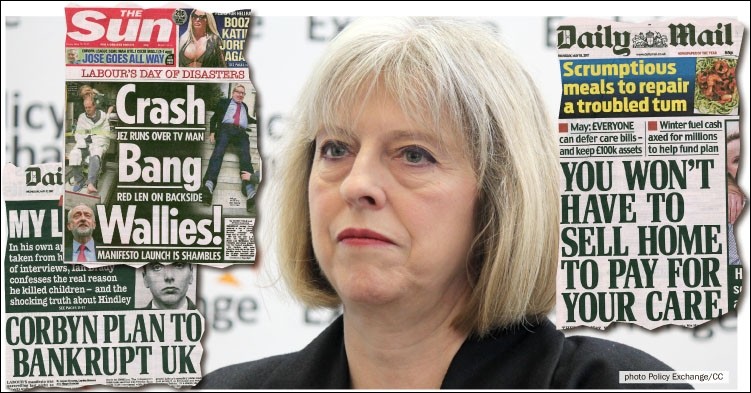
DonatenowButton

This Government Is No World Leader On Disability – Its Record Is Shameful

This article was written by Marsha de Cordova, who is the Labour MP for Battersea, on 24 July. It was originally published in the HuffPost.

At today’s Global Disability Summit, the government will present itself as a leader on disability rights – disabled people know that it is anything but.

Today the government will host the Global Disability Summit in London but the Tories are no world leaders on disability rights – their record is abysmal.

The government’s hypocrisy is no more clearly demonstrated than in the fact that the Secretary of State hosting the summit – which is aimed at guaranteeing “the rights, freedoms, dignity and inclusion” of disabled people – is Penny Mordaunt, who was herself minister for disabled people when a UN report found that the government had violated disabled people’s rights. 

The UN published this report two years ago, after the UN Committee on the Rights of Persons with Disabilities had taken the unprecedented step of investigating one of its signatories – the UK government – for breaching its obligations under the UN Convention on the Rights of Persons with Disabilities.

The committee’s findings were unambiguous: The government had caused “grave and systematic” violations of disabled people’s rights. The committee chair described austerity as having led to a “human catastrophe” for disabled people.

These judgements were hardly news to the millions of disabled people who had been struggling under government policies.

The hypocrisy of the government is staggering. The Minister for Disabled People recently had the audacity to claim that she was “utterly committed” to the UN Convention on the Rights of Persons with Disabilities”, yet the government is still yet to even provide a detailed response to the UN Committee’s more than 80 recommendations, and it rejected the UN’s damning judgement out of hand.

This hypocrisy is starkly evident in the summit’s “Charter for Change”, which takes as its cornerstone the UN Convention on the Rights of Persons with Disabilities. Since the Secretary of State overseeing the summit was a former Minister for Disabled People in a government that was condemned by the UN for breaking that convention, how can she talk with a straight face to world leaders and disabled people’s organisations about this?

The charter includes 10 commitments for participants to agree to, 8 of which the government has itself clearly violated (and one of which is empty posturing).

For example, it calls on countries to commit to “gather and use better data and evidence to understand and address the scale, and nature, of challenges faced by persons with disabilities”.

Yet one of the major recommendations from the committee is for the government to carry out a cumulative impact assessment of its tax and social security changes since 2010, something the government has stubbornly refused to do.

We know this can be done – the Equality and Human Rights Commission has done it, finding that those changes had a particularly damaging impact on disabled people.

Another call of the charter is for countries to “eliminate stigma and discrimination through legislation”. This will sound like a bad joke to the estimated 220,000 disabled people wrongly denied social security support due to what the High Court called “blatantly discriminatory” changes to Personal Independence Payments.

The charter concludes with a commitment to “hold ourselves and others to account for the promises we have made here today.” For this commitment to be made by Mordaunt’s department – under whose watch the government excused itself from promises it was committed to as part of the UN Convention – beggars belief. 

This government treats disabled people with disdain and contempt. From the Bedroom Tax to swingeing cuts to Personal Independence Payments, government cuts have been felt most acutely by those already struggling.

The Department for Work and Pensions charge sheet of failures is long, including an “error” that led to more than 70,000 ill and disabled people being underpaid thousands in Employment and Support Allowance, with what a public accounts committee recently described as a “culture of indifference” leading to it taking six years for this error to begin to be corrected.

The government’s Work Capability Assessments, carried out by profit-driven private companies, have been linked to a dramatic increase in the number of disabled people attempting suicide.

At the Global Disability Summit, the government will try to present itself as a world leader on disability rights. But disabled people know that it is anything but.

Let us remind them of the verdict of the United Nations: “Grave and systematic” rights violations, a “human catastrophe” for disabled people.

On behalf of all those disabled people whose voices have been ignored, we cannot and will not let the government escape the truth. Their record on disability rights shames this country.

Related

A few thoughts on the implications of the United Nations report


I write voluntarily, and do the best I can to raise awareness of political and social issues. In particular I research and write about how policy impacts on citizen wellbeing and human rights. I also co-run a group on Facebook to support other disabled people going through ESA and PIP assessments, mandatory reviews and appeals.

I don’t make any money from my work. I am disabled and don’t have any paid employment. But you can contribute by making a donation and help me continue to research and write informative, insightful and independent articles, and to provide support to others. The smallest amount is much appreciated – thank you.

DonatenowButton

My response to the Conservative Chairman’s invitation to join the Conservative party

Image result for Tory psychographic profilingAn example of audience segmenting, according to a psychographics methodology. I wonder what category data analysts think that I fit into. Whichever it is, they most definitely got me wrong. Note the dehumanising labels (objectification: “the struggler, “the resigned”) and stereotyping. I struggle on little income, don’t consume junk food or very much alcohol, though I have an occasional glass of red wine with a meal. I’m not aimless, I have academic qualifications, but no physical skills as I am disabled because of an illness. I am certainly someone who fits with “the reformer” description but I am not “at the leading edge of society”.  

Psychology has always been used as a tool for political manipulation, particularly in authoritarian regimes. Psychographics uses ‘personality type’ to predict behaviour. The data is gathered from online activity, surveys and other sources. It is then analysed and segmented. Strategic communications are then tailored to fit with each category. For example, those identified as having traits of anxiety may be targeted with political messages aimed at generating fear. Those with materialistic traits may be targeted with political messages about promised tax cuts, and those with progressive tendencies may get a political message claiming that public services are valued and public sector workers are going to have a pay raise after almost a decade of exploitatively low pay.

It’s not a brand-new concept; in the documentary Century of the Self, Adam Curtis shows how researchers from the Stanford Research Institute (SRI) used psychology to understand personality types and so predict political behaviour of the US public during the 1980s. The SRI sent out a huge survey to build an understanding of personal motivations. Strategic political communications are tailored to fit the profiled ‘audience segments.’ 

What is interesting about this is a friend of mine also had an email asking him to join the Conservative party, but his message was rather more about generating fears regarding a future Labour government. My friend suffers from an anxiety disorder. I think it is highly likely the Conservatives are using psychographics and microtargeting techniques. This would certainly fit with the profiles of companies that the government hire for their election campaigns.

I received the following email from Brandon Lewis, the Conservative Chairman, today. I have set out (and sent) my response below:

Dear Sue,
Today we’ve announced the biggest public sector pay rise in almost a decade, recognising the vital work that teachers, the police, our armed forces, prison officers, doctors and dentists do. 
  • This year an early career teacher will get a pay rise of £800.
  • A typical police constable will see £760 a year more.
  • The average soldier will get a £680 pay increase, plus a one-off payment of £300 this year.
This has only been possible because of our balanced approach to the public finances.
Getting debt falling, while investing in our vital services and keeping taxes low.
Backing businesses to help to grow our economy and pay the taxes which fund our public services.
Agree with our decision to increase pay for our dedicated public-sector workers? Then join the Conservative Party today.
These pay rises couldn’t have happened under a Labour government because they don’t know how to handle the economy.
Labour would mean more debt, higher taxes, fewer jobs – and less money available for our public services.
Yours sincerely,
Brandon Lewis, The Rt. Hon. Brandon Lewis MP
Conservative Party Chairman 

My response:

Dear Brandon, 

It’s not enough to adopt progressive language, as that simply attempts to muddy the waters and target persuasive, nudge type at progressives like me with blatant lies. No matter how you try to dress this appeal, your lies are still are still lies. I am not persuaded by this superficial and glib ‘strategic communication’ from you. Your policies are still draconian and have been for the past seven years. Nothing you say to me, no matter how carefully constructed, will change either your authoritarian policies or the wake of terrible consequences of those harmful and socially damaging policies.

A Labour government would never treat our public sectors so badly. You say that this is the biggest public sector pay rise in almost a decade, and also, that you value our public sector workers’ vital work. This is a contradiction, because if you genuinely recognised and valued that vital work, you would not have waited almost a decade to reward that work. Under your government, we have witnessed hard-working nurses having to rely on food banks. We have seen doctors, nurses and other medical professionals striking in protest of their poor pay and conditions. When a government truly values public sector workers, they don’t have a need to strike and protest.

As for Labour not knowing how to handle an economy, well I must disagree. When you took office, may I remind you that the last Labour government had steered the UK out of the global recession by the last quarter of 2009. Your government put us back in recession in 2011 with your ill-conceived austerity programme, which shrunk the economy and led to those you targeted with the unfairest of burdens of cuts suffering so you could hand out tax cuts to the millionaires.

As of Q1 (the first quarter of) 2018, UK government debt amounted to £1.78 trillion, or 86.58% of total GDP, at which time the annual cost of servicing (paying the interest) the public debt amounted to around £48 billion (which is roughly 4% of GDP or 8% of UK government tax income.

For a government that platformed itself on the idea of economic competence, promising to eliminate the deficit, I have to say the reality does not match your rhetoric. You stated in 2010 that you would eliminate the deficit by the 2015/16, and by 2014, admitted that the structural deficit would not be eliminated until the financial year 2017/18. This forecast was also pushed back to 2018/19 in March 2015, and then again to 2019/20 in July 2015, before the target of a return to surplus at any particular time was finally abandoned by the then Chancellor of the Exchequer George Osborne in July 2016.

It was a Tory-led government that lost the Moody’s Investors Service triple A grade, despite your pledges to keep it secure. Moody’s credit ratings represent a rank-ordering of creditworthiness, or expected loss. The Fitch credit rating was also downgraded due to increased borrowing by the Tories, who have borrowed more in 8 years than Labour did in 13. In fact it has been said that since 2010, your government has borrowed more than every Labour government combined. Quite an achievement.

The Conservatives have seized an opportunity to dismantle the institutions you have always hated since the post-war social democratic settlement – institutions of health, welfare, education, culture and human rights which should be provided for all citizens. . Offering and inflicting only regressive policies and devastating cuts, the your party lies you dismantle our social democracy, our public services, fundamental rights and the very basis of our basic civilisation.

Furthermore, the Conservatives have a track record of mismanaging the UK economy. Thatcher and Major also caused recessions in the UK, these were not because of global conditions, but because of their policies. 

Tell me, what is the point of a government in an “economically stable”and wealthy first world country that does not ensure that all citizens can meet their basic needs, and that fails to observe and fulfil basic human rights obligations?

Finally I draw your attention to the growing numbers of people living in poverty, with more than half of those people in work. Whatever your notion of a growing economy actually is, we don’t share it, because we expect that citizens actually benefit from a growing economy, rather than propping it up for the wealthy few.

Meanwhile your government have blatantly and systematically violated the human rights of disabled people, among other groups, and now you claim that the economy has grown, you still have yet to remedy the harm and distress caused to those of us on the receiving end of your draconian policies which are founded on traditional Conservative prejudices against historically marginalised groups. 

A growing economy is of no value to ordinary people when its benefits are hoarded by the very wealthiest minority, when public our wealth is transformed into private profit and placed offshore, leaving a large hole in our economy, that your own government attempts to fill by imposing more and more cuts on those with the very least. 

I have over 700 pieces of work that documents your policies and the consequences of those, collated from my own research, other academic research, and importantly, from citizens’ own accounts. Let me know if you want me to present you with this evidence of how your government has seriously mismanaged the economy and public funds, though as a government that claims to be accountable, to date you have shown a remarkable and  woeful disinterest in serious challenges to your neoliberal dogma, with its incompatibility to established human rights frameworks and democracy. Your answer to a failing neoliberal system is to apply even more aggressive neoliberal policies. Those policies are killing people, causing distress and suffering. That is inexcusable.

I am a Labour party member. I support Jeremy Corbyn’s Labour party, and will be continuing to campaign for a Labour government, and to vote for the many, not the few.

Very sincerely,
and in considerable restraint,

Sue Jones

Related image


I don’t make any money from my work. I am disabled and don’t have any paid employment. But you can contribute by making a donation and help me continue to research and write informative, insightful and independent articles, and to provide support to others. The smallest amount is much appreciated – thank you.

DonatenowButton

UN extreme poverty and human rights Special Rapporteur to visit UK – call for submissions


un-flag-flying-pole-blue-sky-behind-it

The United Nations Special Rapporteur on extreme poverty and human rights, Professor Philip Alston, will undertake an official visit to the UK and Northern Ireland from 6 to 16 November 2018. His visit will focus, in accordance with his mandate, on the interconnections between poverty and the realisation of human rights in the UK

The Special Rapporteur is an independent expert appointed by the United Nations Human Rights Council. The Human Rights Council is an inter-governmental body within the United Nations system, made up of 47 Member States, responsible for the promotion and protection of all human rights around the world. The United Kingdom is a Member of the Council.

Special Rapporteurs are selected on the basis of their expertise and experience in the area of their mandate, personal integrity, independence and impartiality and objectivity. They are not employed by the United Nations and receive no remuneration for their UN work.

Philip Alston is a Professor of Law at New York University, and he works in the field of international law and international human rights law. He has extensive experience as an independent UN human rights expert. He previously chaired the United Nations Committee on Economic, Social and Cultural Rights for eight years (1991-98) and was United Nations Special Rapporteur on Extrajudicial, Summary, or Arbitrary Executions (2004-10).

His resume can be found here.

The Special Rapporteur is part of a system of so-called UN Special Procedures, made up of independent experts who regularly undertake country visits around the world to report on human rights issues. The Special Rapporteur on extreme poverty and human rights has, since 2014, undertaken country visits to Chile, Romania, Mauritania, China, Saudi Arabia, the United States and Ghana.  Every country is different, and each faces its own human rights challenges. The Special Rapporteur thus adapts his approach in accordance with the specific circumstances of each country.

An overview of visits by all UN Special Procedures to the United Kingdom and other countries since 1998 can be found here.

Visits to a country are based on extensive preparations by the Special Rapporteur and his team and are supported by the UN Office of the High Commissioner for Human Rights in Geneva. They involve extensive study of topics relevant to the issue of poverty and human rights as well as interviews with civil society organizations, experts and affected individuals before a visit.

The visits usually last for about two weeks and include meetings between the Special Rapporteur and government officials, members of the legislature and judiciary, state institutions, civil society organizations, academics, and individuals who have experienced poverty. During his visit the Special Rapporteur will travel to various parts of the UK, but a final decision on his itinerary will not be made until close to the start of the visit.

Media inquiries

Regular updates about the visit to the United Kingdom in November will be posted on the website of the Special Rapporteur and via his Twitter and Facebook pages.

On the last day of the visit, November 16, 2018, the Special Rapporteur will hold a press conference in London where he will present a statement regarding his initial findings. He will subsequently submit a final report which he will present to the Human Rights Council in Geneva in 2019.

Media inquiries may be directed to Patricia Varela (pvarela@ohchr.org) and Christiaan van Veen (cvv221@nyu.edu).

Image result for human rights are not optional

Call for written submissions

The Special Rapporteur would like to invite all interested individuals and organizations in the United Kingdom working on issues related to poverty and human rights, including representatives of civil society organizations, experts and academics, to provide input for the preparation of his visit to the United Kingdom in November 2018.

Submissions can be sent to srextremepoverty@ohchr.org until Friday 14 September at 18:00 GMT.

Please note that the Special Rapporteur is also open to receiving input via browser-based encrypted email. Please contact the Special Rapporteur and his team via the email address above about how to further communicate via encrypted email.

Submissions are limited to a maximum of 2,500 words. However, additional reports, academic studies, evidence and other types of background materials can be attached as an annex to the submission.

All input will be treated confidentially by the Special Rapporteur and his team and for the sole purpose of preparing for the country visit. 

If you would like your written submission to be published on the website of the Special Rapporteur, please explicitly indicate this is in your submission.

While all submissions are welcome and the questions below are by no means meant to be exhaustive, it would be greatly appreciated if the submissions can focus on one or more of the following thematic issues:

A. GENERAL

(1) What is the definition of poverty and extreme poverty that your organization employs in the context of the United Kingdom and to what extent do official definitions used by the state adequately encompass poverty in all its dimensions?

(2) What is your view on the current official measurement of poverty by the government, what are the shortcomings of the current measurement and what alternatives would be feasible?

(3) What are the most significant human rights violations that people living in poverty and extreme poverty in the United Kingdom experience? Please exemplify by referring to specific cases and relevant norms of international human rights law.

(4) Could you specify how poverty and extreme poverty in the United Kingdom intersect with civil and political rights issues (such as for example the right to political participation or the right to equality before the law)? Please exemplify by referring to specific cases and relevant norms of international human rights law.

(5) Could you specify how poverty and extreme poverty in the United Kingdom intersect with economic and social rights issues (such as the right to education or the right to health care)? Please exemplify by referring to specific cases and relevant norms of international human rights law.

(6) Which areas of the United Kingdom should the Special Rapporteur visit in light of the poverty and human rights situation in those locations?

(7) Which individuals and organizations should the Special Rapporteur meet with during his country visit to the United Kingdom?

B. AUSTERITY

Since 2010, successive governments have engaged in fiscal consolidation, the process of reducing the amount of fiscal deficit of the United Kingdom. This process is popularly referred to as ‘austerity’ or ‘budget cutting’.

(8) To what extent has austerity been necessary given the fiscal outlook of the United Kingdom in the last decade?

(9) Have austerity measures implemented by the government taken adequate account of the impact on vulnerable groups and reflected efforts to minimize negative effects for those groups and individuals?

(10) What have the effects of austerity been on poverty (and inequality) levels in the United Kingdom in the last decade?

(11) Have the human rights of individuals experiencing poverty been affected by austerity measures?

(12) How have local governments been affected by austerity measures in the last decades? If possible, please specify the impact on public services such as police and fire departments, public libraries, and the administration of the welfare system by local authorities.

(13) What alternatives to austerity might have been considered by governments in the last decade?  Could any such alternatives have had a more positive impact on poverty (and inequality) levels in the United Kingdom?

(14) What are the potential implications of Brexit on austerity measures in the coming years?

C. UNIVERSAL CREDIT

Universal Credit, which was first announced in 2010, is a key element of welfare reform in the United Kingdom.  Its stated aims are to simplify and streamline the benefits system for claimants and administrators, to improve work incentives, to tackle poverty and to reduce fraud and error. The Special Rapporteur is interested in learning more about Universal Credit, including its impact on poverty in the United Kingdom and on the human rights of those living in poverty. Below are some of the questions the Special Rapporteur has in that regard:

(15) To what extent has the Universal Credit been able to achieve the goals identified above?

(16) What has the impact of Universal Credit been on poverty and the lives of the poor in the United Kingdom until now? It would be helpful to also distinguish the specific impact of Universal Credit on specific groups, including for example children, persons with disabilities, women and other groups which may be more vulnerable on the basis of their identity and circumstances.

(17) Claimants apply for Universal Credit online. What has been the impact of Universal Credit being a ‘digital-only benefit’ on the ability of potential claimants to apply for this benefit? How does this relate to broadband internet access in the UK and the so-called ‘digital divide’? What is the role of public libraries and Jobcentres in enabling access to broadband internet for those applying for Universal Credit and have these public services been adequate for the purpose?

(18) What has the impact been of various forms of ‘welfare conditionality’ in the context of Universal Credit in terms of ‘incentivizing’ work?

(19) To what extent has the introduction of Universal Credit reduced the incidence of fraud and error in the welfare system?

D. NEW TECHNOLOGIES IN THE WELFARE SYSTEM

The Special Rapporteur is interested in learning more about the impact of new technologies including the use of ‘big data’, artificial intelligence, algorithms and automated decision-making processes on the human rights of those living in poverty in the United Kingdom, especially in terms of the functioning of the welfare system. Below are some of the questions the Special Rapporteur has in that regard:

(20) What use does the national government, as well devolved governments and local governments, make of such new technologies in the context of decision-making in the welfare system? A recent report by the House of Commons Science and Technology Committee on ‘Algorithms in decision-making’ (May 2018) concluded that the central government does not currently produce, publish or maintain a list of algorithms it uses for public purposes, despite the fact that some of the new technologies that are employed, for example in welfare fraud and error investigations, can may have major negative human rights implications, especially for the poor. The Special Rapporteur is especially interested in learning more about concrete examples of the use of such new technologies by governments in the welfare system.

(21) What is the relevant regulatory framework for the use by government of such new technologies, especially in the context of the welfare system, and are there any shortcomings in the current legal framework?

(22) Which government agencies and departments are responsible for and have oversight over the use of new technologies by governments in the UK, especially in the context of the welfare system? Are their respective responsibilities clearly defined and delineated and are they able to effectively perform their responsibilities?

(23) What are the relevant policies of the central government vis-à-vis the use of these new technologies by the government, including especially in the context of the welfare system, and do these policies take into account the potential impact of the use of these technologies on the human rights of those living in poverty?

(24) What are the potential human rights issues faced by individuals living in poverty as a result of the use of new technologies in the UK welfare system?

E. CHILD POVERTY

(25) What is the extent of child poverty in the United Kingdom, and how has it evolved over the last decade?

(26) What are the implications of child poverty for the rights enumerated in the Convention on the Rights of the Child?

(27) What are the main causes of child poverty in the United Kingdom, what have been the main government responses, and how effective have they been?

F. ‘BREXIT’

(28) What are the potential implications of Brexit for the situation of those living in poverty in the United Kingdom?

(29) What are the potential implications of Brexit in terms of protecting the human rights of low-income groups and of persons living in poverty?

(30) To what extent does government planning for Brexit explicitly address the issues arising under questions 28 and 29 above?

SUBMISSIONS RECEIVED

I shall publish my own submission in due course.


Image result for human rightsImage result for human rights and poverty uk

Human rights are universal. That is the point of them.


My work is unfunded and I don’t make any money from it. But if you like, you can support Politics and Insights and contribute by making a donation which will help me continue to research and write freely accessible, informative, insightful and independent articles, and to provide welfare support to others.

Thank you

DonatenowButton

Universal Credit bereavement run-on payments have been scrapped

For single use only on 10 March 2017

The government claim they value “evidence-based policy”. However, no-one knows exactly what evidence was found to justify Universal Credit, or how and why it may be applied to dismantling publicly funded social security provision for the public.

A grieving family have been forced to pay their loved one’s rent for three weeks following his death.

Ronnie Cowan, the MP for Inverclyde, has spoken out in parliament about the shocking treatment of one of his constituents because of callous Universal Credit rules concerning bereavement.

The Department for Work and Pensions have decided that if a Universal Credit claimant dies, regardless of when, they are classed as having died from the start of their four week assessment period, which can result in families being liable for their rent payments, and possibly council tax. This means that the government is outrageously clawing money from people for up to three weeks before they die and from their bereaved families. 

Cowan said: “Once again, we witness the callous nature of the Department for Work and Pensions, which classes as person as dead from the beginning of their assessment period, even if they die towards the end of that period.

“This means that family members had to meet the cost of the housing rent for a period of three weeks as the payment was stopped from the beginning of the assessment period.

“This is fundamentally wrong and highlights the cruel nature of the current system which is not fit for purpose.”

The MP has asked the government how many more families have been affected in this way because of the Universal Credit bereavement regulations.

These latest concerns follow a recent critical report from the National Audit Office (NAO) that raises questions about Universal Credit being ‘value for money.’

Employment minister Alok Sharma wrote a letter to Cowan offering his sympathies to the family involved and explained the system they use.

Not surprisingly, Cowan says that all social security powers should be passed to the Scottish Government so that a more compassionate system can be put in place.

He added: “This is something which is clearly lacking from this UK Government.

“I will be writing to the minister to ask that they sort out this issue.”

A spokesperson for Department for Work and Pensions told me: “The death of a claimant is a relevant change of circumstances affecting entitlement to Universal Credit. When a single claimant dies there are no further payments due. For the purpose of the award calculation, the death is treated as if it occurred at the beginning of the assessment period. 

“If an overpayment is caused because one member of a couple dies, an overpayment decision should be made as usual. The overpayment will be recoverable from the surviving partner.”

However, I found a universal credit full service guidance placed by the government in the House of Commons library (in the deposited papers archive.) The guidance was originally placed in the Commons library in October 2016 at the request of the then Work and Pensions Minister Lord Freud. In the death and bereavement section of the document, it says:

Bereavement run-on

“In some circumstances, payment of Universal Credit that would otherwise reduce or stop following bereavement can continue for a short time. This is called a Bereavement run-on. For example, following the death of a:

partner
 child
 person for whom the claimant was carer, see Claimant with regular caring
responsibilities
Non-dependants 

Payment of Universal Credit continues as if the person had not died for the assessment period in which the death occurs and the following two assessment periods.

The surviving member of a couple will receive a 3 month run-on for:

 the assessment period in which their partner dies
 two subsequent assessment periods 

When the 3 month run on period has ended, the surviving member of the couple will need to re-declare their circumstances. This is so a single award of Universal Credit can be made (without the need for a new claim).” 

That would be a reasonable and humane approach. 

However, later in the subsection entitled “Debt and deductions after death”, there is no further mention of the bereavement run-on. It looks as if someone with an incapacity for human compassion has amended the guidance and neglected to take out the original kinder version of the regulation guidelines. The document says:

“If an overpayment is caused because one member of a couple dies, an overpayment decision should be made as usual. The overpayment will be recoverable from the surviving partner. 

“An overpayment of housing costs paid direct to a landlord can occur due to the death of the claimant. The overpayment is only recoverable from the landlord if they had failed to disclose the death of their tenant. 

“An example is if they were aware of the death and failed to report it. Otherwise, the overpayment would be recoverable either from the estate of the deceased or any surviving partner of the Universal Credit claimant.

“The death of a claimant is a relevant change of circumstances affecting entitlement to Universal Credit. When a single claimant dies there are no further payments due. For the purpose of the award calculation, the death is treated as if it occurred at the beginning of the assessment period.”

The document also says that the Department for Work and Pensions conduct a search  for an estate in respect of all ‘customers’ who die while in receipt of Universal Credit. A comparison is then made between the information provided for the Universal Credit claim and the assets declared in their estate. 

If a person dies with outstanding debt and they leave an estate, the Department becomes a creditor of their estate. As a creditor, a claim is normally made from the estate for debts such as:

 recoverable overpayment
 Administrative Penalty
 Social Fund loan

People pay tax and national insurance to contribute towards public services, including their social security, should they fall on hard times and require support from public funds. The Conservative government now expect people to pay twice for a barely adequate provision administered within a punitive framework, and delivered within a hostile environment.  

We really need to question such an openly hostile and dehumanising system of social security that not only fails to support people, it also fails to recognise, acknowledge and accommodate the actual date that a person dies, and it fails to afford their loved ones some respect, solicitude, support, dignity and time to grieve in peace. Private moments of grief and emotional space are being heartlessly hijacked by the relentless machinery of the state.

This level of disgraceful dystopic bureaucracy potentially transforms the time in the immediate aftermath of the loss of a loved one from one of private grief and adjustment into one of inexcusable state intrusion and surveillance, and a profoundly distressing struggle for bereaved families. 

The government claims that Universal Credit is designed to make sure that “work pays” and is aimed at “incentivising” people to move into work. The Conservatives clearly think that this may be achieved by ensuring conditions for people needing support are made unbearable. Conservative ministers have also claimed that welfare “puts in place barriers to people fulfilling their potential.”

Image result for maslows hierarchy

This is a poltitically expedient reversal of Abraham Maslow’s hierarchy of human needs. Punitive measures and a hostile environment cannot “help” people into work, nor can it alleviate poverty. It can only increase poverty and make people’s lives even more difficult, disempowering them further because of the additional burden of state inflicted cruelty on them.

History and the social sciences have provided ample empirical evidence that it is poverty, rather than a “lack of incentives,” which reduces people to an inescapable struggle for survival, preventing them from fulfilling their potential.

If people cannot afford shelter, food and fuel – basic survival requirements – how can any rational person expect that those citizens will somehow manage to extend their already very stretched, all-consuming cognitive priority and motivation for basic survival to also meet state demands for meeting unreasonable conditionality, job searching or work requirements?

Benefits Sanctions
Here is an example of severe hardship created by Universal Credit from a parlimentary debate in October last year, which took place because of an Early Day Motion (EDM) tabled by Debbie Abrahams:

Neil Gray Shadow SNP Spokesperson (Social Justice)

At the start of the year, Mr James Moran from Harthill in my constituency qualified as an HGV driver and managed to find work on a zero-hours contract as a driver while also receiving universal credit—exactly the sort of scenario under which universal credit was supposed to work better. Not long after gaining employment, however, Mr Moran was sanctioned, despite being in employment. As he started the process of appealing the sanction, he suffered a stroke, which meant that he was no longer able to work as a driver.

As the sanction was still in place, he returned home from hospital with no means of receiving an income. Despite getting some help from his elderly parents, Mr Moran struggled with no money whatever for more than a month. He then suffered a second stroke.

Mr Moran has advised me that the doctors who treated him in hospital at the time of his second stroke admission told him that the low blood pressure that caused the second stroke was almost certainly caused by malnourishment. That malnourishment was a direct result of a DWP sanctioning error, forcing Mr Moran to live without an income—to live on fresh air.

I wrote to the Secretary of State about the case on 1 September and have repeatedly chased his office for a reply, but I have received nothing in return to date. The six-week minimum wait appears to be built into the Secretary of State’s correspondence turnaround as well. I do not take that personally, because I gather from press reports that the Chair of the Select Committee on Work and Pensions has had similar problems with getting the Secretary of State to put pen to paper. Perhaps he will now chase a reply.

A little later in the debate, in the face of much evidence to the contrary, Iain Duncan Smith shamefully alleged that the opposition were largely “‘scaremongering’ about the way in which the [Universal Credit] system has been designed.”

Universal Credit is clearly NOT an “evidence-based” policy, as claimed, since its architects and other government ministers refuse to recognise any evidence that contradicts their narrow ideological prejudices and assumptions. 

As Gordon Allport once commented, a prejudice, unlike a simple misconception, is actively resistant to all evidence that would unseat it.


I don’t make any money from my work. But you can make a donation if you wish and help me continue to research and write informative, insightful and independent articles, and to provide support to others. The smallest amount is much appreciated – thank you.

DonatenowButton

The link between plots to murder left wing politicians, the rise of social prejudice and Conservative neoliberal dogma

hope-not-hate-national-action-4.pngNational Action, a far-right group that was banned in 2016 by the Home Secretary Amber Rudd over its support of the murder of Labour MP Jo Cox, who was shot and stabbed to death in 2016 by neo-Nazi Thomas Mair. The group was not disbanded, however and continued to operate under the cover of front groups.

“A prejudice, unlike a simple misconception, is actively resistant to all evidence that would unseat it.” Gordon W. Allport

The plot to murder Rosie Cooper

The leader of a neo-nazi group was arrested following a police investigation into a murder plot to target Labour MP Rosie Cooper. He has been given an eight year sentence.

Cooper, the MP for West Lancashire, has thanked a former neo-Nazi group member for saving her life after he exposed the far-right terrorist plot to murder her with a machete.

The National Action group is a far-right neo-Nazi organisation based in the UK. Founded in 2013, the group is secretive, and has rules to prevent members from talking openly about the organisation. “Death to traitors, freedom for Britain” became a slogan for the group after being said in court by Thomas Mair, who was glorified in online propaganda calling for “murders.”

Police had no intelligence that the extremist National Action member was preparing to kill Rosie Cooper until one of the group members, Robbie Mullen, sounded the alarm to a campaign group, Hope Not Hate, who passed the information on to Rosie’s fellow Labour MP Ruth Smeeth. The group’s former chair and plotter, Jack Renshaw, was later arrested. 

The 23-year-old extremist Renshaw has admitted plotting to kill his local Labour MP and had already bought a 19 inch machete, which investigators found hidden in an airing cupboard at his home. He had also researched his targets’ movements. 

Cooper said: “I think it’s awful that any public servant – teacher, nurse, doctor, police, MP – should be targeted and threatened with violence simply because of the job they do. To that end, I’d like to thank Robbie Mullen whose information saved my life.  

“I’d also like to thank Lancashire and Merseyside Police and the counterterrorism police who have supported me greatly, and who have kept me, my staff and the general public safe.”

Mullen had been in contact with Hope Not Hate for several months as he tried to find a way out of the terrorist organisation, which went underground following the government ban.

His fears that its repulsive rhetoric against Jews, non-whites and “race traitors” would tip over into bloody action were confirmed when the group met in a Warrington pub on 1 July last year. Renshaw felt antagonised after being arrested on suspicion of sexually grooming a child and for stirring up racial hatred with two of his speeches in Blackpool and Leeds. Seeking revenge on both the police and “establishment”, he told fellow fanatics of a plot to kill both Rosie Cooper and a female officer who had investigated him.

Mullen said that Renshaw felt that police officers were “destroying his life and trying to make it sound like he was a paedophile”.

Jack Renshaw pleaded guilty to preparing to engage in an act of terrorism by buying a knife to kill the politician and threatening a police officer. Renshaw, from Skelmersdale in Lancashire, has also been convicted of inciting racial hatred in speeches in 2016.

He was accused of being a member of National Action, but the jury failed to reach a verdict.

They also failed to reach verdicts on Andrew Clarke, 33, and Michal Trubini, 35.

Garron Helm, 24, was acquitted of the same charge.

National Action is the first extreme right-wing group to be banned by the government since World War Two and had recruited up to 100 members. 

The court heard that the group planned to “wipe out” non-white people” by “any means necessary”.

Jack Renshaw
Jack Renshaw pleaded guilty to preparing an act of terrorism and threatening a police officer

Head of Investigations for Counter Terrorism Policing in the North West, detective superintendent Will Chatterton, said: “Today’s result has enabled the spotlight to be shone on the sickening activities of the banned extreme right-wing organisation National Action.

“During the trial, one of those jailed today stood before the court and openly denied the Holocaust had taken place – an unimaginably horrific event that resulted in the murder of millions of Jews at the hands of the Nazi regime.

“Today’s result is a body blow to extreme right-wing organisations such as National Action.

“It sends out a clear message that counter-terrorism officers and partner agencies will rigorously identify and investigate any violently extreme individual or group who seek to bring a reign of terror to our shores.”

London’s Old Bailey heard: “Renshaw stated that if he was charged, he was going to kill Rosie Cooper, his local MP. He explained his plan was then to take some people hostage in a pub and when the police arrived he would demand to speak to DC Victoria Henderson.

“When the officer arrived, he would kill her. Renshaw said that after he had killed Ms Henderson he would then commit ‘suicide by cop’ by pretending to have a suicide vest on.”

Prosecutors said the would-be terrorist intended to make a “white jihad” video stating that the attack was carried out in the name of National Action that would be released after his death.

Another National Action member, Matthew Hankinson, said Renshaw should target a synagogue – even if there were children inside – because “all Jews are the same, they’re all vermin”. During the conversation, Renshaw said that he had purchased a machete to use in the attack, which was found days later hidden in a cupboard at a home where he was staying in Skelmersdale.

After stating his intentions, he wrote a series of ominous Facebook posts saying he was “past caring” and “it will all be over soon”. 

One comment said: “I’ll laugh last but it may not be for the longest.” 

Matthew Collins, the Hope Not Hate researcher who was contacted by Mullen, said police “knew absolutely nothing” of the plot. He told the Independent:

“They didn’t monitor them [after the ban on National Action], “They thought that because they were a bunch of skinny little white boys that when they banned them they would go to bed like naughty children. But they had an ideology that developed like a sickness, they developed a lust for violence and an attack was inevitable.”

Renshaw admitted the plot, while fellow neo-Nazis Christopher Lythgoe and Hankinson were also jailed for terror offences. Lythgoe declared himself national leader of the terrorist group, while Hankinson organised security and gave a speech calling for Nazis to “split the people into two groups, the racially loyal nationalists and the traitors”.

A jury deliberated for 20 hours to find Lythgoe guilty of membership of National Action but clear him of involvement in the terror plot, which he was alleged to have approved by telling Renshaw not to “f*** it up”.

Jailing the 32-year-old for eight years, Mr Justice Jay said he “did nothing to stop or discourage” the plot to kill Ms Cooper, adding: “You are a fully-fledged neo-Nazi complete with concomitant, deep-seated racism and antisemitism.”

The judge described National Action as having a “truly evil and dystopian vision” of waging a race war and said that without Lythgoe’s obsessive determination it would have “withered and died on the vine”.

“Fortunately… the truly evil and dystopian vision I am describing could never have been achieved through the activities of National Action, a very small group operating at the very periphery of far-right wing extremism. The real risk to society inheres instead in the carrying out of isolated acts of terror inspired by the perverted ideology I have been describing.”

Hankinson, 24, of Newton-le-Willows in Merseyside, was also found guilty of being a prominent member of the terrorist group and was jailed for six years. The Old Bailey jury acquitted Garron Helm, 24, of Seaforth in Merseyside, of being a member of National Action after it was made a proscribed organisation.

It failed to reach verdicts on Renshaw, Andrew Clarke, 33, and Michal Trubini, 35, from Warrington, for the same charge. 

Cooper, who was in court for the verdicts, later thanked Jeremy Corbyn, the prime minister and “every single member of this house for the kindness they have shown me” in an emotional address to parliament.

Theresa May replied: “Can I first of all say how very good it is to see her in her place and I know from the response that is a view that is shared across the whole of this house.”

However, I have written previously more than once about how the extremely divisive approach of Conservative governments has provided a space for far-right groups to flourish. The Thatcher era also saw the rise of neo-Nazi groups like the National Front. White supremicist thinking, be it from the likes of academics like Charles Murray or ordinary UKIP members, seems to be a key symptom of a broader disease – competitive individualism, which lies at the heart of neoliberalism. Neoliberalism is a system that enables a handful of ‘winners’ and many more ‘losers’. That is, after all, the nature of competition.

However, the public would be unlikely to accept a socioeconomic system that benefits so few people unless it was sold to them with the idea that anyone may benefit, providing they deserve to do so. Neoliberalism is therefore sold as a system of opportunities. We are led to believe that there is room at the top for everyone, and those at the bottom are there because of their own personal flaws, rather than because the system itself inevitably distributes opportunities very unequally and demands the establishment of a hierarchy comprised of a few ‘winners’ and many more ‘losers.’  Furthermore, it’s a system that enables winners to keep on winning. This continued winning is facilitated by dispossessing everyone else.

Neoliberalism, competitive individualism and racism

“What is familiar tends to become a value.” Gordon W. Allport

The myth of meritocracy – the idea that an individual’s personal qualities, skills and character may justify social inequality is itself an endorsement of the differential values placed on social groups by government and society, establishing a hierarchy of human worth. Notions of meritocracy have whitewashed historical forms of dispossession. Individuals are blamed for their poverty or held in esteem for their wealth and power, even when at least a third of very wealthy people inherited their wealth, regardless of their personal qualities and character.

These justifications of inequalities have been normalised since the Thatcher administration, though Conservatives have traditionally been elitist. Institutional discrimination has somehow sidestepped the issue of traditional marginalisation and  dispossession of some social groups, and the hate crimes with which it is historically associated. The culture of individualism itself is both a blind justification for and an explanation of social injustice and inequality.

Neoliberal ideology demands that every aspect of social life is brought (or bought) within the competitive market place, including relationships, thus objectifying and dehumanising, transforming norms, moral and ethical values, culture, ideals and principles – such as democracy and even the environment – very planet we live on.

It is the basis of how neoliberal ideology determines worth, allocates a category, a numerical and moral value, depending on how a person, human group, resource or geographical area stand up to the neoliberal test – their potential exploitability for profit. Justice, health, welfare, education, opportunity, the means to meet basic human needs and human potential itself are reduced to commercial commodification.

Within this overarching neoliberal framework, we have witnessed the rise of ‘us’ and ‘them’, the reoccurrence of virulent parochialism and nationalism, of pathologising, scapegoating and dispossession of disadvantaged groups and the rapid expansion of injustice and inequality. The world in its entirety exists solely for the benefit of the neoliberal market. Those not buying are being sold.

The ability to deflect public anger away from the architects of inequality and direct it at a variety of politically constructed scapegoats, demonstrates the consistent pattern for neoliberal demagogues – the government perpetually blames others for the failings of neoliberal dogma and policy.

Anti-racist scholar Robin J DiAngelo has argued that the discourse of individualism functions to: deny the significance of race and the advantages of being white; hide the accumulation of wealth over generations; deny social and historical context; prevent a macro analysis of the institutional and structural dimensions of social life; deny collective socialisation and the power of dominant culture (media, education and so on to shape our perspectives and ideology; function as neo-colourblindness and reproduce the myth of meritocracy; and make collective action difficult.

Furthermore, being viewed as an individual is a privilege only available to the dominant group. He argues that while we may be considered individuals in general, white insistence on individualism in discussions of racism in particular functions to obscure and maintain racism. Racists tend to see others as a threat to individualism, their perceptions and their own culture. Individualism tends to undermine regard for communities.

From internationalism to nationalism

The Conservatives (and those further right) have parochialised both explanations of and responses to the global economic crisis, reducing us to a gossiping around the parish-pump type of politics. Parochialism entails neglect of the interests of identified “outsiders”, and this kind of isolationist tendency has also provided a political platform for nationalism. 

Parochialism tends to support inter-group hostilities, and it tends to lead to violations of human rights, as we are currently witnessingParochialism directly opposes a fundamental set of [internationally agreed] principles that constitute these rights: namely that all humans beings are of equal worth, and that human rights are universally applicable – they apply to everyone.

Even to the social groups that you may not like.

The whole point of human rights is that they apply universally, and that they are not simply provision for the already wealthy and powerful. They are a mechanism that is designed to hold the wealthy and powerful accountable.

The Conservatives have suspended the human rights of some disadvantaged communities, and made a “hostile environment” the norm for its policy strategies directed at marginalised social groups. The policies that extend the hostile environment are founded on the government’s traditional prejudices. In doing so, the government have normalised those prejudices, legitimised discrimination and role modelled behaviours and attitudes that are not only fundamentally unacceptable. They are dangerous.

The subtext of discriminatory policies permits the open expression of social prejudices. The message presented to the public is that some communities should not be included in our society, they are not worthy of human rights, nor should they be treated with dignity and respect. Furthermore, the punitive nature of Conservative policies aimed at disadvantaged groups signals that punishing others is acceptable. 

The Conservatives have historically hated trade unions, and have launched a raft of laws to disempower the trade union movement. Recently, the far-right launched an unprovoked violent attack on senior RMT official Steve Hedley after he and thousands of other anti-fascists had turned out in central London to oppose a “free Tommy Robinson” march.

It seems extraordinary that working class Tommy Robinson supporters are turning acts of violence on an official of an organisation that promotes working class rights and solidarity, and fights oppression.

Sometimes the oppressed are very oppressive too.

 Hope Not Hate)

Steve Hedley, following the unprovoked violent attack last weekend

However, it’s also worth bearing in mind that fascists never stop at discriminating against and persecuting the one social group of your choice. Fascists are fascists and tend to discriminate almost indiscriminately. However, fascists generally spare the establishment, curiously enough. Pastor Martin Niemöller famously observed public complicity and the consequences of bystander apathy and silence when he wrote: “First they came for the socialistsand I did not speak out – Because I was not a Socialist…”

Of course Britain is not divided by race and culture: it’s divided by wealth inequalities fueled by the government’s ideology, policies and austerity programme.  Blaming people who are unemployed, sick and disabled, refugees and immigrants for the failings of the government has fueled misperceptions that drive support for the far-Right. People complain they can’t get council houses, surely the only really honest question an honest politician ought to ask is: “Why aren’t there more council houses?”

And when there are large numbers of people receiving unemployment benefit or tax credits, then the only honest question to ask is: “Why is the economy failing to provide enough jobs, or ensure that employers pay adequate wages?”

As a society that once promised equality and democracy, we now preside over massive inequalities of wealth: that’s a breeding ground for racism, classism and other vicious resentments.

Hate crime directed at disabled people has risen over the past five years, and is now at the highest level it’s ever been since records began. That’s the kind of society we have become.

Austerity cuts and the steady and deliberate erosion of democratic inclusion have served to awaken the disgruntled beast within people, the one that feeds on anger, disempowerment, demoralisation, fear, resentment and uncertainty. And loss of a sense of meaning and identity.

And wherever antipathy and a degree of enmity exist, the far-Right have always tried to perpetuate, exploit and increase public rancour. The fascism of the 20s and 30s gained prominence because it played on wider public fears, manipulating them, and deflecting attention, as ever, from those who are truly to blame for dire social conditions: the ever-greedy elite. There’s a well-established link between political extremism, economic hardship and recession and social cleavages, with the far-Right “anti-system” parties now deceitfully winning the support of those who would never previously have thought of themselves as extremists. 

The political right have always sought to divide sections of the poor and middle class and set them to fight one against the other; to have us see enemies in our midst which do not exist, so that we see economic policies – the Tory-rigged “free market” competition – as the solution rather than the cause of our problems.

Many people are disgruntled because of our socioeconomic circumstances. Prejudiced discourse is being used politically to divert attention from the fact that our socioeconomic organisation is the problem, rather than those that have been diminished and denigrated by it. 

When you just feed the disgruntled beasts, you only end up with beasts.

I’ve often written about the right’s tendency to infrahumanise, dehumanise and create categories of “others”; scapegoating, using the media to stigmatise groups, create folk devils, and to extend the politics of division and prejudice, and hate-mongering rhetoric. I’ve also written about how Conservative governments always work to encourage the rise of far-right groups and a toxic climate of individualism and nationalism. 

Thatcher’s government was no different. Now Conservatives need to take some responsibility for what that kind of context does to people’s sense of identity and mental health, to social solidarity and community cohesion. They need to take some responsibility for transforming what was a diverse and reasonably tolerant culture into one of labeling and bullying, and ultimately into one of murder and plots to murder. Perhaps the Conservatives need to read Gordon Allport’s work about how prejudice escalates and as a reminder from history about the terrible social consequences of that, again.

Gordon Allport studied the psychological and social processes that create a society’s progression from prejudice and discrimination to genocide. In his research of how the Holocaust happened, he describes sociopolitical processes that foster increasing social prejudice and discrimination and he demonstrates how the unthinkable becomes tenable: it happens incrementally, because of a steady erosion of our moral and rational boundaries, and propaganda-driven changes in our attitudes towards politically defined others, that advances culturally, by almost inscrutable degrees.

Decades of research findings in sociology and psychology inform us that as soon as a group can be defined as an outgroup, people will start to view them differently. The very act of demarcating groups begins a process of ostracisation.

The process always begins with the political scapegoating of a social group and with ideologies that identify that group as the Other: an “enemy” or a social “burden” in some way. A history of devaluation of the group that becomes the target, authoritarian culture, and the passivity of internal and external witnesses (bystanders) all contribute to the probability that violence against that group will develop, and ultimately, if the process is allowed to continue evolving, extermination of the group being targeted.

Economic recession, uncertainty and political systems on the authoritarian -> totalitarian spectrum contribute to shaping the social conditions that seem to trigger Allport’s escalating scale of prejudice.

Prejudice requires the linguistic downgrading of human life, it requires dehumanising metaphors: a dehumanising sociopolitical system using a dehumanising language, and it has now become familiar and all-pervasive: it has seeped almost unnoticed into our lives. Because we permitted it to do so. 

The government (and the media) have shown contempt for rational debate, democracy and for the opposition. They role model appallingly authoritarian, abusive and bullying behaviour for the public to see. Their language is dehumanising, referring, for example, to the left as a “cult”, and these strategies permit others to engage in the same behaviours. 

The Conservatives have also tended to lump reasonable opposition, challenges, legitimate democratic dialogue and action into the same category as examples of abuse. 

The government made a strategic decision to discredit, smear and delegitimise the official opposition, portraying Labour’s left supporters as “extremists”, “dangerous”, and “terrorist sympathisers”. Such an attack tactic has some very chilling and profoundly anti-democratic implications, because it leaves the left exposed as a dangerous internal enemy, which legitimises radical right wingers’ belief that the left needs to be “eliminated”.

The Conservatives then claim that the “hard left” are abusive to divert attention – this “abuse” accusation is one of many techniques used by the right to police the boundaries of “acceptable” political thought.

Jo Cox was murdered. This has been linked to the rhetoric employed by hardcore right-wing Brexit campaign. Others, including myself, have also linked it with a growth in wider social prejudice, and the social divisions which have been politically fostered, motivated and manipulated by the Conservatives. Lynton Crosby’s dog whistle racism and negative campaigning strategies have been a key feature of elections over recent years and have normalised below the radar “coded” racist messaging, with the inbuilt “safeguard” of plausible deniability.

Dog whistling is designed to trigger previously indoctrinated prejudice, bigotry and  hatred without being recognised by outsiders as hateful speech in prejudiced communities. The legitimising of sentiment which has previously been considered inappropriate is one of Crosby’s trademarks, and this approach has steadily pushed at public moral boundaries, making hate speech and hate crime much more likely. 

The philosopher Jennifer Saul has how the linguistic drift of increasingly intolerant speech can lead to racist violence. As we become habituated to a subject of speech, our standard of what is acceptable to say (or not say) shifts, which in turn opens up possibilities for how we may act.

Of course intolerant speech is that which creates categories of outgrouped others, and this process of othering hasn’t been confined to ethnic minoritiesThe Conservatives have also stigmatised disabled people, social security claimants more generally, trade unions, public sector workers, among others and have systematically demonised and personally discredited critics, opposition (including charities and academics), and especially, those on the left.

The government has consistently sent out a broader message, in the form of a series of coded emotive appeals and sometimes, quite explicitly stated, that the left has/will take your taxes and give it to “undeserving” minorities. Those “minorities” are disabled people, people in low paid work, people who have lost their job, as well as asyum seekers and migrants.

As opposed to tax cheating millionaires and rogue multinationals.

This is a government that has sneeringly labelled those reasonably calling for an end to austerity, adequate funding for our public services and adequate social security protection for disabled people as “unrepentant Marxists”, “Trots”, “the Hard Left”, “the Loony Left”,  and who ran almost all of their election campaign as a strategic, pointed, deeply personal smear attack on Jeremy Corbyn and some of the shadow cabinet. 

The Conservatives ran an election campaign that was almost entirely about character assassinations and smearing the opposition, rather than offered policies. It was also about telling the electorate who they must and must not vote for. They seem to have forgotten that it is the public who decide who is “fit” to run the country, not the increasingly authoritarian incumbent government. We live in a democracy, after all, not a one-party state.

We need to recognise their moral and rational boundaries are being politically manipulated and systematically pushed. That has consequences. Increasing inequality, poverty, prejudice, discrimination and social injustice and social isolation, decreasing democracy, social inclusion and civic rights are just some such consequences. There are many more, some happening at a profoundly existential level. All at a time when supportive provision is being steadily withdrawn, public and mental health services are in crisis because of the Conservative cuts to funding. And many people are dying as a consequence.

Against this backdrop, it’s also become almost normal for the far right to murder and plot to murder left-wing politicians. Those of us who object and challenge the way things have become are dismissed and labelled with derogatory terms like “scaremonger”, “virtue signaller” and so on. 

Jo Cox was a dedicated Labour MP, who fought tirelessly for social justice. She was just 41 and was taken from a husband and two young children, as well as her friends and constituents. Her final words were “my pain is too much.” Jo’s grieving husband, Brendan, has urged us to “fight the hatred that killed her.”  We must.

It must be time to recognise that each and every one of us bears some responsibility and has some positive contribution to make to the kind of society we live in.

To make it the one we want to live in.

And surely that society is not the one we witness today.


Related image

Related

Austerity Brings Extremism: Why the Welfare State Is the Key to Understanding the Rise of Europe’s Far Right

UKIP: Parochialism, Prejudice and Patriotic Ultranationalism

The still face paradigm, the just world fallacy, inequality and the decline of empathy

It’s time the government took some lessons in the ethical use of power and influence amid the discussion about abuse

Not one day more: Tory councillor suspended for sneering racism and vindictive Tory anti-welfarism

A couple more lies that politicians and the media have told about Jeremy Corbyn – editing someone’s character is abusive

From the Zinoviev letter to the Labour party coup – the real enemy within

Conservatives, cruelty and the collective unconscious


I don’t make any money from my work. But you can support Politics and Insights and contribute by making a donation which will help me continue to research and write informative, insightful and independent articles, and to provide support to others. The smallest amount is much appreciated, and helps to keep my articles free and accessible to all – thank you.
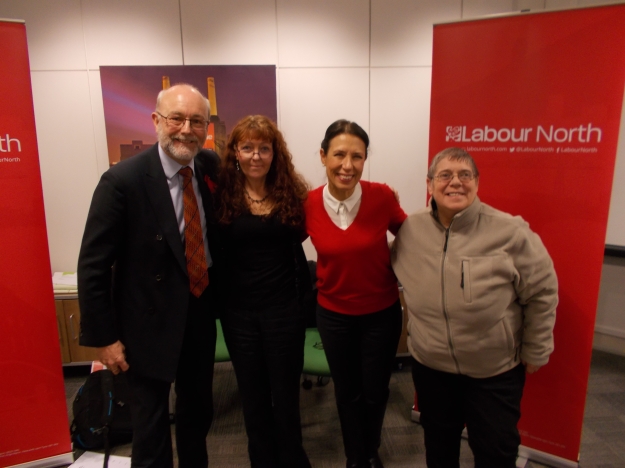
DonatenowButton